Skip to Content
GUILCOR SENSORS
  • Home
  • Probes
    Smooth tube probe

    Smooth Tube

    Refrigerator, heat pump, oven, freezer, water heater
    Contact probe

    Contact

    Pipe, pipe surface, heating plate
    Slot probe

    Slot

    Motor, alternator, winding, stator
    Head connection probe

    Connection head

    Boiler, heat pump, air conditioning, technical rooms, ventilation
    Waterproof probe

    Waterproof

    Air conditioning, ventilation, refrigeration, cold storage, ductwork
    Stick-in probe

    Stick-in

    Oven, cooking, food processing equipment
    Winding probe

    Winding

    Motor, alternator, transformer, winding, stator
    Ambient probe

    Ambient

    Boiler, heat pump, air conditioning, technical rooms, ventilation
    Thread probe

    Thread

    Coffee machine, boiler, steam, pressurized fluid
    Jacketed probe

    Jacketed

    Industrial installations, heavy-duty applications
    Bayonet probe

    Bayonet

    Plastic molding, tooling, injection molding machine, engine, alternator
    PCBA Design

    PCBA design

    Specific application, embedded electronics, custom electronic boards
  • Sensors

    RTD

    Pt10, Pt50, Pt100, Pt200, Pt500, Pt1000, Pt5000, Ni100, Ni120, Cu10, Cu50, Balco

    PTC

    KTY81-110, KTY81-210, KTY83-110, KTY84-130, PTC130, Silistor, TFPT, MZ6, MZ8, MZ9

    1-Wire

    DS18B20, DS18S20, DS1822, DS28EA00, DS18B20-PAR, DS1920, DS2438, DS1835...

    Thermocouple

    B, E, J, K, N, R, S, T, C, D, G

    UART

    MLX90614, MLX90615, GY-906, DHT11, DHT22, SHT75, SHT85, RS232, RS485

    SPI

    MAX6675, MAX31855, MAX31856, MCP3208, TMP125, TMP121, ADT7310, LTC2983...

    NTC

    1kΩ, 2kΩ, 3kΩ, 5kΩ, 10kΩ, 15kΩ, 20kΩ, 30kΩ, 50kΩ, 100kΩ, 200kΩ, 470kΩ, 1MΩ

    I²C

    TMP102, TMP117, LM75, LM73, MCP9808, MCP9600, SHT31, SHTC3, BME280, BME688, HTU21D, HDC1080, Si7051, ADT7410, STTS751, TCN75A...
  • About us
  • 0
  • 0
  • Follow us
  • English (US) Français Español
  • Sign in
  • Contact Us
GUILCOR SENSORS
  • 0
  • 0
    • Home
    • Probes
    • Sensors
    • About us
  • Follow us
  • English (US) Français Español
  • Sign in
  • Contact Us

 Balco 
 Temperature sensors 

Balco temperature sensors use a nickel–iron alloy to deliver high sensitivity and stable performance in electrical equipment monitoring.

 Maximum precision
+/- 0.20°K

 Minimum temperature
-40°C

 Maximum temperature
+150°C

 Minimum dimensions
2 x 5 x 20

 Response time
Fast

 Self-heating
Low

 Price
Low

Drift
Low

What is a Balco sensor ?Operating principleTechnical specificationsWiring configurationSelf-heatingApplication areas

What is a Balco sensor ?


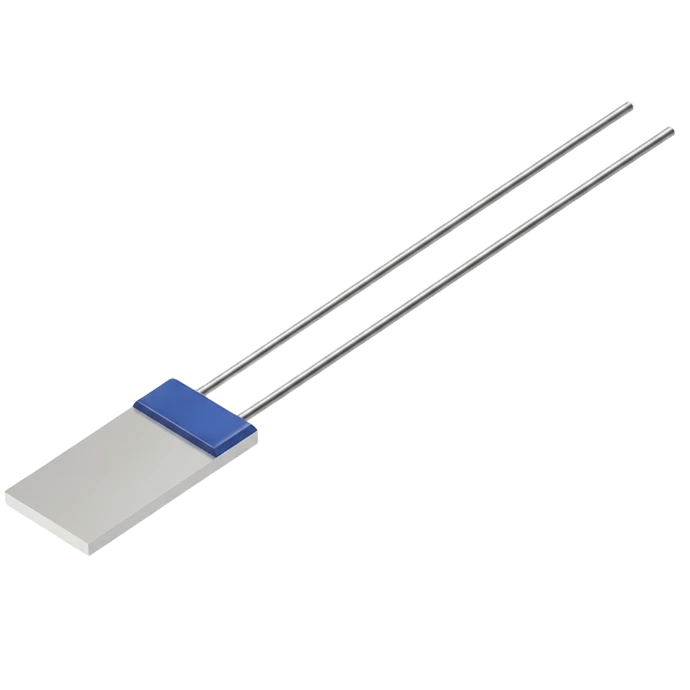
 The Balco 500 Ω is a resistance sensor made of Balco alloy, consisting of a mixture of nickel and iron (Ni–Fe).

Its nominal resistance is 500 Ω at 25 °C and it varies almost linearly with temperature between −40 °C and +150 °C.

Very stable, low-cost, and easy to integrate, it is widely used in HVAC systems, automotive devices, and industrial thermal regulations.

Operating principle


The variation of the resistivity of the Balco alloy (Ni–Fe) with temperature is modeled by a quadratic equation:

R(T) = R₀ [1 + α(T − 25) + β(T − 25)²]

avec :

  • R₀ = 500 Ω

  • α = 3,93 × 10⁻³

  • β = −5,0 × 10⁻⁶

  • (valable de −40 °C à +150 °C)

This alloy offers better linearity than pure nickel, while remaining more economical than platinum.

Technical specifications


Parameter
Typical Value
Nominal resistance at 0 °C 500 Ω
Temperature coefficient (α) 0,00393 °C⁻¹
Measurement range −40 °C to +150 °C
Linearity Very good
Element material Ni–Fe Alloy (Balco)
Typical measuring current 0,1 → 0,3 mA
Response time 0,3 s
 Long-term drift < 0,1 °C/year

Wiring configuration


Type
Description

Precision

2-wire

Simple assembly, sufficient for short distances.

✅ Good

3-wire

Reduces cable error.

🏆 Excellent

4-wire

Reserved for test benches.

💡 Maximum

Self-heating


Thanks to its resistance of 500 Ω and its low measurement current, the Balco 500 Ω exhibits negligible self-heating (< 0.02 °C).

Application areas


🏢 HVAC Systems (heating and cooling regulation)

🚗 Automotive Applications (engine management, indoor air)

⚙️ Light Industrial Instrumentation

💧 Thermal Control of Fluids

🧠 Embedded Economic Sensors

Should I choose a Balco sensor ?

Strengths points

  • 💡 Remarkable linearity
    → Its curve is almost linear between -40 °C and +150 °C, ideal for simple circuits without correction.
  • 🔋 Low consumption
    → Its high resistance (500 Ω) reduces the excitation current and limits self-heating.
  • 💰 Excellent performance/price ratio
    → Economic solution for HVAC and appliances without sacrificing accuracy.

Weaknesses points

  • 🌦️ Sensitive to humidity
    → The nickel-iron alloy oxidizes faster without proper protection.
  • 🧩 Limited use
    → Moderate temperature range, not suitable for harsh industrial environments.
  • 🧾 Reduced standardization
    → No strict international standard (unlike the Pt100), calibration often specific to the manufacturer.

Useful information

Here is some useful information regarding Balco sensors.

°C 0 1 2 3 4 5 6 7 8 9
-40 331.65 334.24 336.83 339.42 342.01 344.60 347.19 349.78 352.37 354.96
-30 357.55 360.14 362.73 365.32 367.91 370.50 373.09 375.68 378.27 380.86
-20 383.45 386.04 388.63 391.22 393.81 396.40 398.99 401.58 404.17 406.76
-10 409.35 411.94 414.53 417.12 419.71 422.30 424.89 427.48 430.07 432.66
0 435.25 437.84 440.43 443.02 445.61 448.20 450.79 453.38 455.97 458.56
10 461.15 463.74 466.33 468.92 471.51 474.10 476.69 479.28 481.87 484.46
20 487.05 489.64 492.23 494.82 497.41 500.00 502.59 505.18 507.77 510.36
30 512.95 515.54 518.13 520.72 523.31 525.90 528.49 531.08 533.67 536.26
40 538.85 541.44 544.03 546.62 549.21 551.80 554.39 556.98 559.57 562.16
50 564.75 567.34 569.93 572.52 575.11 577.70 580.29 582.88 585.47 588.06
60 590.65 593.24 595.83 598.42 601.01 603.60 606.19 608.78 611.37 613.96
70 616.55 619.14 621.73 624.32 626.91 629.50 632.09 634.68 637.27 639.86
80 642.45 645.04 647.63 650.22 652.81 655.40 657.99 660.58 663.17 665.76
90 668.35 670.94 673.53 676.12 678.71 681.30 683.89 686.48 689.07 691.66
100 694.25 696.84 699.43 702.02 704.61 707.20 709.79 712.38 714.97 717.56
110 720.15 722.74 725.33 727.92 730.51 733.10 735.69 738.28 740.87 743.46
120 746.05 748.64 751.23 753.82 756.41 759.00 761.59 764.18 766.77 769.36
130 771.95 774.54 777.13 779.72 782.31 784.90 787.49 790.08 792.67 795.26
140 797.85 800.44 803.03 805.62 808.21 810.80 813.39 815.98 818.57 821.16
150 823.75


Temperature (°C) Class B (±°C) Class A (±°C) 1/3 B (±°C) 1/10 B (±°C)
-40 0.50 0.23 0.17 0.05
-30 0.45 0.21 0.15 0.04
-20 0.40 0.19 0.13 0.04
-10 0.35 0.17 0.12 0.04
0 0.30 0.15 0.10 0.03
10 0.35 0.17 0.12 0.04
20 0.40 0.19 0.13 0.04
30 0.45 0.21 0.15 0.05
40 0.50 0.23 0.17 0.05
50 0.55 0.25 0.18 0.06
60 0.60 0.27 0.20 0.06
70 0.65 0.29 0.22 0.07
80 0.70 0.31 0.23 0.07
90 0.75 0.33 0.25 0.08
100 0.80 0.35 0.27 0.08
110 0.85 0.37 0.29 0.09
120 0.90 0.39 0.30 0.09
130 0.95 0.41 0.32 0.10
140 1.00 0.43 0.33 0.10
150 1.05 0.45 0.35 0.11

The Balco 500 Ω exhibits a nearly linear variation of its resistance with temperature, modeled by:

R(T) = R₀ [1 + α(T − 25) + β(T − 25)²]

avec :

  • R₀ = 500 Ω

  • α = 3,93 × 10⁻³

  • β = −5,0 × 10⁻⁶

  • (valable de −40 °C à +150 °C)

This relationship is more accurate than the pure linear formula while remaining easy to calculate.


🔹 Example 1 : calculation of resistance at 100 °C

R(100) = 500 × [1 + 3,93 × 10⁻³ × (100 − 25) − 5,0 × 10⁻⁶ × (100 − 25)²]

R(100) = 500 × [1 + 0,29475 − 0,028125]

R(100) = 500 × 1,266625 = 633,31 Ω

✅ Result : at 100 °C, the resistance of the Balco 500 Ω is approximately 633 Ω.


🔹 Example 2: calculating the temperature from a measured resistance

We measure R=570Ω.

What is the corresponding temperature ?

We solve the inverse equation :

β(T − 25)² + α(T − 25) + (1 − R / R₀) = 0

−5 × 10⁻⁶ (T − 25)² + 3,93 × 10⁻³ (T − 25) + (1 − 570 / 500) = 0

−5 × 10⁻⁶ (T − 25)² + 3,93 × 10⁻³ (T − 25) − 0,14 = 0

T − 25 = [−3,93 × 10⁻³ + √((3,93 × 10⁻³)² − 4 × (−5 × 10⁻⁶) × (−0,14))] / [2 × (−5 × 10⁻⁶)]

T − 25 ≈ 40,3 ⇒ T ≈ 65 °C

✅ Result: the equivalent temperature is approximately 65 °C.


🔹 Practical Remarks

  • The Balco alloy exhibits superior stability compared to nickel and has natural linearity.
  • The quadratic equation remains simple to implement on a microcontroller.
  • This type of sensor is ideal for cost-effective devices requiring acceptable accuracy (±0.2 °C).

The Balco sensor is perfectly suited for measurement circuits using a voltage divider or Wheatstone bridge, thanks to its high resistance and nearly perfect linearity.

It can be directly connected to an ADC converter or a moderate-gain instrumentation amplifier.

🔹 Typical components

Composant Function
RTD Balco 500 Ω (2 or 3 wires)
Sensitive element Ni–Fe
Stable current source (~0.2 mA)
Provides a constant current limiting self-heating
Measurement bridge or Wheatstone bridge
Convert the resistance variation into voltage
Instrumentation amplifier (INA826, AD620)
Amplify the differential voltage
ADC 16–24 bits
Digitize the measured voltage
Microcontroller (STM32, ESP32, Arduino, etc.)
Calculate the temperature from the resistance
RC Filtering
Reduces noise on measurement signals

🔹 Functional diagram (ASCII)

+3.3 V │ Current source (0.2 mA) │ [ Balco 500 Ω ]

(2 wires or 3 shielded wires) │ │ │ │ Measurement bridge or amplifier │ [ ADC ] │ [ Microcontroller ]

(calculation of T = 25 + (R/R25 - 1)/α)

🔹 Principe de fonctionnement

  1. A constant current (0.2 mA) flows through the Balco resistance.
  2. → at 25 °C: V = 500Ω × 0.2mA = 100mV
  3. → at 100 °C: V = 694Ω × 0.2mA = 139mV
  4. The measured voltage is proportional to the temperature.
  5. It can be directly converted via the ADC of a modern microcontroller.
  6. The microcontroller calculates the temperature using the equation:
  7. T = 25 + R/R25−1 / α
  8. The processed signal can then be displayed, sent via bus (I²C, RS485, etc.),
  9. or used to control a regulator (heating, air conditioning, etc.).

🔹 Best Practices

⚡ Use a shielded cable if the sensor is far from the measurement module.

💧 Mechanically protect the probe from moisture and corrosion.

🧩 Prefer a 3-wire configuration if the cables exceed 2 m to compensate for losses.

🔄 Calibrate at 0 °C and 100 °C to adjust the coefficient α according to the production batch.

🧯 Avoid currents > 0.3 mA, which cause slight self-heating (≈ 0.05 °C).

We integrate any sensor into any probe

Smooth tube probe

 Smooth tube 

Waterproof probe

 Waterproof

Bayonet probe

 Bayonet

Slot probe

 Slot

Ambient probe

 Atmosphere

Connection head probe

Termal block

Stick-in probe

Stick-in

Thread probe

Thread

Contact probe

Contact

Jacketed probe

Jacketed

PCBA Design

PCBA design

Winding probe

Winding

More than 1,000,000 probes delivered in 2025

Contact us for a personalized offer

Contact Us

Need a Balco sensor?

We design customized solutions tailored to your technical constraints, volumes, and objectives.


Submit
Useful Links
  • Home
  • About Us
  • Jobs
  • Legal Notices
  • Privacy Policy
  • Contact us
About us

At Guilcor, our mission is to provide every client with a measurement solution perfectly suited to their specific needs. With full control over design and manufacturing, we ensure the precision and reliability of our sensors in even the most demanding environments.

Technical excellence and customer satisfaction are at the heart of everything we do.

Connect with us
  • Contact us
  • contact@guilcor.com
Follow us