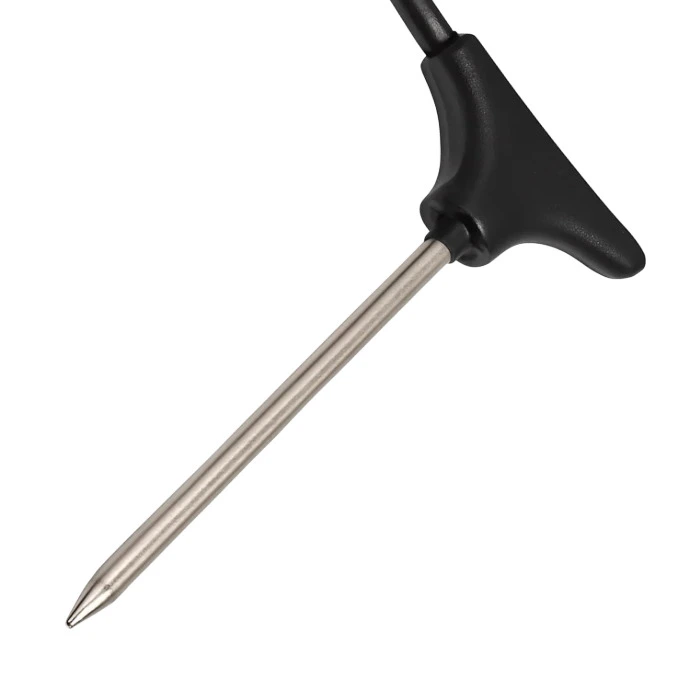
What is a Type G thermocouple ?
The type G thermocouple (tungsten-molybdenum alloy) is a sensor designed for extreme temperatures, up to +2,320 °C, in reducing environments or under vacuum.
Composed of W (pure tungsten) and Mo (pure molybdenum), it offers exceptional thermal resistance but cannot be used in open air.
It is distinguished by its high mechanical stability and resistance to violent thermal gradients, making it a preferred choice for energy and nuclear applications.
Operating principle
The G type operates according to the Seebeck effect, generating a voltage based on the temperature difference between the hot and cold junctions.
E = S × (T_hot - T_cold)
For type G:
S ≈ 17 µV/°C at 1,000 °C
Although its voltage is lower than that of types C or D, its mechanical strength and stability under thermal stress more than compensate for this point.
Technical specifications
| Parameter |
Typical Value |
| Measurement range | 0 °C → +2 320 °C |
| Sensitivity | 17 µV/°C at 1 000 °C |
| Tension at 1000 °C | ≈ 12,3 mV |
| Tension at 2000 °C | ≈ 24,6 mV |
| Tension at 2300 °C | ≈ 28,3 mV |
| Oxidation resistance | Null (unusable in open air) |
| Response time (cable sheath Ø6 mm) | 6 to 12 s |
| Reference standard | ASTM E230 (no official IEC standard) |
Voltage / Temperature Curve
(Reference: Cold junction at 0 °C — ASTM E230 standard)
Type G produces a stable and monotonic voltage across its operating range, but slightly lower than that of types C and D.
Its drift remains very low even after several hundred hours at over 2,000 °C.
📈 General behavior:
- From 0 to 2,320 °C → increasing voltage (~0 to +28.3 mV)
- Average slope: ≈ 17 µV/°C at 1,000 °C
- Drift: <0.05% after 100 h at 2,000 °C
💡 Type G is intended for extreme applications, where precision is secondary to physical resistance.
Compatibility / Compensation
The G type is not compatible with standard converters.
It requires specific electronics capable of handling low voltages and extreme temperature conditions.
It is imperative to use it in a high vacuum or a reducing atmosphere (dry hydrogen, pure argon, helium).
Application areas
⚙️ Fusion and processing of refractory metals
🔬 Plasma physics and vacuum processes
🧪 Nuclear research and advanced materials
🚀 Space propulsion and high-temperature energy systems