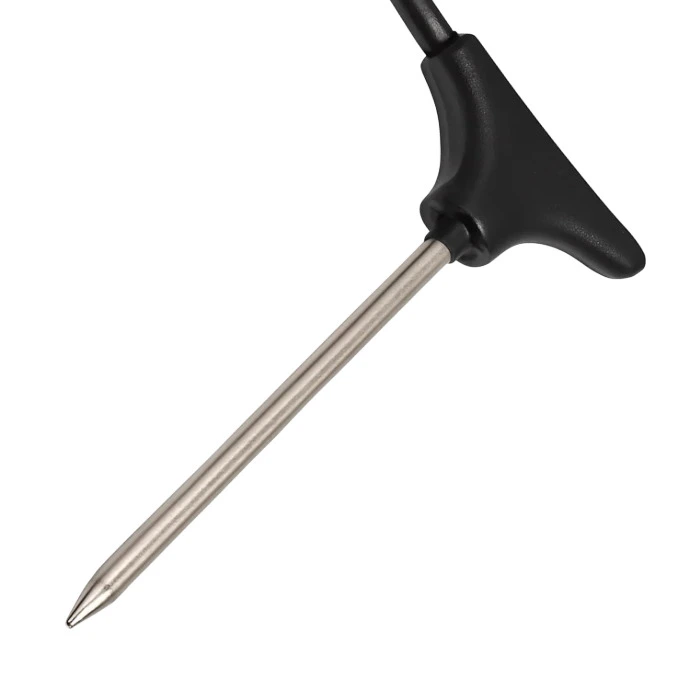
What is a Type N thermocouple ?
The type N thermocouple is a direct evolution of the type K, designed to address its weaknesses at high temperatures.
It combines Nicrosil (Ni-Cr-Si) and Nisil (Ni-Si), two nickel alloys reinforced with silicon to resist oxidation and thermochemical drift.
This sensor is ideal for environments where long-term stability and corrosion resistance are priorities.
It is increasingly used in the chemical, energy, and aerospace industries.
Operating principle
Like other thermocouples, type N relies on the Seebeck effect: a voltage proportional to the temperature difference is generated between the hot junction and the cold junction.
E = Sn × (T_hot - T_cold)
For type N:
S ≈ 39 µV/°C around 0 °C
Its stability and resistance to contamination make its voltage/temperature curve more consistent than that of type K over the long term.
Technical specifications
| Parameter |
Typical Value |
| Measurement range | −200 °C → +1 280 °C |
| Sensitivity | 39 µV/°C to 0 °C |
| Tension at 100 °C | ≈ 3,90 mV |
| Tension at 500 °C | ≈ 19,30 mV |
| Tension at 1000 °C | ≈ 47,51 mV |
| Oxidation resistance | Excellent |
| Response time (cable sheath Ø3 mm) | 0,5 to 3 s |
| Reference standard | IEC 60584-1, ASTM E230 |
Voltage / Temperature Curve
(Reference: Cold junction at 0 °C — IEC 60584-1 standard)
Type N has a curve very similar to type K, but it is more stable and consistent over the long term.
Its drift is significantly reduced above 1,000 °C.
📈 General behavior:
- From −200 to 0 °C → negative voltage (~−4.8 mV to 0 mV)
- From 0 to 1,280 °C → positive voltage (~0 to +47.5 mV)
- Average slope: ≈ 39 µV/°C
💡 Its stability and resistance to contamination make it a modern and durable alternative to type K.
Compatibility / Compensation
The N type uses the same measurement electronics as the K type (same circuits, same converters).
However, its more stable chemistry makes it less prone to drift and more reliable over the long term.
It is the sensor of choice in processes where measurement consistency takes precedence over cost.
Application areas
⚗️ Chemical, petrochemical, and gas industries
🏭 Energy production, thermal power plants
🚀 Aerospace and high-temperature material testing
🧪 High stability laboratory instrumentation