Passa al contenuto
guilcor.com
  • Home
  • Prove
    Sonda a tubo liscio

    Tubo Liscio

    Frigorifero, pompa di calore, forno, congelatore, scaldabagno
    Sonda di contatto

    Contatto

    Tubo, superficie del tubo, piastra riscaldante
    Sonda a fessura

    Fessura

    Motore, alternatore, avvolgimento, statore
    Sonda di connessione testa

    Testa di connessione

    Caldaia, pompa di calore, aria condizionata, locali tecnici, ventilazione
    Sonda impermeabile

    Impermeabile

    Aria condizionata, ventilazione, refrigerazione, stoccaggio a freddo, condotti
    Sonda da infilare

    Infilare

    Forno, cottura, attrezzature per la lavorazione degli alimenti
    Sonda di avvolgimento

    Avvolgimento

    Motore, alternatore, trasformatore, avvolgimento, statore
    Sonda ambientale

    Ambientale

    Caldaia, pompa di calore, aria condizionata, locali tecnici, ventilazione
    Sonda a filettatura

    Filettatura

    Macchina da caffè, caldaia, vapore, fluido pressurizzato
    Sonda giacketata

    Giacketata

    Installazioni industriali, applicazioni pesanti
    Sonda a baionetta

    Baionetta

    Stampaggio plastico, attrezzature, macchina per stampaggio ad iniezione, motore, alternatore
    Progettazione PCBA

    progettazione PCBA

    Applicazione specifica, elettronica integrata, schede elettroniche personalizzate
  • Sensori

    RTD

    Pt10, Pt50, Pt100, Pt200, Pt500, Pt1000, Pt5000, Ni100, Ni120, Cu10, Cu50, Balco

    PTC

    KTY81-110, KTY81-210, KTY83-110, KTY84-130, PTC130, Silistor, TFPT, MZ6, MZ8, MZ9

    1-Wire

    DS18B20, DS18S20, DS1822, DS28EA00, DS18B20-PAR, DS1920, DS2438, DS1835...

    Termocoppia

    B, E, J, K, N, R, S, T, C, D, G

    UART

    MLX90614, MLX90615, GY-906, DHT11, DHT22, SHT75, SHT85, RS232, RS485

    SPI

    MAX6675, MAX31855, MAX31856, MCP3208, TMP125, TMP121, ADT7310, LTC2983...

    NTC

    1kΩ, 2kΩ, 3kΩ, 5kΩ, 10kΩ, 15kΩ, 20kΩ, 30kΩ, 50kΩ, 100kΩ, 200kΩ, 470kΩ, 1MΩ

    I²C

    TMP102, TMP117, LM75, LM73, MCP9808, MCP9600, SHT31, SHTC3, BME280, BME688, HTU21D, HDC1080, Si7051, ADT7410, STTS751, TCN75A...
  • Chi siamo
  • 0
  • 0
  • Seguici
  • English (US) Français Italiano Español
  • Accedi
  • Contattaci
guilcor.com
  • 0
  • 0
    • Home
    • Prove
    • Sensori
    • Chi siamo
  • Seguici
  • English (US) Français Italiano Español
  • Accedi
  • Contattaci

 DS1822 
 Temperature sensors 

High-precision digital temperature sensor with long-term stability, suitable for electronics and environmental monitoring.

 Maximum precision
+/- 2,0°K

 Minimum temperature
-55°C

 Maximum temperature
+125°C

 Minimum dimensions
4 x 6 x 27

 Response time
Medium

 Self-heating
Medium

 Price
Low

Drift
Low

What is a DS1822 sensor ?Operating principleTechnical specificationsWiring configurationSelf-heatingApplication areas

What is a DS1822 sensor ?


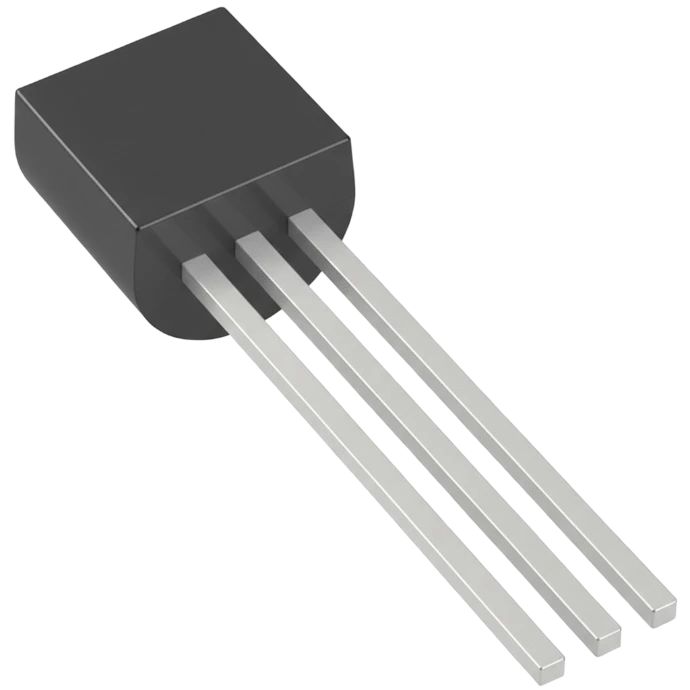
The DS1822 is a digital temperature sensor with a 1-Wire protocol, developed by Maxim Integrated as a cost-effective version of the DS18B20.

It maintains the same pinout, commands, and internal architecture, but with a wider tolerance and simplified calibration.

It is an excellent compromise between cost, reliability, and ease of integration, especially for consumer applications or non-critical sensor networks.

Operating principle


The DS1822 operates on the same principle as the DS18B20:

the measured temperature is converted to a digital format and transmitted via the 1-Wire bus.

The relationship remains:

  • ​​​T = Brut Value / 16

Each unit of measurement depends on the configured resolution (9 to 12 bits).

ResolutionPass (°C)
Conversion time
9 bits0,5 °C93,75 ms
10 bits0,25 °C187,5 ms
11 bits0,125 °C375 ms
12 bits0,0625 °C750 ms

Technical specifications


Parameter
Typical Value
Measurement range −55 °C → +125 °C
Typical precision ±2,0 K (−10 → +85 °C)
Resolution 9 to 12 bits (configurable)
Conversion time 93,75 to 750 ms
Alimentation 3.0 → 5.5 V or parasitic mode
Interface Digital (1-Wire bus)
Unique identifier 64 bits (family 0x22)
Typical current < 1 mA

Annual drift

Average (±0.5 K/year)

Case

TO-92, stainless steel cable or IP68 sealing

Wiring configuration


Type
Description

Precision

3-wires

VDD + DATA + GND

✅ Standard

2-wires (parasite)

DATA + GND, without dedicated power supply

💡 Wiring economy

Chained (multi-drop)

Multiple sensors on the same bus

🏗️ Wide Area Networks

Self-heating


Low (≈ 0.3 °C at 5 V).

Due to its low power consumption, the DS1822 is suitable for battery-operated systems or continuous measurements without significant thermal drift.

Application areas


⚙️ Economic Systems of Thermal Monitoring

🧱 Domestic and HVAC Applications

💧 Waterproof Thermometers for Pools, Aquariums, Greenhouses

🔋 Measurements on Microcontrollers (Arduino, ESP32, etc.)

🧠 Low-Cost Educational or IoT Projects


Should I choose a DS1822 sensor ?

Strengths points

  • 💸 Excellent value for money
    → The DS1822 offers the same functions as the DS18B20 (12-bit resolution, 1-Wire bus, unique ID), but at a lower cost, perfect for high-volume projects.
  • 🔗 Total compatibility with the DS18B20
    → Same pinout, same commands, and identical protocol: it can directly replace a DS18B20 without software modification.
  • 🧠 Low consumption and parasitic mode
    → Ideal for low energy or battery-powered applications, with a simplified 2-wire power supply.
DS1822 sensors

Weaknesses points

  • 🎯 Reduced precision
    → With a typical tolerance of ±2 K, it is less accurate than the DS18B20 (±0.5 K). It is not well-suited for demanding industrial measurements.
  • 📉 Average drift over time
    → The simplified calibration results in a drift of approximately ±0.5 K/year, requiring occasional recalibration during extended use.
  • 📊 Not guaranteed across the entire extended range
    → Errors can increase beyond +85 °C or below -10 °C to be avoided for extreme environments.

Useful information

Here is some useful information regarding the DS1822 sensors.

The DS1822 has the same measurement core as the DS18B20, but with reduced accuracy and simplified calibration.

The resolution remains configurable from 9 to 12 bits, adjustable via the internal configuration register.

Resolution No measurement (°C)
Conversion time
Accuracy (−10 → +85 °C)
Extended accuracy (−55 → +125 °C)
9 bits 0,5 °C 93,75 ms ±2,0 K ±3,0 K
10 bits 0,25 °C 187,5 ms ±2,0 K ±3,0 K
11 bits 0,125 °C 375 ms ±1,5 K ±2,5 K
12 bits 0,0625 °C 750 ms ±1,5 K ±2,0 K

🔹 Remarks:

  • Resolution and protocol identical to the DS18B20 → completely interchangeable.
  • Average annual drift (≈ ±0.5 K/year), stable for non-critical applications.
  • No recalibration required in most use cases.

As with the DS18B20, the DS1822 provides a 16-bit numeric value corresponding to the measured temperature.

The conversion formula is the same:

T(°C) = Brut Value / 16


🔹 Example 1 – Standard Reading

The sensor returns:

  • LSB = 0xA2
  • MSB = 0x00

Raw value 0x00A2 = 162₁₀ T = 162 / 16 = 10.125 °C

✅ Result: the measured temperature is ≈ 10.1 °C.


🔹 Example 2 – Negative reading

The sensor returns:

  • LSB = 0x5E
  • MSB = 0xFF

Raw value (two's complement):

Raw value 0xFF5E = -162₁₀ T = -162 / 16 = -10.125 °C

✅ Result: measured temperature = −10.1 °C.


🔹 Practical notes:

  • Reading via “Read Scratchpad” command (0xBE).
  • Resolution configured in the R1/R0 bits register.
  • The data includes TH/TL alarms and the CRC for validation.

The DS1822 connects via a 1-Wire bus, similar to the DS18B20.

It operates in both normal mode (3 wires) and parasite mode (2 wires).

🔹 Typical components

Component
Function
DS1822 1-Wire Digital Sensor
Pull resistance 4.7 kΩ
Maintaining the DATA bus in a high state
Microcontroller (Arduino, ESP32, STM32, Raspberry Pi) Bus Master
Shielded cable
Recommended beyond 10–15 m
Nutrition 3,3 V / 5 V Source (or parasitic power)
🔹 Functional diagram (ASCII)

Classic 3-wire mode

+3.3V / +5V │ [4.7kΩ] │ DATA ────┼──────────────┐ │ │ GND DS1822 │ GND

Parasitic mode (2 wires)

DATA ───┬────────────── DS1822 │ GND

🔹 Operating Principle

1️⃣ The 1-Wire master initializes the bus with a reset pulse.

2️⃣ The DS1822 responds with a presence pulse.

3️⃣ The "Convert T" command (0x44) initiates the conversion.

4️⃣ After the conversion delay (93–750 ms), the microcontroller reads the result with "Read Scratchpad" (0xBE).

Each DS1822 has a unique 64-bit address, structured as follows:

  • 8 bits: family code (0x22 for DS1822)
  • 48 bits: unique serial number
  • 8 bits: CRC check

This system guarantees:

  • 🔗 Simple chaining of multiple sensors on a single bus.
  • 🧠 Automatic unique identification without reconfiguration.
  • 🧩 Easier maintenance: identical replacement without recalibration.

Example of a unique address:

22-FF-1A-34-86-15-03-5C

✅ Each sensor can be addressed independently, even on the same shared cable.

 We integrate any sensor into any probe 

Smooth tube probe

 Smooth tube 

Waterproof probe

 Waterproof

Bayonet probe

 Bayonet

Slot probe

 Slot

Ambient probe

 Atmosphere

Head connection probe

Termal block

Stick-in probe

Stick-in

Thread probe

Thread

Contact probe

Contact

Jacketed probe

Jacketed

PCBA Design

PCBA design

Winding probe

Winding

More than 1,000,000 probes delivered in 2025

Contact us for a personalized offer

Contact Us

Need a DS1822 sensor?

Whether you need a few parts for a prototype or several hundred for a production line, we support you at every step.


Submit
Collegamenti utili
  • Casa
  • Chi Siamo
  • Lavori
  • Note Legali
  • Informativa sulla Privacy
  • Contattaci
Chi siamo

Presso Guilcor, la nostra missione è fornire a ogni cliente una soluzione di misurazione perfettamente adatta alle proprie esigenze specifiche. Con il pieno controllo sul design e sulla produzione, garantiamo la precisione e l'affidabilità dei nostri sensori anche negli ambienti più esigenti.

L'eccellenza tecnica e la soddisfazione del cliente sono al centro di tutto ciò che facciamo.

Entra in contatto con noi
  • Contattaci
  • contact@guilcor.com
Seguici

Politica sui cookie

Usiamo cookie per garantirti la migliore esperienza utente sul nostro sito web. Informativa sui cookie

Solo essenziali Accetto