Passa al contenuto

 Pt200 
 Temperature sensors 

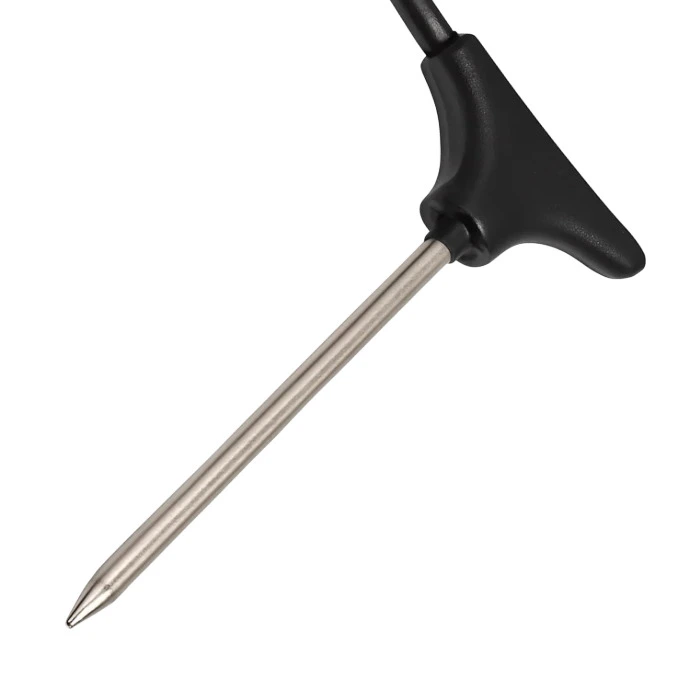
Pt200 temperature sensors offer improved signal resolution while maintaining the precision and reliability of platinum RTDs.

 Maximum precision
+/- 0.10°K

 Minimum temperature
-200°C

 Maximum temperature
+850°C

 Minimum dimensions
2 x 8 x30

 Response time
Medium

 Self-heating
Low

 Price
High

Drift
Low

What is a Pt200 sensor ?


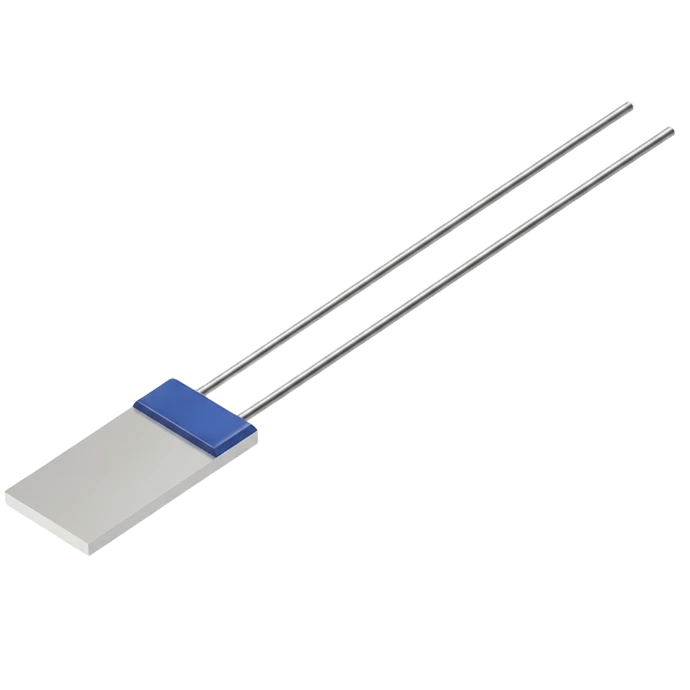
 The Pt200 is a pure platinum resistance probe (99.99%), with a nominal resistance of 200 Ω at 0 °C.

It is an evolution of the Pt100, providing a voltage output that is twice as high, which improves measurement resolution and noise rejection without altering thermal behavior.

The Pt200 is therefore ideal for precision industrial applications and long-distance wiring embedded systems.

Operating principle


Like all platinum RTD sensors, the Pt200 follows the Callendar–Van Dusen equation:

​ ​ ​ ​​​R(T) = R0[(1+A⋅T+B⋅T²+C⋅(T-100)⋅T³]

With :

  • R₀ = 200 Ω (pour Pt200)
  • A = 3,9083 × 10⁻³
  • B = -5,775 × 10⁻⁷
  • C = −4,183×10−12 (pour T < 0 °C)

Technical specifications


Parameter
Typical Value
Nominal resistance at 0 °C 200 Ω
Temperature coefficient (α) 0,00385 °C⁻¹
Measurement range −200 °C to +850 °C
Linearity Excellent
Element material Platinium pur
Typical measuring current 0,1 → 1 mA
Response time 0,5 s (gain Ø3 mm)
Long-term drift < 0,05 °C/year

Wiring configuration


Type
Description

Precision

2-wire

Simple but the influence of cables is not negligible.

⚠️ Average

3-wire

Partial compensation for line losses.

✅ Good

4-wire

Kelvin measurement eliminates the resistance of conductors.

🏆 Excellent

Self-heating


The Pt200 generates a higher voltage for the same current, allowing for a lower excitation (≈ 0.3 mA).

Result: a self-heating of less than 0.03 °C, perfect for precise long-term applications.

Application areas


⚙️ High-precision industrial instrumentation

🧪 Test benches and automatic calibrations

🚀 Embedded systems and aerospace control

🧠 Long-distance scientific measurement equipment

🔧 High-end replacement for Pt100 in noisy environments

Should I choose a Pt200 sensor ?

Strengths points

  • 🔍 Naturally amplified signal
    → With 200 Ω at 0 °C, the Pt200 generates a voltage twice as high as a Pt100 → better resolution without amplifying as much.
  • 🧠 Excellent noise immunity
    → Its greater resistance allows for better rejection of electromagnetic interference, ideal for long distances.
  • 🧩 Compatible Pt100
    → Same equation, same coefficient α = 0.00385: it can replace a Pt100 in most systems without recalibration.

Weaknesses points

  • 💸 Less common sensor
    → More platinum = higher price, especially on miniaturized sensors or stainless steel sheathed ones.
  • ⚡ Excitation current to adjust
    → A voltage that is too high can saturate the amplifiers; therefore, the supply current must be reduced (< 0.5 mA).
  • 🧯 Rarely used in the market
    → Less common than the Pt100, which limits the availability of compatible converters and controllers.

Useful information

Here is some useful information regarding Pt200 sensors.

Temp (°C)

0

1

2

3

4

5

6

7

8

9

0

200,00

200,78

201,56

202,34

203,12

203,91

204,69

205,47

206,25

207,03

10

207,81

208,58

209,36

210,14

210,92

211,70

212,48

213,25

214,03

214,81

20

215,59

216,36

217,14

217,92

218,69

219,47

220,25

221,02

221,80

222,57

30

223,35

224,12

224,89

225,67

226,44

227,22

227,99

228,76

229,54

230,31

40

231,08

231,85

232,63

233,40

234,17

234,94

235,71

236,48

237,25

238,02

50

238,79

239,56

240,33

241,10

241,87

242,64

243,41

244,18

244,95

245,72

60

246,48

247,25

248,02

248,79

249,55

250,32

251,09

251,85

252,62

253,38

70

254,15

254,92

255,68

256,45

257,21

257,97

258,74

259,50

260,27

261,03

80

261,79

262,56

263,32

264,08

264,84

265,61

266,37

267,13

267,89

268,65

90

269,41

270,17

270,94

271,70

272,46

273,22

273,97

274,73

275,49

276,25

100

277,01

277,77

278,53

279,29

280,04

280,80

281,56

282,32

283,07

283,83

110

284,59

285,34

286,10

286,85

287,61

288,36

289,12

289,87

290,63

291,38

120

292,14

292,89

293,64

294,40

295,15

295,90

296,66

297,41

298,16

298,91

130

299,66

300,42

301,17

301,92

302,67

303,42

304,17

304,92

305,67

306,42

140

307,17

307,92

308,67

309,42

310,16

310,91

311,66

312,41

313,16

313,90

150

314,65

315,40

316,14

316,89

317,64

318,38

319,13

319,87

320,62

321,36

160

322,11

322,85

323,60

324,34

325,09

325,83

326,57

327,32

328,06

328,80

170

329,54

330,29

331,03

331,77

332,51

333,25

333,99

334,74

335,48

336,22

180

336,96

337,70

338,44

339,18

339,92

340,65

341,39

342,13

342,87

343,61

190

344,35

345,08

345,82

346,56

347,30

348,03

348,77

349,50

350,24

350,98

200

351,71

352,45

353,18

353,92

354,65

355,39

356,12

356,85

357,59

358,32

210

359,06

359,79

360,52

361,25

361,99

362,72

363,45

364,18

364,91

365,64

220

366,38

367,11

367,84

368,57

369,30

370,03

370,76

371,49

372,21

372,94

230

373,67

374,40

375,13

375,86

376,58

377,31

378,04

378,77

379,49

380,22

240

380,95

381,67

382,40

383,12

383,85

384,57

385,30

386,02

386,75

387,47

250

388,20

388,92

389,64

390,37

391,09

391,81

392,54

393,26

393,98

394,70

260

395,42

396,15

396,87

397,59

398,31

399,03

399,75

400,47

401,19

401,91

270

402,63

403,35

404,07

404,79

405,50

406,22

406,94

407,66

408,38

409,09

280

409,81

410,53

411,24

411,96

412,68

413,39

414,11

414,82

415,54

416,25

290

416,97

417,68

418,40

419,11

419,82

420,54

421,25

421,96

422,68

423,39

300

424,10

424,82

425,53

426,24

426,95

427,66

428,37

429,08

429,79

430,50

310

431,22

431,93

432,63

433,34

434,05

434,76

435,47

436,18

436,89

437,60

320

438,30

439,01

439,72

440,43

441,13

441,84

442,55

443,25

443,96

444,66

330

445,37

446,08

446,78

447,49

448,19

448,89

449,60

450,30

451,01

451,71

340

452,41

453,12

453,82

454,52

455,22

455,93

456,63

457,33

458,03

458,73

350

459,43

460,13

460,83

461,53

462,23

462,93

463,63

464,33

465,03

465,73

360

466,43

467,13

467,83

468,52

469,22

469,92

470,62

471,31

472,01

472,71

370

473,40

474,10

474,79

475,49

476,19

476,88

477,58

478,27

478,96

479,66

380

480,35

481,05

481,74

482,43

483,13

483,82

484,51

485,20

485,90

486,59

390

487,28

487,97

488,66

489,35

490,04

490,73

491,43

492,12

492,81

493,49

400

494,18

494,87

495,56

496,25

496,94

497,63

498,32

499,00

499,69

500,38


Temperature (°C)

Classe A

Classe B

Classe 1/3 B (DIN)

Classe 1/10 B (DIN)

-200

0,55

1,3

0,4333

0,13

-190

0,53

1,25

0,4167

0,125

-180

0,51

1,2

0,4

0,12

-170

0,49

1,15

0,3833

0,115

-160

0,47

1,1

0,3667

0,11

-150

0,45

1,05

0,35

0,105

-140

0,43

1

0,3333

0,1

-130

0,41

0,95

0,3167

0,095

-120

0,39

0,9

0,3

0,09

-110

0,37

0,85

0,2833

0,085

-100

0,35

0,8

0,2667

0,08

-90

0,33

0,75

0,25

0,075

-80

0,31

0,7

0,2333

0,07

-70

0,29

0,65

0,2167

0,065

-60

0,27

0,6

0,2

0,06

-50

0,25

0,55

0,1833

0,055

-40

0,23

0,5

0,1667

0,05

-30

0,21

0,45

0,15

0,045

-20

0,19

0,4

0,1333

0,04

-10

0,17

0,35

0,1167

0,035

0

0,15

0,3

0,1

0,03

10

0,17

0,35

0,1167

0,035

20

0,19

0,4

0,1333

0,04

30

0,21

0,45

0,15

0,045

40

0,23

0,5

0,1667

0,05

50

0,25

0,55

0,1833

0,055

60

0,27

0,6

0,2

0,06

70

0,29

0,65

0,2167

0,065

80

0,31

0,7

0,2333

0,07

90

0,33

0,75

0,25

0,075

100

0,35

0,8

0,2667

0,08

110

0,37

0,85

0,2833

0,085

120

0,39

0,9

0,3

0,09

130

0,41

0,95

0,3167

0,095

140

0,43

1

0,3333

0,1

150

0,45

1,05

0,35

0,105

160

0,47

1,1

0,3667

0,11

170

0,49

1,15

0,3833

0,115

180

0,51

1,2

0,4

0,12

190

0,53

1,25

0,4167

0,125

200

0,55

1,3

0,4333

0,13

The Pt200 follows the normalized Callendar–Van Dusen equation, identical to that of the Pt100, but with a doubled nominal resistance.


R(T) = R₀ [1 + A·T + B·T² + C·(T − 100)·T³]

with :

  • R₀ = 200 Ω

  • A = 3,9083 × 10⁻³

  • B = −5,775 × 10⁻⁷

  • C = −4,183 × 10⁻¹² (pour T < 0 °C)

This equation provides a stable, linear, and reproducible relationship from −200 °C to +850 °C.


🔹 Example 1 : calculation of resistance at 100 °C

R(100) = 200 × [1 + 3,9083 × 10⁻³ × 100 − 5,775 × 10⁻⁷ × 100²]

R(100) = 200 × (1 + 0,39083 − 0,005775)

R(100) = 200 × 1,385055 = 277,01 Ω

Result : at 100 °C, the resistance of a Pt200 is approximately 277.0 Ω.


🔹 Example 2 : calculating the temperature from a measured resistance

A resistance R=236.2 Ω is measured.

What is the corresponding temperature?

T = (−A + √(A² − 4B(1 − R/R₀))) / (2B)

T = (−3,9083 × 10⁻³ + √[(3,9083 × 10⁻³)² − 4 × (−5,775 × 10⁻⁷) × (1 − 236,2 / 200)]) / [2 × (−5,775 × 10⁻⁷)]

T ≈ 47 °C

Result : the equivalent temperature is approximately 47 °C.


🔹 Technical notes

  • The Pt200 provides a voltage that is twice that of the Pt100 for the same current → better ADC resolution.
  • The equation can be directly integrated into a microcontroller firmware (Arduino, STM32, ESP32, etc.).
  • Below 0 °C, the cubic component C(T−100)T3 becomes essential to maintain the accuracy of ±0.1 °C.

The Pt200 generates a proportionally higher signal than the Pt100, which allows for reduced excitation current and limits self-heating.

It is perfectly suited for 3 or 4 wire differential configurations.

🔹 Typical components of the configuration

Component Function
RTD Pt200 (3 or 4 wires)
Sensitive element in pure platinum
Stable current source (~0.3 mA)
Provides a constant current
Instrumentation amplifier (INA333, AD8421)
Amplify the tension from the sensor
High-resolution ADC (≥ 16 bits)
Digitize the voltage for the microcontroller
Microcontroller (STM32, ESP32, Arduino)
Calculate the temperature using Callendar–Van Dusen
Shielded wiring
Reduces electromagnetic noise over long distances
🔹 Functional diagram (ASCII)

+3.3 V / +5 V │ Power source (0.3 mA) │ [ Pt200 ] (2 power wires + 2 measurement wires) │ │ │ │ Diff. amplifier ───→ High-resolution ADC │ [ Microcontroller ] (Calcul T = f(R) + compensation)

🔹 Operating Principle

1️⃣ The constant current flows through the Pt200.

→ At 0 °C: V = 200 Ω × 0.3 mA = 60 mV

→ At 100 °C: V = 277 Ω × 0.3 mA = 83 mV

2️⃣ The differential amplifier boosts the signal (gain ≈ 50 to 100).

→ Typical output: 3 to 8 V depending on the ADC configuration.

3️⃣ The microcontroller calculates the temperature using the Callendar–Van Dusen equation.

🔹 Best Practices

  • 🧩 4-wire wiring is recommended to eliminate line effects.
  • ⚡ Reduce the excitation current to a maximum of 0.3 mA to avoid overheating.
  • 💧 Use a sealed enclosure to protect the sensor in humid environments.
  • 🔄 Regularly calibrate at 0 °C and 100 °C.
  • 🧲 Filter the amplifier input (RC 1 kΩ / 100 nF) to reject industrial noise.

More than 1,000,000 probes delivered in 2025

Contact us for a personalized offer

Contact Us

Need a Pt200 sensor ?

We design customized solutions tailored to your technical constraints, volumes, and objectives.