Passa al contenuto

 Pt500 
 Temperature sensors 

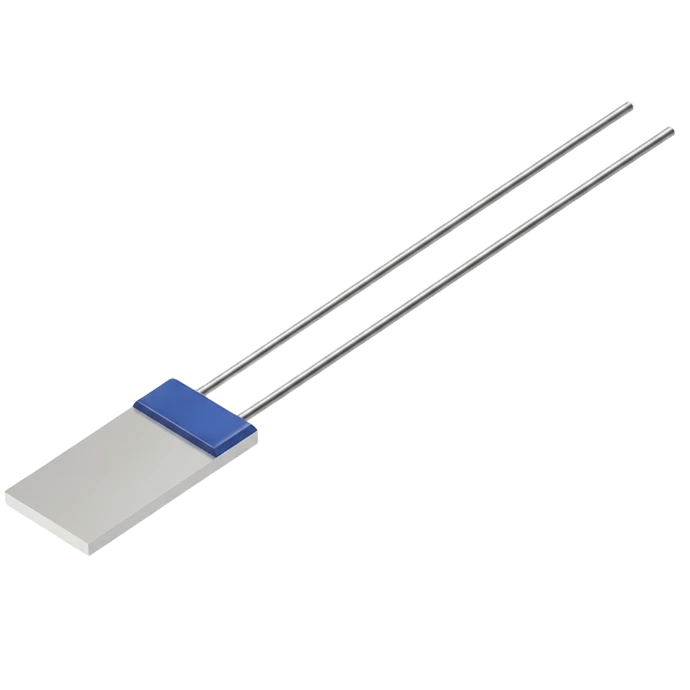
Pt500 temperature sensors deliver higher resistance values, enhancing measurement resolution and reducing sensitivity to line resistance.

 Maximum precision
+/- 0.1°K

 Minimum temperature
-200°C

 Maximum temperature
+600°C

 Minimum dimensions
2 x 8 x 30

 Response time
Medium

 Self-heating
Low

 Price
Medium

Drift
Low

What is a Pt500 sensor ?


 The Pt500 is a platinum resistance sensor that presents 500 Ω at 0 °C.

It offers increased sensitivity compared to the Pt100, with a higher output voltage and excellent linearity.

This sensor is ideal for digital measurement applications (controllers, HVAC regulators, process probes) requiring good accuracy without excessive amplification.

Operating principle


Like all platinum RTD sensors, the Pt500 follows the Callendar–Van Dusen equation:

R(T) = R_0 [1 + A·T + B·T^2 + C·(T - 100)·T^3]

with :

  • R_0 = 500 Ω

  • A = 3,9083 × 10⁻³
  • B = -5,775 × 10⁻⁷
  • C = −4,183×10−12 (pour T < 0 °C)

The output tension being about 5 times higher than that of a Pt100, the Pt500 is perfectly suited for the 0–5 V or 0–10 V analog inputs of industrial systems.

Technical specifications


Parameter
Typical Value
Nominal resistance at 0 °C 500 Ω
Temperature coefficient (α) 0,00385 °C⁻¹
Measurement range −200 °C to +600 °C
Linearity Excellent
Element material Platinium pur
Typical measuring current 0,2 à 0,5 mA
Response time 0,5 s
Long-term drift < 0,05 °C/year

Wiring configuration


Type
Description

Precision

2-wire

Simple but not very accurate over long distances.

⚠️ Average

3-wire

Partially compensates for the resistance of the cables.

✅ Good

4-wire

Completely eliminates parasitic resistance.

🏆 Excellent

Self-heating


The Pt500 operates with a low excitation current (0.2 to 0.5 mA).

Due to its high resistance, the internal heating remains below 0.02 °C, even in still air.

Application areas


🌡️ HVAC Controllers and Regulators

⚙️ Industrial Instrumentation Systems

🧪 Electronic Test Benches

🚗 Embedded Measurements and Energy Monitoring

🔬 Automated Scientific Equipment

Should I choose a Pt500 sensor ?

Strengths points

  • 📈 High measurement sensitivity
    → Thanks to its 500 Ω at 0 °C, the Pt500 delivers a stronger and more usable signal without the need for complex amplification.
  • ⚙️ Easy integration into digital systems
    → Compatible with standard analog inputs (0-5 V / 0-10 V), it easily integrates with controllers, regulators, and ADC boards.
  • 🧊 Excellent stability/cost ratio
    → It maintains the linearity and stability of platinum while being more economical than a Pt1000 or Pt5000.

Weaknesses points

  • 💰 Slightly more expensive than a Pt100
    → The higher quantity of platinum modestly increases the unit cost.
  • 🔌 Requires appropriate excitation
    → A current that is too strong (> 0.5 mA) can distort the measurement; the current source must be adjusted precisely.
  • 🌡️ Response time a bit slower
    → Its higher resistance implies a slight thermal inertia, noticeable during rapid temperature changes.

Useful information

Here is some useful information regarding Pt500 sensors.

°C

0

1

2

3

4

5

6

7

8

9

0

500,00

501,95

503,91

505,86

507,81

509,76

511,71

513,66

515,61

517,56

10

519,51

521,46

523,41

525,36

527,30

529,25

531,19

533,14

535,08

537,02

20

538,97

540,91

542,85

544,79

546,73

548,67

550,61

552,55

554,49

556,43

30

558,36

560,30

562,24

564,17

566,11

568,04

569,98

571,91

573,84

575,77

40

577,70

579,63

581,56

583,49

585,42

587,35

589,28

591,21

593,13

595,06

50

596,99

598,91

600,84

602,76

604,68

606,60

608,53

610,45

612,37

614,29

60

616,21

618,13

620,05

621,97

623,88

625,80

627,72

629,63

631,55

633,46

70

635,38

637,29

639,20

641,11

643,03

644,94

646,85

648,76

650,67

652,58

80

654,48

656,39

658,30

660,21

662,11

664,02

665,92

667,83

669,73

671,63

90

673,53

675,44

677,34

679,24

681,14

683,04

684,94

686,84

688,73

690,63

100

692,53

694,42

696,32

698,21

700,11

702,00

703,90

705,79

707,68

709,57

110

711,46

713,35

715,24

717,13

719,02

720,91

722,80

724,68

726,57

728,45

120

730,34

732,22

734,11

735,99

737,87

739,76

741,64

743,52

745,40

747,28

130

749,16

751,04

752,92

754,79

756,67

758,55

760,42

762,30

764,17

766,05

140

767,92

769,79

771,67

773,54

775,41

777,28

779,15

781,02

782,89

784,76

150

786,63

788,49

790,36

792,23

794,09

795,96

797,82

799,68

801,55

803,41

160

805,27

807,13

808,99

810,85

812,71

814,57

816,43

818,29

820,15

822,00

170

823,86

825,72

827,57

829,43

831,28

833,13

834,99

836,84

838,69

840,54

180

842,39

844,24

846,09

847,94

849,79

851,64

853,48

855,33

857,17

859,02

190

860,86

862,71

864,55

866,40

868,24

870,08

871,92

873,76

875,60

877,44

200

879,28

881,12

882,96

884,79

886,63

888,47

890,30

892,14

893,97

895,80

210

897,64

899,47

901,30

903,13

904,96

906,79

908,62

910,45

912,28

914,11

220

915,94

917,76

919,59

921,42

923,24

925,07

926,89

928,71

930,54

932,36

230

934,18

936,00

937,82

939,64

941,46

943,28

945,10

946,91

948,73

950,55

240

952,36

954,18

955,99

957,81

959,62

961,43

963,25

965,06

966,87

968,68

250

970,49

972,30

974,11

975,92

977,73

979,53

981,34

983,14

984,95

986,76

260

988,56

990,36

992,17

993,97

995,77

997,57

999,37

1001,17

1002,97

1004,77

270

1006,57

1008,37

1010,17

1011,96

1013,76

1015,55

1017,35

1019,14

1020,94

1022,73

280

1024,52

1026,32

1028,11

1029,90

1031,69

1033,48

1035,27

1037,06

1038,85

1040,63

290

1042,42

1044,21

1045,99

1047,78

1049,56

1051,35

1053,13

1054,91

1056,69

1058,48

300

1060,26

1062,04

1063,82

1065,60

1067,38

1069,15

1070,93

1072,71

1074,49

1076,26

310

1078,04

1079,81

1081,59

1083,36

1085,13

1086,91

1088,68

1090,45

1092,22

1093,99

320

1095,76

1097,53

1099,30

1101,07

1102,83

1104,60

1106,37

1108,13

1109,90

1111,66

330

1113,42

1115,19

1116,95

1118,71

1120,47

1122,24

1124,00

1125,76

1127,51

1129,27

340

1131,03

1132,79

1134,55

1136,30

1138,06

1139,81

1141,57

1143,32

1145,08

1146,83

350

1148,58

1150,33

1152,08

1153,83

1155,58

1157,33

1159,08

1160,83

1162,58

1164,33

360

1166,07

1167,82

1169,56

1171,31

1173,05

1174,80

1176,54

1178,28

1180,02

1181,76

370

1183,51

1185,25

1186,99

1188,72

1190,46

1192,20

1193,94

1195,67

1197,41

1199,15

380

1200,88

1202,62

1204,35

1206,08

1207,82

1209,55

1211,28

1213,01

1214,74

1216,47

390

1218,20

1219,93

1221,66

1223,38

1225,11

1226,84

1228,56

1230,29

1232,01

1233,74

400

1235,46

1237,18

1238,91

1240,63

1242,35

1244,07

1245,79

1247,51

1249,23

1250,95

Temperature (°C)

Classe A (°K)

Classe B (°K)

Classe 1/3 B (°K)

Classe 1/10 B (°K)

-200

0,55

1,3

0,43

0,13

-190

0,53

1,25

0,42

0,12

-180

0,51

1,2

0,4

0,12

-170

0,49

1,15

0,38

0,12

-160

0,47

1,1

0,37

0,11

-150

0,45

1,05

0,35

0,11

-140

0,43

1

0,33

0,1

-130

0,41

0,95

0,32

0,1

-120

0,39

0,9

0,3

0,09

-110

0,37

0,85

0,28

0,08

-100

0,35

0,8

0,27

0,08

-90

0,33

0,75

0,25

0,08

-80

0,31

0,7

0,23

0,07

-70

0,29

0,65

0,22

0,06

-60

0,27

0,6

0,2

0,06

-50

0,25

0,55

0,18

0,06

-40

0,23

0,5

0,17

0,05

-30

0,21

0,45

0,15

0,04

-20

0,19

0,4

0,13

0,04

-10

0,17

0,35

0,12

0,03

0

0,15

0,3

0,1

0,03

10

0,17

0,35

0,12

0,03

20

0,19

0,4

0,13

0,04

30

0,21

0,45

0,15

0,04

40

0,23

0,5

0,17

0,05

50

0,25

0,55

0,18

0,06

60

0,27

0,6

0,2

0,06

70

0,29

0,65

0,22

0,06

80

0,31

0,7

0,23

0,07

90

0,33

0,75

0,25

0,08

100

0,35

0,8

0,27

0,08

110

0,37

0,85

0,28

0,08

120

0,39

0,9

0,3

0,09

130

0,41

0,95

0,32

0,1

140

0,43

1

0,33

0,1

150

0,45

1,05

0,35

0,11

160

0,47

1,1

0,37

0,11

170

0,49

1,15

0,38

0,12

180

0,51

1,2

0,4

0,12

190

0,53

1,25

0,42

0,12

200

0,55

1,3

0,43

0,13


The Pt500 sensor follows the same Callendar–Van Dusen equation as other platinum RTDs:


R(T) = R₀ [1 + A·T + B·T² + C·(T − 100)·T³]

with :

  • R₀ = 500 Ω

  • A = 3,9083 × 10⁻³

  • B = −5,775 × 10⁻⁷

  • C = −4,183 × 10⁻¹² (pour T < 0 °C)

This relationship ensures great linearity and remarkable stability from -200 °C to +600 °C.


🔹 Example 1: calculation of resistance at 100 °C

R(100) = 500 × [1 + 3,9083 × 10⁻³ × 100 − 5,775 × 10⁻⁷ × 100²]

R(100) = 500 × (1 + 0,39083 − 0,005775)

R(100) = 500 × 1,385055 = 692,53 Ω

✅ Result: at 100 °C, the resistance of a Pt500 is approximately 692.5 Ω.


🔹 Example 2: calculating the temperature from a measured resistance

We measure R = 570.6Ω.

What is the corresponding temperature?

T = (−A + √(A² − 4B(1 − R/R₀))) / (2B)

T = (−3,9083 × 10⁻³ + √[(3,9083 × 10⁻³)² − 4 × (−5,775 × 10⁻⁷) × (1 − 570,6 / 500)]) / [2 × (−5,775 × 10⁻⁷)]

T ≈ 34 °C

✅ Result: the corresponding temperature is approximately 34 °C.


🔹 Practical notes

  • The equation is directly supported by most industrial controllers.
  • On microcontrollers, it can be integrated via a polynomial formula or an R/T table.
  • The Pt500 offers increased resolution due to its resistance being five times greater than that of a Pt100.

The nominal resistance of 500 Ω provides a comfortable output voltage and good noise immunity, allowing for the use of a low excitation current (0.2–0.5 mA).

🔹 Typical components of the assembly

Component Function
RTD Pt500 (3 or 4 wires)
Sensitive platinum element
Stable current source (~0.3 mA)
Probe power supply
Instrumentation amplifier (INA333, AD8426)
Amplify the tension from the RTD
High-resolution ADC (≥ 16 bits)
Convert the voltage into digital data
Microcontroller (STM32, ESP32, Arduino)
Calculate T = f(R) and apply the compensation
RC filtering / shielded cable
Noise reduction and signal stabilization

🔹 Functional diagram (ASCII)

+3.3 V / +5 V │ Current source (0.3 mA) │ [ Pt500 ] (2 power wires + 2 measurement wires) │ │ │ │ Diff. amplifier ──→ High-resolution ADC │ [ Microcontroller ] (Calculation T = f(R) + display)

🔹 Operating Principle

1️⃣ A constant current flows through the RTD.

→ At 0 °C: V = 500 Ω × 0.3 mA = 150 mV

→ At 100 °C: V ≈ 692 Ω × 0.3 mA = 208 mV

2️⃣ The amplifier boosts this signal (gain ≈ 20–50) to obtain an amplitude suitable for the ADC (0–5 V).

3️⃣ The microcontroller calculates the temperature using the Callendar–Van Dusen equation.

🔹 Best Practices

  • 🧩 Use a 4-wire configuration to eliminate the resistance of the conductors.
  • ⚡ Limit the current to ≤ 0.5 mA to avoid self-heating.
  • 💧 Protect the probe from moisture and vibrations.
  • 🔄 Calibrate at fixed points (0 °C / 100 °C).
  • 🧲 Provide RC filtering on the amplifier's input to reject 50/60 Hz noise.

More than 1,000,000 probes delivered in 2025

Contact us for a personalized offer

Contact Us

Need a Pt500 sensor ?

We design customized solutions tailored to your technical constraints, your volumes, and your objectives.