Passa al contenuto
guilcor.com
  • Home
  • Prove
    Sonda a tubo liscio

    Tubo Liscio

    Frigorifero, pompa di calore, forno, congelatore, scaldabagno
    Sonda di contatto

    Contatto

    Tubo, superficie del tubo, piastra riscaldante
    Sonda a fessura

    Fessura

    Motore, alternatore, avvolgimento, statore
    Sonda di connessione testa

    Testa di connessione

    Caldaia, pompa di calore, aria condizionata, locali tecnici, ventilazione
    Sonda impermeabile

    Impermeabile

    Aria condizionata, ventilazione, refrigerazione, stoccaggio a freddo, condotti
    Sonda da infilare

    Infilare

    Forno, cottura, attrezzature per la lavorazione degli alimenti
    Sonda di avvolgimento

    Avvolgimento

    Motore, alternatore, trasformatore, avvolgimento, statore
    Sonda ambientale

    Ambientale

    Caldaia, pompa di calore, aria condizionata, locali tecnici, ventilazione
    Sonda a filettatura

    Filettatura

    Macchina da caffè, caldaia, vapore, fluido pressurizzato
    Sonda giacketata

    Giacketata

    Installazioni industriali, applicazioni pesanti
    Sonda a baionetta

    Baionetta

    Stampaggio plastico, attrezzature, macchina per stampaggio ad iniezione, motore, alternatore
    Progettazione PCBA

    progettazione PCBA

    Applicazione specifica, elettronica integrata, schede elettroniche personalizzate
  • Sensori

    RTD

    Pt10, Pt50, Pt100, Pt200, Pt500, Pt1000, Pt5000, Ni100, Ni120, Cu10, Cu50, Balco

    PTC

    KTY81-110, KTY81-210, KTY83-110, KTY84-130, PTC130, Silistor, TFPT, MZ6, MZ8, MZ9

    1-Wire

    DS18B20, DS18S20, DS1822, DS28EA00, DS18B20-PAR, DS1920, DS2438, DS1835...

    Termocoppia

    B, E, J, K, N, R, S, T, C, D, G

    UART

    MLX90614, MLX90615, GY-906, DHT11, DHT22, SHT75, SHT85, RS232, RS485

    SPI

    MAX6675, MAX31855, MAX31856, MCP3208, TMP125, TMP121, ADT7310, LTC2983...

    NTC

    1kΩ, 2kΩ, 3kΩ, 5kΩ, 10kΩ, 15kΩ, 20kΩ, 30kΩ, 50kΩ, 100kΩ, 200kΩ, 470kΩ, 1MΩ

    I²C

    TMP102, TMP117, LM75, LM73, MCP9808, MCP9600, SHT31, SHTC3, BME280, BME688, HTU21D, HDC1080, Si7051, ADT7410, STTS751, TCN75A...
  • Chi siamo
  • 0
  • 0
  • Seguici
  • English (US) Français Italiano Español
  • Accedi
  • Contattaci
guilcor.com
  • 0
  • 0
    • Home
    • Prove
    • Sensori
    • Chi siamo
  • Seguici
  • English (US) Français Italiano Español
  • Accedi
  • Contattaci

 Si7051 
 Temperature sensors 

Precision digital temperature sensor with excellent stability and accuracy for industrial and embedded systems.

 Measurement range
-40 / 125°C

 Temperature accuracy
+/- 0,1°K

 Resolution (Rh and T°)
14 bits

 Power supply voltage
1,9 → 3,6V

Conversion time
10 ms

 Typical current
195µA(active)

 I²C Speed
100 / 400 kHz

 Price
Medium

What is a Si7051 sensor ?Operating principleVoltage / Temperature CurveOperating principlePrinciple diagram (I2C connection)Application areas

What is a Si7051 sensor ?


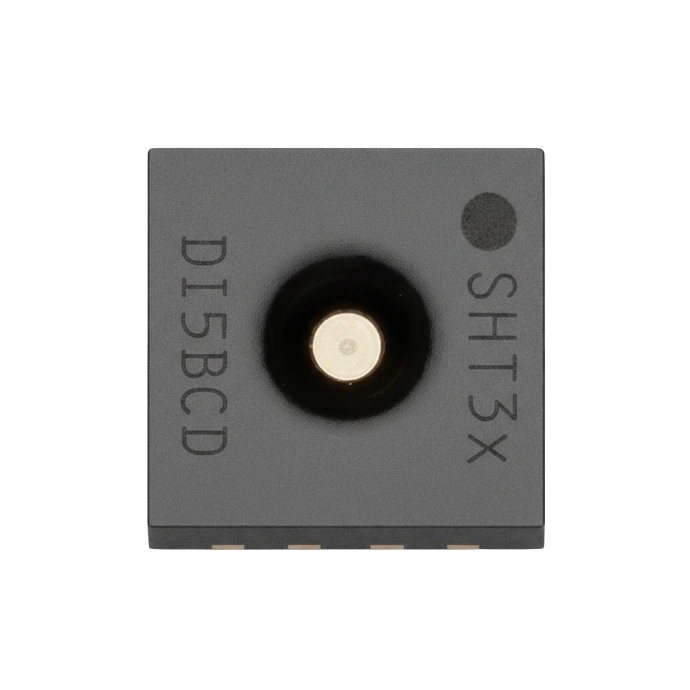
The Si7051 is a precision digital temperature sensor that uses the I²C bus to communicate directly with a microcontroller.

Based on patented CMOS technology, it offers exceptional long-term stability and laboratory-grade accuracy in a tiny form factor.

It is often used as a reference sensor in:

  • low-power IoT systems,
  • medical connected devices,
  • data loggers and calibration devices.

Operating principle


The sensor integrates:

  • an ultra-stable CMOS thermal detection element,
  • a 14-bit analog-to-digital converter,
  • and an internal processor that applies the calibration curve stored in EEPROM.

The temperature is calculated from a raw code (Tcode) according to the formula provided by Silicon Labs:

T(°C) = (175,72 × T_code) / 2¹⁶ − 46,85

💡 The calibration coefficients are factory integrated and guaranteed across the entire range.

Voltage / Temperature Curve


The Si7051 does not output an analog voltage, but we can visualize the equivalent digital curve:

T (°C) Binary code (on 16 bits)
−40 0x0000
0 0x3A70
+25 0x61A0
+85 0xC000
+125 0xF320

💡 The relationship is almost linear, ideal for digital processing without recalibration.

Operating principle


#include <Wire.h> #define SI7051_ADDR 0x40 #define CMD_MEASURE_TEMP 0xF3 void setup() { Serial.begin(9600); Wire.begin(); } void loop() { Wire.beginTransmission(SI7051_ADDR); Wire.write(CMD_MEASURE_TEMP); Wire.endTransmission(); delay(15); Wire.requestFrom(SI7051_ADDR, 2); uint16_t raw = (Wire.read() << 8) | Wire.read(); float tempC = ((175.72 * raw) / 65536.0) - 46.85; Serial.print("Température : "); Serial.print(tempC, 2); Serial.println(" °C"); delay(1000); }

✅ Example of result:

Temperature: 23.72 °C

Principle diagram (I2C connection)


+3.3V │ [Si7051] │ SDA ───────┐ │ SCL ───────┤── MCU (Arduino, STM32, ESP32…) │ GND

💡 4.7 kΩ pull-up resistors recommended on SDA/SCL.

Application areas


🧠 Medical equipment and wearables

🏭 Precise industrial measurements

🧪 Instrumentation and calibration

🌿 IoT sensors and connected objects

🔋 Battery-powered systems


Should I choose a Si7051 sensor ?

Strengths points

  • 🎯 Deadly accuracy
    → ±0.1 K over the useful range – comparable to a Pt100 class A sensor.
  • 🔋 Ultra low power consumption→ Ideal for long-lasting battery devices.
  • 🧠 Factory calibration
    → No correction needed: ready to use.
  • ⚙️ Universal I²C Integration
    → Compatible with all modern microcontrollers.
Si7051 probes

Weaknesses points

  • 💰 Higher cost than consumer sensors
    → But justified by its metrological precision.
  • 🌡️ No humidity or pressure measurement
    → It is a purely thermal sensor.
  • 📏 Tiny package (DFN)
    → Requires good PCB routing or pre-assembled module.

Useful information

Here is some useful information regarding the Si7051 sensors.

Brooch
Name
Description
1 VDD 1,9–3,6 V
2 GND Mass
3 SDA I²C Data
4 SCL I²C Clock
💡 On breakout modules, pull-up resistors are often integrated.
Command (hex) Description
0xE3 Measure temperature (hold master)
0xF3 Measure temperature (no hold)
0xE0 Firmware reading
0xFE Sensor reset
0xFA 0x0F Reading of the electronic ID

3.3V ─────────┐ │ [Si7051] │ SDA ─────┐ │ SCL ─────┤── MCU │ GND

💡 The fixed I²C address (0x40) simplifies the configuration.

Temperature (°C) Typical error (K) Annual drift
−40 ±0,2 < 0,02 K/an
0 ±0,1 < 0,02 K/an
+25 ±0,1 < 0,02 K/an
+85 ±0,15 < 0,02 K/an
+125 ±0,2 < 0,02 K/an

💡 Exemplary long-term stability, without recalibration.

The output is perfectly linear between −40 °C and +125 °C, which allows for:

T(code) = a · T_réelle + b

with a≈1.000 and b≈0.0

💡 No compensation needed even after several years of use.

 We integrate any sensor into any probe 

Smooth tube probe

 Smooth tube 

Waterproof probe

 Waterproof

Bayonet probe

 Bayonet

Slot probe

 Slot

Ambient probe

 Atmosphere

Head connection probe

Termal block

Stick-in probe

Stick-in

Thread probe

Thread

Contact probe

Contact

Jacketed probe

Jacketed

PCBA Design

PCBA design

Winding probe

Winding

More than 1,000,000 probes delivered in 2025

Contact us for a personalized offer

Contact Us

Need a Si7051 sensor?

Whether you need a few parts for a prototype or several hundred for a production line, we support you at every step.

Submit
Collegamenti utili
  • Casa
  • Chi Siamo
  • Lavori
  • Note Legali
  • Informativa sulla Privacy
  • Contattaci
Chi siamo

Presso Guilcor, la nostra missione è fornire a ogni cliente una soluzione di misurazione perfettamente adatta alle proprie esigenze specifiche. Con il pieno controllo sul design e sulla produzione, garantiamo la precisione e l'affidabilità dei nostri sensori anche negli ambienti più esigenti.

L'eccellenza tecnica e la soddisfazione del cliente sono al centro di tutto ciò che facciamo.

Entra in contatto con noi
  • Contattaci
  • contact@guilcor.com
Seguici

Politica sui cookie

Usiamo cookie per garantirti la migliore esperienza utente sul nostro sito web. Informativa sui cookie

Solo essenziali Accetto