Ir al contenido
guilcor.com
  • Sondas
    Smooth tube probe

    Tubo liso

    Refrigerador, bomba de calor, horno, congelador, calentador de agua
    Contact probe

    Contacto

    Tubería, superficie de tubería, placa calefactora
    Slot probe

    Ranura

    Motor, alternador, bobinado, estator
    Head connection probe

    Cabezal de conexión

    Caldera, bomba de calor, aire acondicionado, salas técnicas, ventilación
    Waterproof probe

    Impermeable

    Aire acondicionado, ventilación, refrigeración, almacenamiento en frío, conductos
    Stick-in probe

    Inserción

    Horno, cocción, equipos de procesamiento de alimentos
    Winding probe

    Bobinado

    Motor, alternador, transformador, bobinado, estator
    Ambient probe

    Ambiente

    Caldera, bomba de calor, aire acondicionado, salas técnicas, ventilación
    Thread probe

    Con racor

    Máquina de café, caldera, vapor, fluido presurizado
    Jacketed probe

    Envainadas

    Instalaciones industriales, aplicaciones de alta resistencia
    Bayonet probe

    Bayoneta

    Moldeo de plástico, herramientas, máquina de moldeo por inyección, motor, alternador
    PCBA Design

    Diseño de PCBA

    Aplicación específica, electrónica embebida, placas electrónicas personalizadas
  • Sensores

    RTD

    Pt10, Pt50, Pt100, Pt200, Pt500, Pt1000, Pt5000, Ni100, Ni120, Cu10, Cu50, Balco

    PTC

    KTY81-110, KTY81-210, KTY83-110, KTY84-130, PTC130, Silistor, TFPT, MZ6, MZ8, MZ9

    1-Wire

    DS18B20, DS18S20, DS1822, DS28EA00, DS18B20-PAR, DS1920, DS2438, DS1835...

    Termopar

    B, E, J, K, N, R, S, T, C, D, G

    UART

    MLX90614, MLX90615, GY-906, DHT11, DHT22, AM2302, SHT75, SHT85, RS232, RS485

    SPI

    MAX6675, MAX31855, MAX31856, MCP3208, TMP125, TMP121, ADT7310, LTC2983...

    NTC

    1kΩ, 2kΩ, 3kΩ, 5kΩ, 10kΩ, 15kΩ, 20kΩ, 30kΩ, 50kΩ, 100kΩ, 200kΩ, 470kΩ, 1MΩ

    I²C

    TMP102, TMP117, LM75, LM73, MCP9808, MCP9600, SHT31, SHTC3, SHT85, BME280, BME688, HTU21D, HDC1080, Si7051, ADT7410, STTS751, TCN75A...
  • Sobre nosotros
  • 0
  • 0
  • Síganos
  • English (US) Français Español
  • Iniciar sesión
  • Contáctenos
guilcor.com
  • 0
  • 0
    • Sondas
    • Sensores
    • Sobre nosotros
  • Síganos
  • English (US) Français Español
  • Iniciar sesión
  • Contáctenos

 Type E 
 Temperature sensors 

High-sensitivity thermocouple delivering accurate measurements at low to moderate temperatures, ideal for cryogenic and industrial use.

 Maximum precision
+/- 1,5°K

 Minimum temperature
-200°C

 Maximum temperature
+900°C

 Minimum dimensions
0,5 x 30 x 3

 Response time
High

 Internal Resistance
Medium

 Linearity
High

Price
Medium

What is a Type E thermocouple ?Operating principleTechnical specificationsVoltage / Temperature CurveCompatibility / CompensationApplication areas

What is a Type E thermocouple ?


The type E thermocouple combines nickel-chrome (Chromel) and nickel-constantan (Constantan).

It is distinguished by its high sensitivity — the highest among common thermocouples — with approximately 68 µV/°C.

This makes it a very precise sensor for low temperatures, often used in laboratories, cryogenic systems, and precision testing devices.

Operating principle


Like all thermocouples, type E relies on the Seebeck effect: a temperature difference between the hot junction and the cold junction generates a measurable voltage.

E = Se × (T_hot - T_cold)

For type E:

S_E ≈ 68 µV/°C (around 0 °C)
→ which is about 6.8 mV for a 100 °C difference.

It produces about 61 mV at 1,000 °C, which is a sensitivity 30% higher than type K.

Technical specifications


Parameter
Typical Value
Measurement range −270 → +1 000 °C
Sensitivity 68 µV/°C to 0 °C
Tension at 1,000 °C ≈ 61,0 mV
Linearity ±0.4 °C over the useful range
Materials Chromel (NiCr) / Constantan (CuNi)
Oxidation resistance Medium
Response time (6 mm diameter sheath) 1 s (liquid) / 3 s (air)
Reference standard IEC 60584-1, ASTM E230

Voltage / Temperature Curve


(Reference: cold junction at 0 °C — IEC 60584-1 standard)

The relationship between temperature and the generated voltage is nearly linear over the useful measurement range (−200 to +900 °C).

Here is an overview of the typical curve 👇

📈 General behavior:

  • From −200 °C to 0 °C → negative voltage, rapid variation (~−8.8 mV to 0 mV)
  • From 0 °C to 900 °C → positive voltage, nearly linear (~0 to +55 mV)
  • Average slope: ≈ 68 µV/°C

💡 This linearity simplifies the voltage ↔ temperature conversion and reduces calculation errors in digital systems.

Compatibility / Compensation


The E type requires a cold weld compensation above ±1 °C of ambient variation.

It is compatible with most SPI/I²C measurement modules (MAX31855-E, MAX6675, AD8495E, etc.).

Application areas


🧊 Cryogenics and cold rooms (-200 °C)

🧪 Laboratories and precision test benches

⚙️ Scientific and thermal instrumentation

🧱 Light industrial applications up to 900 °C

🚀 Aerospace instrumentation / light propulsion
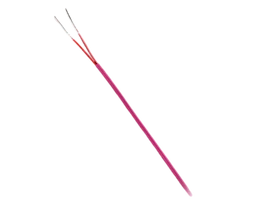


Should I choose a Type E thermocouple ?

Strengths points

  • ⚡ Ultra-sensitive, even in the cold
    → The type E reacts to the slightest variation: perfect for fine measurements where other sensors are still inactive.
  • 🎯 Powerful and precise signal
    → Its high output amplitude limits errors due to electrical noise a real asset for digital measuring devices.
  • 🧊 Cut for the negative
    → It remains stable and usable down to −200 °C, where K or J types begin to drop off.
Thermocouple Type E sensors

Weaknesses points

  • 🔥 Bad companion of high temperatures
    → Beyond +900 °C, its accuracy drops and its conductors wear out quickly.
  • 💨 Sensitive to oxidation
    → The Chromel wire does not like humidity or oxidizing environments; it is better to protect it with a suitable sheath.
  • 🔌 Limited compatibility
    → Less common than other models, it requires specifically calibrated type E electronics to fully realize its potential.

Useful information

Here is some useful information regarding Type E thermocouples.

(Reference: cold junction at 0 °C — IEC 60584-1 standard)

Temperature (°C) Tension (mV) Temperature (°C) Tension (mV)
−200 −8,825 200 11,486
−100 −4,387 400 23,842
0 0,000 600 36,256
100 5,865 800 48,837
200 11,486 1 000 61,016

💡 Type E generates a voltage of about 61 mV at 1,000 °C, which is the highest of all standard thermocouples.

Class Tolerance (°C)
Operating temperature range (°C)
Typical usage
Class 1

±1,5 K

−40 → +800 °C

High precision

Class 2

±2,5 K

−200 → +900 °C

Industrial standard

Class 3

±2,5 K

−270 → +40 °C

Low temperature measurements (cryogenics)

🔹 Class 1 offers the best accuracy over a wide range, often used in scientific calibration.

🔸 Example 1 – Calculation of the generated voltage

Measured temperature = 600 °C

Cold weld = 25 °C

E_measured = E(600) - E(25)

E_measured = 36.256 - 1.613 = 34.643 mV

✅ Measured voltage ≈ 34.64 mV


🔸 Example 2 – Calculating temperature from a voltage

Measured voltage = 11.486 mV

Cold junction at 0 °C

→ Referring to the IEC table, this corresponds to:

T=200°C

✅ Measured temperature ≈ 200 °C

The type E thermocouple generates a voltage of a few tens of millivolts. It must be connected to a precise differential amplifier, with cold junction compensation and a high-resolution ADC (≥ 16 bits).

🔹 Typical components
Component
Function
Thermocouple type E (Chromel–Constantan)
Seebeck voltage source
Instrumentation amplifier (e.g. AD8495E, MAX31855E)
Amplify the differential tension
Compensation sensor (NTC or internal sensor)
Correct the reference temperature
ADC 16–24 bits Analog-to-digital conversion
Microcontroller
Linearization, display, final calculation
🔹 Functional diagram (ASCII)

​ [Hot junction]────┬────(+) Amplifier │ └────(−) Amplifier │ [ADC 24 bits] │ [Microcontroller] │ [Cold welding compensation]

💡 Thanks to its high sensitivity, type E is ideal for precise measurements at low temperatures while remaining economical and robust.

 We integrate any sensor into any probe 

Smooth tube probe

 Smooth tube 

Waterproof probe

 Waterproof

Bayonet probe

 Bayonet

Slot probe

 Slot

Ambient probe

 Atmosphere

Head connection probe

Termal block

Stick-in probe

Stick-in

Thread probe

Thread

Contact probe

Contact

Jacketed probe

Jacketed

PCBA Design

PCBA design

Winding probe

Winding

More than 1,000,000 probes delivered in 2025

Contact us for a personalized offer

Contact Us

Need a Type E sensor?

Whether you need a few parts for a prototype or several hundred for a production line, we support you at every step.


Submit
Enlaces útiles
  • Inicio
  • Sobre nosotros
  • Empleos
  • Avisos legales
  • Política de privacidad
  • Contáctenos
Sobre nosotros

At Guilcor, our mission is clear: to provide every client with a measurement solution perfectly suited to their specific needs.With full control over design and manufacturing, we ensure the precision and reliability of our sensors in even the most demanding environments.

La excelencia técnica y la satisfacción del cliente están en el corazón de todo lo que hacemos.

Contáctenos
  • Contáctenos
  • contact@guilcor.com
Síganos