Passa al contenuto
guilcor.com
  • Home
  • Prove
    Sonda a tubo liscio

    Tubo Liscio

    Frigorifero, pompa di calore, forno, congelatore, scaldabagno
    Sonda di contatto

    Contatto

    Tubo, superficie del tubo, piastra riscaldante
    Sonda a fessura

    Fessura

    Motore, alternatore, avvolgimento, statore
    Sonda di connessione testa

    Testa di connessione

    Caldaia, pompa di calore, aria condizionata, locali tecnici, ventilazione
    Sonda impermeabile

    Impermeabile

    Aria condizionata, ventilazione, refrigerazione, stoccaggio a freddo, condotti
    Sonda da infilare

    Infilare

    Forno, cottura, attrezzature per la lavorazione degli alimenti
    Sonda di avvolgimento

    Avvolgimento

    Motore, alternatore, trasformatore, avvolgimento, statore
    Sonda ambientale

    Ambientale

    Caldaia, pompa di calore, aria condizionata, locali tecnici, ventilazione
    Sonda a filettatura

    Filettatura

    Macchina da caffè, caldaia, vapore, fluido pressurizzato
    Sonda giacketata

    Giacketata

    Installazioni industriali, applicazioni pesanti
    Sonda a baionetta

    Baionetta

    Stampaggio plastico, attrezzature, macchina per stampaggio ad iniezione, motore, alternatore
    Progettazione PCBA

    progettazione PCBA

    Applicazione specifica, elettronica integrata, schede elettroniche personalizzate
  • Sensori

    RTD

    Pt10, Pt50, Pt100, Pt200, Pt500, Pt1000, Pt5000, Ni100, Ni120, Cu10, Cu50, Balco

    PTC

    KTY81-110, KTY81-210, KTY83-110, KTY84-130, PTC130, Silistor, TFPT, MZ6, MZ8, MZ9

    1-Wire

    DS18B20, DS18S20, DS1822, DS28EA00, DS18B20-PAR, DS1920, DS2438, DS1835...

    Termocoppia

    B, E, J, K, N, R, S, T, C, D, G

    UART

    MLX90614, MLX90615, GY-906, DHT11, DHT22, SHT75, SHT85, RS232, RS485

    SPI

    MAX6675, MAX31855, MAX31856, MCP3208, TMP125, TMP121, ADT7310, LTC2983...

    NTC

    1kΩ, 2kΩ, 3kΩ, 5kΩ, 10kΩ, 15kΩ, 20kΩ, 30kΩ, 50kΩ, 100kΩ, 200kΩ, 470kΩ, 1MΩ

    I²C

    TMP102, TMP117, LM75, LM73, MCP9808, MCP9600, SHT31, SHTC3, BME280, BME688, HTU21D, HDC1080, Si7051, ADT7410, STTS751, TCN75A...
  • Chi siamo
  • 0
  • 0
  • Seguici
  • English (US) Français Italiano Español
  • Accedi
  • Contattaci
guilcor.com
  • 0
  • 0
    • Home
    • Prove
    • Sensori
    • Chi siamo
  • Seguici
  • English (US) Français Italiano Español
  • Accedi
  • Contattaci

 LM75 
 Temperature sensors 

Industry-standard I²C temperature sensor for reliable thermal monitoring in electronics and control systems.

 Maximum precision
+/- 2,0°K

 Measurement range
-55 / 125°C

 Resolution
9 bits

 Power supply voltage
2,7 → 5,5V

Conversion speed

100mS

I2C adress
0 x 48

 Typical current
250µA(active)

 Price
Low

What is a LM75 sensor ?Operating principleTemperature curve / numerical value (12-bit resolution)Principle diagram (I2C connection)Application areas

What is a LM75 sensor ?


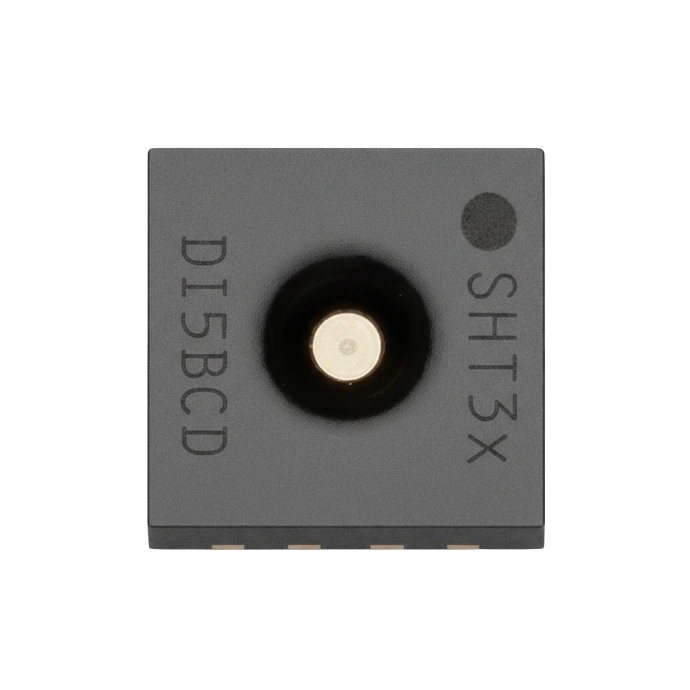
The LM75 is a very simple digital temperature sensor, originally developed by National Semiconductor and now produced by several manufacturers (TI, NXP, ST…).

It is one of the first sensors with I²C output, still widely used for its reliability, low cost, and universal compatibility.

It directly provides the temperature in digital form on 9 bits, with a resolution of 0.5 °C and an SMBus / I²C compatible interface.

Operating principle


The LM75 measures temperature using an integrated silicon diode, whose threshold voltage decreases proportionally to the temperature.

This voltage is digitized by an internal 9-bit ADC and then transmitted via the I²C bus.

The most significant bit (MSB) indicates the sign (negative or positive temperature).

​T(°C) = Binare code x 0,5

Example:

0x19 → 25 × 0.5 = 12.5 °C

Temperature curve / numerical value (12-bit resolution)


Temperature (°C)
Numerical value (hex)

Binary output (12bits)

-25

0xFE7

1111 1110 0111

0 0x0000

0000 0000 0000

25

0x019

0000 0001 1001

50 0x032

0000 0011 0010

100

0x064

0000 0110 0100

125

0x07D

0000 0111 1101

💡 Each bit represents 0.5 °C. The format is signed on 9 bits (negative values are encoded in two's complement).

Principle diagram (I2C connection)


+3.3V │ [LM75] │ SDA ─────────┐ │ SCL ─────────┤── [I²C Microcontroller] │ OS (alerte) ─┘ │ GND

💡 The A0–A2 pins allow you to change the I²C address to connect up to 8 LM75 on the same bus.

Application areas


🧠 Electronic cards and microcontrollers

⚙️ Thermal monitoring of embedded systems

🔋 Thermal management of batteries and power supplies

🧪 Basic environmental measurements (HVAC, home automation)


Should I choose a LM75 sensor ?

Strengths points

  • 💰 Unbeatable value for money
    → It is one of the most cost-effective I²C digital sensors on the market.
  • ⚙️ Ease of integration
    → No calibration required, compatible with native SMBus and I²C.
  • 🔋 Low consumption
    → Less than 1 µA in standby, perfect for low-power systems.
LM75 sensors

Weaknesses points

  • 🌡️ Limited resolution (0.5 °C)
    → Unsuitable for applications requiring fine precision (replaced by TMP117, MCP9808…).
  • 📡 Slow communication
    → Modest sampling rate (~100 ms), insufficient for dynamic measurements.
  • 🌬️ Sensitive to parasitic heat
    → May be influenced by the thermal dissipation of the circuit to which it is soldered.

Useful information

Here is some useful information regarding the LM75 sensors.

Adress Registry Name
Function
0x00 Temperature Register Contains the temperature measurement (9 signed bits)
0x01 Configuration Register Activate the alert, sleep mode, or polarity
0x02 T_HYST Register Hysteresis temperature (low threshold)
0x03 T_OS Register Alert trigger temperature

i2c_start(); i2c_write(0x48 << 1); // Adress LM75 i2c_write(0x00); // Temperature log i2c_start(); i2c_write((0x48 << 1) | 1); MSB = i2c_read_ack(); LSB = i2c_read_nack(); i2c_stop(); // Signed 9-bit data: raw = (MSB << 1) | (LSB >> 7); if (raw > 255) raw -= 512; // Sign management temp = raw * 0.5;

✅ Example:

MSB = 0x19, LSB = 0x00

→ (0x19 << 1) = 0x32 → temp = 25.0 °C

+3.3V ───────────┐ │ [LM75] │ SDA ───────┐ │ SCL ───────┤── MCU (Arduino, ESP32, STM32…) │ OS ────────┘ (alert exit) │ GND

💡 Plan for pull-up resistors of 4.7 kΩ on SDA/SCL, and possibly a resistor on OS if the comparator mode is enabled.

If the temperature register contains 0x19:

T=0x19×0.5=25.0°CT = 0x19 \times 0.5 = 25.0 °CT=0x19×0.5=25.0°C

If the temperature falls below the threshold defined by T_HYST, the OS pin is activated (alarm mode).

Temperature (°C) Max error (LM75) Max error (LM75A/B)
−40 ±2,5 K ±1,0 K
0 ±2,0 K ±0,75 K
50 ±1,5 K ±0,5 K
100 ±2,0 K ±0,75 K
125 ±3,0 K ±1,0 K

💡 The LM75A/B offers better accuracy and the same pinout as the standard LM75.

 We integrate any sensor into any probe 

Smooth tube probe

 Smooth tube 

Waterproof probe

 Waterproof

Bayonet probe

 Bayonet

Slot probe

 Slot

Ambient probe

 Atmosphere

Head connection probe

Termal block

Stick-in probe

Stick-in

Thread probe

Thread

Contact probe

Contact

Jacketed probe

Jacketed

PCBA Design

PCBA design

Winding probe

Winding

More than 1,000,000 probes delivered in 2025

Contact us for a personalized offer

Contact Us

Need a LM75 sensor?

Whether you need a few parts for a prototype or several hundred for a production line, we support you at every step.

Submit
Collegamenti utili
  • Casa
  • Chi Siamo
  • Lavori
  • Note Legali
  • Informativa sulla Privacy
  • Contattaci
Chi siamo

Presso Guilcor, la nostra missione è fornire a ogni cliente una soluzione di misurazione perfettamente adatta alle proprie esigenze specifiche. Con il pieno controllo sul design e sulla produzione, garantiamo la precisione e l'affidabilità dei nostri sensori anche negli ambienti più esigenti.

L'eccellenza tecnica e la soddisfazione del cliente sono al centro di tutto ciò che facciamo.

Entra in contatto con noi
  • Contattaci
  • contact@guilcor.com
Seguici

Politica sui cookie

Usiamo cookie per garantirti la migliore esperienza utente sul nostro sito web. Informativa sui cookie

Solo essenziali Accetto