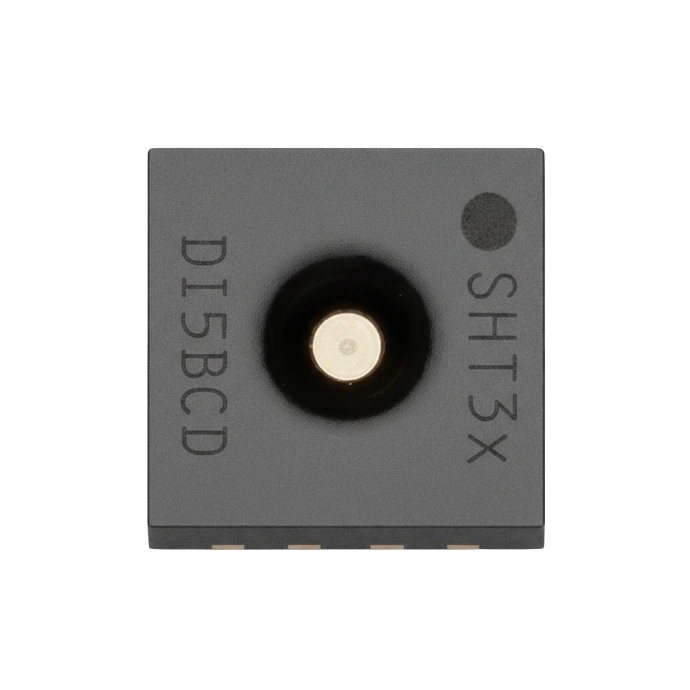
What is a LM75 sensor ?
The LM75 is a very simple digital temperature sensor, originally developed by National Semiconductor and now produced by several manufacturers (TI, NXP, ST…).
It is one of the first sensors with I²C output, still widely used for its reliability, low cost, and universal compatibility.
It directly provides the temperature in digital form on 9 bits, with a resolution of 0.5 °C and an SMBus / I²C compatible interface.
Operating principle
The LM75 measures temperature using an integrated silicon diode, whose threshold voltage decreases proportionally to the temperature.
This voltage is digitized by an internal 9-bit ADC and then transmitted via the I²C bus.
The most significant bit (MSB) indicates the sign (negative or positive temperature).
T(°C) = Binare code x 0,5
Example:
0x19 → 25 × 0.5 = 12.5 °C
Temperature curve / numerical value (12-bit resolution)
| Temperature (°C) |
Numerical value (hex) | Binary output (12bits) |
-25 |
0xFE7 | 1111 1110 0111 |
| 0 | 0x0000 | 0000 0000 0000 |
25 | 0x019 | 0000 0001 1001 |
| 50 | 0x032 | 0000 0011 0010 |
100 | 0x064 | 0000 0110 0100 |
125 | 0x07D | 0000 0111 1101 |
💡 Each bit represents 0.5 °C. The format is signed on 9 bits (negative values are encoded in two's complement).
Principle diagram (I2C connection)
+3.3V
 │
[LM75]
 │ SDA ─────────┐
 │ SCL ─────────┤── [I²C Microcontroller]
 │ OS (alerte) ─┘
 │ GND
💡 The A0–A2 pins allow you to change the I²C address to connect up to 8 LM75 on the same bus.
Application areas
🧠 Electronic cards and microcontrollers
⚙️ Thermal monitoring of embedded systems
🔋 Thermal management of batteries and power supplies
🧪 Basic environmental measurements (HVAC, home automation)