Passa al contenuto
guilcor.com
  • Home
  • Prove
    Sonda a tubo liscio

    Tubo Liscio

    Frigorifero, pompa di calore, forno, congelatore, scaldabagno
    Sonda di contatto

    Contatto

    Tubo, superficie del tubo, piastra riscaldante
    Sonda a fessura

    Fessura

    Motore, alternatore, avvolgimento, statore
    Sonda di connessione testa

    Testa di connessione

    Caldaia, pompa di calore, aria condizionata, locali tecnici, ventilazione
    Sonda impermeabile

    Impermeabile

    Aria condizionata, ventilazione, refrigerazione, stoccaggio a freddo, condotti
    Sonda da infilare

    Infilare

    Forno, cottura, attrezzature per la lavorazione degli alimenti
    Sonda di avvolgimento

    Avvolgimento

    Motore, alternatore, trasformatore, avvolgimento, statore
    Sonda ambientale

    Ambientale

    Caldaia, pompa di calore, aria condizionata, locali tecnici, ventilazione
    Sonda a filettatura

    Filettatura

    Macchina da caffè, caldaia, vapore, fluido pressurizzato
    Sonda giacketata

    Giacketata

    Installazioni industriali, applicazioni pesanti
    Sonda a baionetta

    Baionetta

    Stampaggio plastico, attrezzature, macchina per stampaggio ad iniezione, motore, alternatore
    Progettazione PCBA

    progettazione PCBA

    Applicazione specifica, elettronica integrata, schede elettroniche personalizzate
  • Sensori

    RTD

    Pt10, Pt50, Pt100, Pt200, Pt500, Pt1000, Pt5000, Ni100, Ni120, Cu10, Cu50, Balco

    PTC

    KTY81-110, KTY81-210, KTY83-110, KTY84-130, PTC130, Silistor, TFPT, MZ6, MZ8, MZ9

    1-Wire

    DS18B20, DS18S20, DS1822, DS28EA00, DS18B20-PAR, DS1920, DS2438, DS1835...

    Termocoppia

    B, E, J, K, N, R, S, T, C, D, G

    UART

    MLX90614, MLX90615, GY-906, DHT11, DHT22, SHT75, SHT85, RS232, RS485

    SPI

    MAX6675, MAX31855, MAX31856, MCP3208, TMP125, TMP121, ADT7310, LTC2983...

    NTC

    1kΩ, 2kΩ, 3kΩ, 5kΩ, 10kΩ, 15kΩ, 20kΩ, 30kΩ, 50kΩ, 100kΩ, 200kΩ, 470kΩ, 1MΩ

    I²C

    TMP102, TMP117, LM75, LM73, MCP9808, MCP9600, SHT31, SHTC3, BME280, BME688, HTU21D, HDC1080, Si7051, ADT7410, STTS751, TCN75A...
  • Chi siamo
  • 0
  • 0
  • Seguici
  • English (US) Français Italiano Español
  • Accedi
  • Contattaci
guilcor.com
  • 0
  • 0
    • Home
    • Prove
    • Sensori
    • Chi siamo
  • Seguici
  • English (US) Français Italiano Español
  • Accedi
  • Contattaci

 NI120 
 Temperature sensors 

Ni120 temperature sensors provide enhanced sensitivity compared to Ni100, commonly used in HVAC and control applications.

 Maximum precision
±0.15°K

 Minimum temperature
-60°C

 Maximum temperature
+180°C

 Minimum dimensions
1,5 x 5 x 15

 Response time
Fast

 Self-heating
Low

 Price
Medium

Drift
Low

What is a Ni120 sensor ?Operating principleTechnical specificationsWiring configurationSelf-heatingApplication areas

What is a Ni120 sensor ?


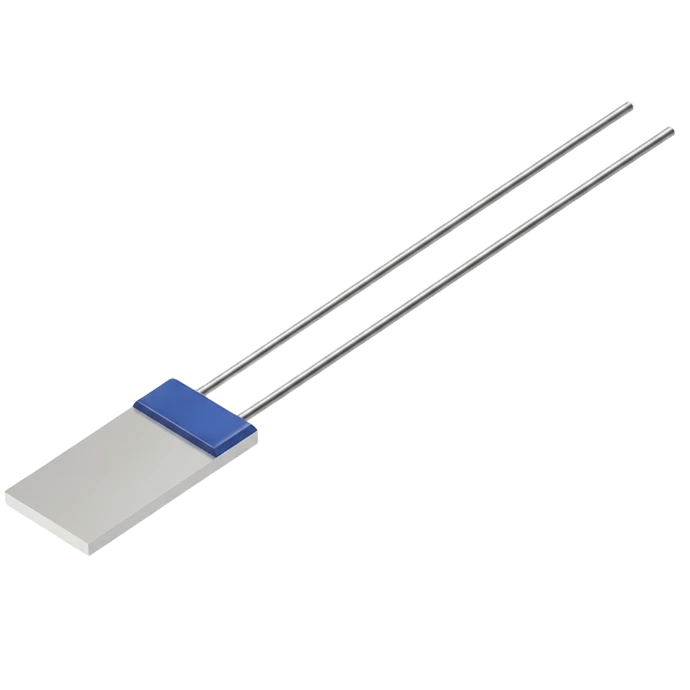
 The Ni120 is a pure nickel resistance probe with a nominal resistance of 120 Ω at 0 °C.

It is a variant of the Ni100, providing a slightly higher signal for the same excitation, and better stability over long measurement lines.

Widely used in HVAC temperature control systems, test benches, and embedded electronic equipment, it combines sensitivity, response speed, and controlled cost.

Operating principle

The operation is based on the variation of the resistance of pure nickel according to temperature:

R(T) = R₀ (1 + αT + βT²)

avec :

  • R₀ = 120 Ω

  • α = 6,18 × 10⁻³

  • β = 1,4 × 10⁻⁵

This equation is quasi-linear between -60 °C and +180 °C, ensuring good accuracy without complex correction.

Technical specifications


Parameter
Typical Value
Nominal resistance at 0 °C 120 Ω
Temperature coefficient (α) 0,00618 °C⁻¹
Measurement range −60 °C to +180 °C
Linearity Very good
Element material Pure nickel
Typical measuring current 0,1 to 0,3 mA
Response time 0,3 s
 Long-term drift < 0,1 °C/year

Wiring configuration


Type
Description

Precision

2-wire

Simple, sufficient for short applications.

✅ Good

3-wire

Compensate for the cable's resistance.

🏆 Excellent

4-wire

Rarely necessary.

💡 Very precise

Self-heating


Thanks to its superior resistance, the Ni120 requires a lower current to achieve the same voltage as a Ni100.

Self-heating remains below 0.03 °C, even in stagnant environments.

Application areas


🌡️ HVAC and thermal automation

⚙️ Medium precision industrial instrumentation

🚗 Automotive embedded control

🧪 Test benches and electronic monitoring

🧰 Economical measuring devices

Should I choose a Ni120 sensor ?

Strengths points

  • ⚡ Signal stronger than the Ni100
    → With 120 Ω at 0 °C, the Ni120 generates a higher output voltage, which improves measurement resolution and reduces noise without the need for an amplifier.
  • 🧠 Natural linearity
    → The R/T curve is nearly linear over the range of -60 °C to +180 °C, simplifying calculations and integration into measurement systems.
  • 💶 Economic and precise solution
    → It is an excellent compromise between cost and performance, ideal for HVAC, automotive, or industrial systems with a controlled budget.
Ni120 Sensors

Weaknesses points

  • 🌡️ Not suitable for extreme temperatures
    → The limited operating temperature range (−60 °C to +180 °C) makes it incompatible with cryogenic or high-temperature environments.
  • 🧪 Sensitive to oxidation
    → Nickel degrades faster than platinum at high temperatures, reducing long-term stability.
  • 📏 Less standardized than the Pt100
    → Not all regulators recognize the Ni120 without specific configuration, which can complicate integration.

Useful information

Here is some useful information regarding the Ni120 sensors.

Temp (°C) 0 1 2 3 4 5 6 7 8 9
0 120.00 120.74 121.48 122.23 122.97 123.71 124.46 125.20 125.95 126.69
10 127.44 128.18 128.93 129.67 130.42 131.16 131.91 132.65 133.40 134.14
20 134.89 135.63 136.38 137.12 137.87 138.61 139.36 140.10 140.85 141.59
30 142.34 143.08 143.83 144.57 145.32 146.06 146.81 147.55 148.30 149.04
40 149.79 150.53 151.28 152.02 152.77 153.51 154.26 155.00 155.75 156.49
50 157.24 157.98 158.73 159.47 160.22 160.96 161.71 162.45 163.20 163.94
60 164.69 165.43 166.18 166.92 167.67 168.41 169.16 169.90 170.65 171.39
70 172.14 172.88 173.63 174.37 175.12 175.86 176.61 177.35 178.10 178.84
80 179.59 180.33 181.08 181.82 182.57 183.31 184.06 184.80 185.55 186.29
90 187.04 187.78 188.53 189.27 190.02 190.76 191.51 192.25 193.00 193.74
100 194.49 195.23 195.98 196.72 197.47 198.21 198.96 199.70 200.45 201.19
110 201.94 202.68 203.43 204.17 204.92 205.66 206.41 207.15 207.90 208.64
120 209.39 210.13 210.88 211.62 212.37 213.11 213.86 214.60 215.35 216.09
130 216.84 217.58 218.33 219.07 219.82 220.56 221.31 222.05 222.80 223.54
140 224.29 225.03 225.78 226.52 227.27 228.01 228.76 229.50 230.25 230.99
150 231.74 232.48 233.23 233.97 234.72 235.46 236.21 236.95 237.70 238.44
160 239.19 239.93 240.68 241.42 242.17 242.91 243.66 244.40 245.15 245.89
170 246.64 247.38 248.13 248.87 249.62 250.36 251.11 251.85 252.60 253.34
180 254.09 254.83 255.58 256.32 257.07 257.81 258.56 259.30 260.05 260.79

Temperature (°C) Class B (±°C) Class A (±°C) 1/3 B (DIN) (±°C) 1/10 B (DIN) (±°C)
−60 0.60 0.27 0.20 0.06
−50 0.55 0.25 0.18 0.06
−40 0.50 0.23 0.17 0.05
−30 0.45 0.21 0.15 0.04
−20 0.40 0.19 0.13 0.04
−10 0.35 0.17 0.12 0.04
0 0.30 0.15 0.10 0.03
10 0.35 0.17 0.12 0.04
20 0.40 0.19 0.13 0.04
30 0.45 0.21 0.15 0.05
40 0.50 0.23 0.17 0.05
50 0.55 0.25 0.18 0.06
60 0.60 0.27 0.20 0.06
70 0.65 0.29 0.22 0.07
80 0.70 0.31 0.23 0.07
90 0.75 0.33 0.25 0.08
100 0.80 0.35 0.27 0.08
110 0.85 0.37 0.28 0.09
120 0.90 0.39 0.30 0.09
130 0.95 0.41 0.32 0.10
140 1.00 0.43 0.33 0.10
150 1.05 0.45 0.35 0.11
160 1.10 0.47 0.37 0.11
170 1.15 0.49 0.38 0.12
180 1.20 0.51 0.40 0.12

The Ni120 follows a quadratic law between temperature and resistance, characteristic of nickel sensors:

R(T) = R₀ (1 + αT + βT²)

avec :

  • R₀ = 120 Ω

  • α = 6,18 × 10⁻³

  • β = 1,4 × 10⁻⁵

  • (valable entre −60 °C et +180 °C)

This simple equation allows for a direct conversion between the measured resistance and the temperature without complex correction.


🔹 Example 1: calculating the resistance at 100 °C

R(100) = 120 × [1 + 6,18 × 10⁻³ × 100 + 1,4 × 10⁻⁵ × 100²]

R(100) = 120 × (1 + 0,618 + 0,14) = 120 × 1,758 = 210,96 Ω

✅ Result: at 100 °C, the resistance of Ni120 is approximately 211 Ω.


🔹 Example 2: calculating the temperature from a measured resistance

We measure R=165Ω.

What is the corresponding temperature ?

βT² + αT + (1 − R/R₀) = 0

1,4 × 10⁻⁵ T² + 6,18 × 10⁻³ T + (1 − 165 / 100) = 0

1,4 × 10⁻⁵ T² + 6,18 × 10⁻³ T − 0,375 = 0

T = [−6,18 × 10⁻³ + √((6,18 × 10⁻³)² − 4 × 1,4 × 10⁻⁵ × (−0,375))] / (2 × 1,4 × 10⁻⁵)

T ≈ 57 °C

✅ Result: the equivalent temperature is approximately 57 °C.


🔹 Practical notes

  • The Ni120 equation is easy to implement on microcontrollers (Arduino, STM32, ESP32).
  • The stronger signal compared to the Ni100 improves resolution without increasing current.
  • Outside the range of −60 °C → +180 °C, non-linearity increases significantly, so it should be avoided.

The Ni120 is ideal for low-cost setups where the linearity of nickel is sufficient, while providing a signal that can be directly used by an analog-to-digital converter (ADC).

🔹 Typical assembly components

Composant Function
RTD Ni120 (2 or 3 wires)
Pure nickel sensitive element
Stable current source (~0.2 mA)
Feed the probe
Differential amplifier (INA333, AD620)
Amplify the signal
ADC 12 to 16 bits
Convert the voltage to a numerical value
Microcontroller (STM32, ESP32, Arduino)
Calculate T = f(R)
RC filtering / shielded wiring
Reduces EMI interference
🔹 Functional diagram (ASCII)

+3.3 V / +5 V │ Current source (0.2 mA) │ [ Ni120 ] (2 power wires + 1 measurement wire) │ │ │ │ Diff. amplifier ───→ ADC 16 bits │ [ Microcontroller ] (Calculation T = f(R) + display)

🔹 Operating Principle

1️⃣ A constant current flows through the RTD.

→ At 0 °C: V = 120 Ω × 0.2 mA = 24 mV

→ At 100 °C: V ≈ 211 Ω × 0.2 mA = 42 mV

2️⃣ The amplifier raises the voltage (gain ≈ 50 → output ≈ 2 V).

3️⃣ The microcontroller calculates the temperature from the resistance using the quadratic equation.

🔹 Best Practices

🧩 Use a 3-wire configuration to reduce line errors.

⚙️ Limit the current to ≤ 0.3 mA to avoid self-heating.

💧 Protect the probe in a stainless steel or ceramic housing if humidity is present.

🔄 Calibrate regularly at 0 °C and 100 °C.

🧲 Use an RC filter (1 kΩ / 100 nF) to stabilize the signal.

We integrate any sensor into any probe

Smooth tube probe

 Smooth tube 

Waterproof probe

 Waterproof

Bayonet probe

 Bayonet

Slot probe

 Slot

Ambient probe

 Atmosphere

Head connection probe

Termal block

Stick-in probe

Stick-in

Thread probe

Thread

Contact probe

Contact

Jacketed probe

Jacketed

PCBA Design

PCBA design

Winding probe

Winding

More than 1,000,000 probes delivered in 2025

Contact us for a personalized offer

Contact Us

Need a Ni120 sensor?

We design customized solutions tailored to your technical constraints, your volumes, and your objectives.


Submit
Collegamenti utili
  • Casa
  • Chi Siamo
  • Lavori
  • Note Legali
  • Informativa sulla Privacy
  • Contattaci
Chi siamo

Presso Guilcor, la nostra missione è fornire a ogni cliente una soluzione di misurazione perfettamente adatta alle proprie esigenze specifiche. Con il pieno controllo sul design e sulla produzione, garantiamo la precisione e l'affidabilità dei nostri sensori anche negli ambienti più esigenti.

L'eccellenza tecnica e la soddisfazione del cliente sono al centro di tutto ciò che facciamo.

Entra in contatto con noi
  • Contattaci
  • contact@guilcor.com
Seguici

Politica sui cookie

Usiamo cookie per garantirti la migliore esperienza utente sul nostro sito web. Informativa sui cookie

Solo essenziali Accetto