Passa al contenuto
guilcor.com
  • Home
  • Prove
    Sonda a tubo liscio

    Tubo Liscio

    Frigorifero, pompa di calore, forno, congelatore, scaldabagno
    Sonda di contatto

    Contatto

    Tubo, superficie del tubo, piastra riscaldante
    Sonda a fessura

    Fessura

    Motore, alternatore, avvolgimento, statore
    Sonda di connessione testa

    Testa di connessione

    Caldaia, pompa di calore, aria condizionata, locali tecnici, ventilazione
    Sonda impermeabile

    Impermeabile

    Aria condizionata, ventilazione, refrigerazione, stoccaggio a freddo, condotti
    Sonda da infilare

    Infilare

    Forno, cottura, attrezzature per la lavorazione degli alimenti
    Sonda di avvolgimento

    Avvolgimento

    Motore, alternatore, trasformatore, avvolgimento, statore
    Sonda ambientale

    Ambientale

    Caldaia, pompa di calore, aria condizionata, locali tecnici, ventilazione
    Sonda a filettatura

    Filettatura

    Macchina da caffè, caldaia, vapore, fluido pressurizzato
    Sonda giacketata

    Giacketata

    Installazioni industriali, applicazioni pesanti
    Sonda a baionetta

    Baionetta

    Stampaggio plastico, attrezzature, macchina per stampaggio ad iniezione, motore, alternatore
    Progettazione PCBA

    progettazione PCBA

    Applicazione specifica, elettronica integrata, schede elettroniche personalizzate
  • Sensori

    RTD

    Pt10, Pt50, Pt100, Pt200, Pt500, Pt1000, Pt5000, Ni100, Ni120, Cu10, Cu50, Balco

    PTC

    KTY81-110, KTY81-210, KTY83-110, KTY84-130, PTC130, Silistor, TFPT, MZ6, MZ8, MZ9

    1-Wire

    DS18B20, DS18S20, DS1822, DS28EA00, DS18B20-PAR, DS1920, DS2438, DS1835...

    Termocoppia

    B, E, J, K, N, R, S, T, C, D, G

    UART

    MLX90614, MLX90615, GY-906, DHT11, DHT22, SHT75, SHT85, RS232, RS485

    SPI

    MAX6675, MAX31855, MAX31856, MCP3208, TMP125, TMP121, ADT7310, LTC2983...

    NTC

    1kΩ, 2kΩ, 3kΩ, 5kΩ, 10kΩ, 15kΩ, 20kΩ, 30kΩ, 50kΩ, 100kΩ, 200kΩ, 470kΩ, 1MΩ

    I²C

    TMP102, TMP117, LM75, LM73, MCP9808, MCP9600, SHT31, SHTC3, BME280, BME688, HTU21D, HDC1080, Si7051, ADT7410, STTS751, TCN75A...
  • Chi siamo
  • 0
  • 0
  • Seguici
  • English (US) Français Italiano Español
  • Accedi
  • Contattaci
guilcor.com
  • 0
  • 0
    • Home
    • Prove
    • Sensori
    • Chi siamo
  • Seguici
  • English (US) Français Italiano Español
  • Accedi
  • Contattaci

 PTC130 
 Temperature sensors 

Versatile PTC temperature sensor designed for circuit protection and reliable thermal monitoring across various electronics.

 Maximum precision
+/- 5,0°K

 Minimum temperature
-20°C

 Maximum temperature
+180°C

 Minimum dimensions
2,5 x 10

 Response time
Medium

 Self-heating
Low

 Price
Medium

Drift
Low

What is a PTC130 sensor ?Operating principleTechnical specificationsWiring configurationSelf-heatingApplication areas

What is a PTC130 sensor ?


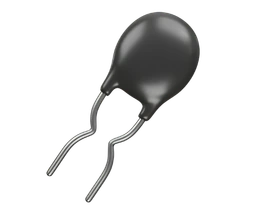
The PTC130 is a positive temperature coefficient thermistor designed to detect and signal the exceedance of a predefined temperature limit, here approximately 130 °C.

Below this threshold, the resistance is low and stable; beyond it, it increases sharply, triggering a cutoff or alarm signal in the circuit.

These sensors are widely used for the thermal protection of electric motors, transformer windings, coils, and power supplies.

Operating principle


Unlike linear sensors (KTY, RTD), the PTC130 operates in threshold mode.

When the temperature reaches the nominal value, the resistance increases sharply — typically from 150 Ω to several kilo-ohms over a few degrees.

Typical behavior curve:

Temperature (°C) Resistance (Ω)
20 150
100 180
130 1 650
140 4 500
160 10 000
180 20 000

🧠 This rapid increase in resistance allows for triggering a command or cutting off a relay in case of overheating.

Technical specifications


Parameter Typical value
Nominal resNominal temperature (T_N) 130°C
Resistance at 25 °C (R_25) 150 Ω ±20 %
Resistance at T_N ≥ 1650 Ω
Maximum measuring current 2,5 mA
Electrical isolation ≥ 2,5 kV
Response time 3 to 5 s
Case Epoxy, glass or encapsulated ceramic

Wiring Configuration


Type Description

Precision

2-wire

Simple connection (series in the control circuit).

✅ Standard

Multiple chain

Several PTCs in series for multi-winding motors.

🏆 Industrial

Integrated

Stuck in the winding or encapsulated in resin.

💡 Engine protection

Self-heating


The recommended measurement current is very low (< 2.5 mA) so as not to influence the threshold behavior.

Self-heating is almost negligible, even at the limit temperature.

Application areas


⚙️ Protection of three-phase electric motors

🔋 Thermal monitoring of transformers and inductors

🧱 Temperature control in converters and inverters

🧠 Thermal safety devices (alarm, shutdown)

🚗 Protection of batteries or charging modules


Should I choose a PTC130 sensor ?

Strengths points

  • 💵 Economic solution
    → The PTC130 is an affordable sensor, making it a preferred choice for projects requiring large volumes without blowing the budget.
  • 🔋 Very low self-heating
    → Its design helps to limit the heat generated by the measurement current, ensuring stable accuracy over time.
  • 🔧 Reliability in Component Protection
    → Often used as protection against overheating, it provides additional safety for electronic circuits and motors.
PTC130 Sensors

Weaknesses points

  • 🌡️ Restricted temperature range
    → With a usage limit of around +150 °C, it is not suitable for high-temperature industrial environments.
  • 🛑 Not designed for very precise measurements
    → This sensor is mainly used for detecting thermal thresholds, but not for detailed temperature measurements.
  • ⏳ Limited measurement frequency
    → The PTC130 is not optimized for rapid and continuous measurements, which can be a hindrance in certain dynamic applications.

Useful information

Here is some useful information regarding the PTC130 sensors.

The protection PTCs like the PTC130 are defined according to the DIN 44081 / 44082 standard and are not classified into “classes A/B/C” like linear sensors. The key criterion is the switching point tolerance (Tₙ) – the temperature at which the resistance increases sharply.

Type PTC
Nominal temperature (Tₙ)
Tolerance (Tₙ)
Resistance at 25 °C (R25)
Resistance to Tₙ
Applicable standard
PTC 120 120 °C ±5 K 150 Ω ±20 % ≥ 1 650 Ω DIN 44081
PTC 130 130 °C ±5 K 150 Ω ±20 % ≥ 1 650 Ω DIN 44081
PTC 150 150 °C ±5 K 150 Ω ±20 % ≥ 1 650 Ω DIN 44082

🔹 The tolerances are measured around the switching point (Tₙ). The resistance remains low and nearly constant up to about 100 °C, then increases sharply by ±5 K around the threshold.

Unlike linear sensors, the PTC130 behaves like a thermal switch.

The simplified modeling of resistance as a function of temperature can be expressed as follows:

R(T) = ​{ R₀ × [1 + α(T - 25)] for T < T_N 

​ ​{ R_N × e^{β(T - T_N)} for T ≥ T_N

with: 

• R₀ = 150 Ω: resistance at 25°C

• α ≈ 3 × 10⁻³ K⁻¹ 

• R_N = 1650 Ω: nominal threshold resistance at 130°C 

• β ≈ 0.25 K⁻¹: exponential growth coefficient


🔹 Example 1: operation under normal conditions (80 °C)

R(80) = 150 × [1 + 3×10⁻³ × (80 - 25)] = 150 × 1.165 = 174.8 Ω

✅ Resistance ≈ 175 Ω → sensor "closed," no alarm.


🔹 Example 2: overheating operation (140 °C)

R(140) = 1650 × e^(0.25 × (140 - 130)) = 1650 × e^2.5 ≈ 1650 × 12.18 = 20100 Ω

✅ Resistance ≈ 20 kΩ → threshold exceeded, the protection system may trigger.


🔹 Practical notes

The PTC130 does not provide a "continuous" temperature value, but a threshold signal.

The change in resistance is often interpreted through a detection module or a PTC relay.

A series of multiple PTCs can be connected in series to monitor several windings at once.

The PTC130 is often used in a motor protection circuit associated with a PTC detection relay (compliant with DIN 44081/82).

When the sensor resistance exceeds approximately 1.5 kΩ, the relay cuts off the control circuit.

🔹 Typical components

Component Function
PTC130 Threshold temperature sensor (≈130 °C)
PTC detection module or thermal relay
Analyze the resistance and open the circuit beyond the threshold
Power Supply (24 V DC)
Source of the control module
Switch or dimmer
Engine or protected system shutdown
🔹 Functional diagram (ASCII)

+24 V │ [PTC Relay] │ ├────┴────┐ │ │ [PTC130] [PTC130] (in series, 1 per winding) │ │ └────┬────┘ │ GND

🔹 Operating Principle

1️⃣ Each PTC is placed in the motor winding.

2️⃣ As long as T < Tₙ, the resistances are low → the relay remains closed.

3️⃣ As soon as a PTC reaches Tₙ ≈ 130 °C → its resistance skyrockets → the relay opens the circuit.

🔹 Best Practices

  • 🧩 Measure the resistance at 25 °C before installation for verification.
  • ⚡ Limit the test current < 2.5 mA to avoid self-heating.
  • 🔄 Replace PTCs in pairs or in series to maintain uniformity.
  • 💧 Avoid immersion in oil or resin that is not electrically compatible.
  • 🧠 Use a certified DIN detection module (ABB, Siemens, Schneider…).

 We integrate any sensor into any probe 

Smooth tube probe

 Smooth tube 

Waterproof probe

 Waterproof

Bayonet probe

 Bayonet

Slot probe

 Slot

Ambient probe

 Atmosphere

Head connection probe

Termal block

Stick-in probe

Stick-in

Thread probe

Thread

Contact probe

Contact

Jacketed probe

Jacketed

PCBA Design

PCBA design

Winding probe

Winding

More than 1,000,000 probes delivered in 2025

Contact us for a personalized offer

Contact Us

Need a PTC130 sensor?

Whether you need a few parts for a prototype or several hundred for a production line, we support you at every step.


Submit
Collegamenti utili
  • Casa
  • Chi Siamo
  • Lavori
  • Note Legali
  • Informativa sulla Privacy
  • Contattaci
Chi siamo

Presso Guilcor, la nostra missione è fornire a ogni cliente una soluzione di misurazione perfettamente adatta alle proprie esigenze specifiche. Con il pieno controllo sul design e sulla produzione, garantiamo la precisione e l'affidabilità dei nostri sensori anche negli ambienti più esigenti.

L'eccellenza tecnica e la soddisfazione del cliente sono al centro di tutto ciò che facciamo.

Entra in contatto con noi
  • Contattaci
  • contact@guilcor.com
Seguici

Politica sui cookie

Usiamo cookie per garantirti la migliore esperienza utente sul nostro sito web. Informativa sui cookie

Solo essenziali Accetto