Se rendre au contenu
guilcor.com
  • Page d'accueil
  • Sondes
    Smooth tube probe

    Tube lisse

    Réfrigérateur, pompe à chaleur, four, congélateur, chauffe-eau
    Contact probe

    Contact

    Tuyau, surface de tuyau, plaque de chauffage
    Slot probe

    D'Encoche

    Moteur, alternateur, enroulement, stator
    Head connection probe

    Avec Bornier

    Chaudière, pompe à chaleur, climatisation, locaux techniques, ventilation
    Waterproof probe

    Étanche

    Climatisation, ventilation, réfrigération, stockage à froid, conduits
    Stick-in probe

    À Piquer

    Four, cuisson, équipements alimentaire
    Winding probe

    Bobinage

    Moteur, alternateur, transformateur, enroulement, stator
    Ambient probe

    Ambiance

    Chaudière, pompe à chaleur, climatisation, locaux techniques, ventilation
    Thread probe

    Avec Raccord

    Machine à café, chaudière, vapeur, fluide sous pression
    Jacketed probe

    Chemisée

    Installations industrielles, applications lourdes
    Bayonet probe

    Baïonnette

    Moulage plastique, outillage, machine de moulage par injection, moteur, alternateur
    PCBA Design

    PCB Design

    Application spécifique, électronique embarquée, cartes électroniques sur mesure
  • Capteurs

    RTD

    Pt10, Pt50, Pt100, Pt200, Pt500, Pt1000, Pt5000, Ni100, Ni120, Cu10, Cu50, Balco...

    PTC

    KTY81-110, KTY81-210, KTY83-110, KTY84-130, PTC130, Silistor, TFPT, MZ6, MZ8, MZ9...

    1-Wire

    DS18B20, DS18S20, DS1822, DS28EA00, DS18B20-PAR, DS1920, DS2438, DS1825...

    Thermocouple

    B, E, J, K, N, R, S, T, C, D, G

    UART

    MLX90614, MLX90615, GY-906, DHT11, DHT22, AM2302, SHT75, SHT85, RS232, RS485

    SPI

    MAX6675, MAX31855, MAX31856, MCP3208, TMP125, TMP121, ADT7310, LTC2983...

    NTC

    1kΩ, 2kΩ, 3kΩ, 5kΩ, 10kΩ, 15kΩ, 20kΩ, 30kΩ, 50kΩ, 100kΩ, 200kΩ, 470kΩ, 1MΩ...

    I²C

    TMP102, TMP117, TMP119, LM75, LM73, MCP9808, MCP9600, SHT31, SHTC3, BME280, BME688, HTU21D, HDC1080, Si7051, ADT7410, STTS751, TCN75A
  • Entreprise
  • 0
  • 0
  • Suivez-nous
  • English (US) Français Español
  • Se connecter
  • Contactez-nous
guilcor.com
  • 0
  • 0
    • Page d'accueil
    • Sondes
    • Capteurs
    • Entreprise
  • Suivez-nous
  • English (US) Français Español
  • Se connecter
  • Contactez-nous

 PTC130 
 Temperature sensors 

Versatile PTC temperature sensor designed for circuit protection and reliable thermal monitoring across various electronics.

 Maximum precision
+/- 5,0°K

 Minimum temperature
-20°C

 Maximum temperature
+180°C

 Minimum dimensions
2,5 x 10

 Response time
Medium

 Self-heating
Low

 Price
Medium

Drift
Low

What is a PTC130 sensor ?Operating principleTechnical specificationsWiring configurationSelf-heatingApplication areas

What is a PTC130 sensor ?


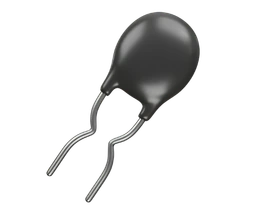
The PTC130 is a positive temperature coefficient thermistor designed to detect and signal the exceedance of a predefined temperature limit, here approximately 130 °C.

Below this threshold, the resistance is low and stable; beyond it, it increases sharply, triggering a cutoff or alarm signal in the circuit.

These sensors are widely used for the thermal protection of electric motors, transformer windings, coils, and power supplies.

Operating principle


Unlike linear sensors (KTY, RTD), the PTC130 operates in threshold mode.

When the temperature reaches the nominal value, the resistance increases sharply — typically from 150 Ω to several kilo-ohms over a few degrees.

Typical behavior curve:

Temperature (°C) Resistance (Ω)
20 150
100 180
130 1 650
140 4 500
160 10 000
180 20 000

🧠 This rapid increase in resistance allows for triggering a command or cutting off a relay in case of overheating.

Technical specifications


Parameter Typical value
Nominal resNominal temperature (T_N) 130°C
Resistance at 25 °C (R_25) 150 Ω ±20 %
Resistance at T_N ≥ 1650 Ω
Maximum measuring current 2,5 mA
Electrical isolation ≥ 2,5 kV
Response time 3 to 5 s
Case Epoxy, glass or encapsulated ceramic

Wiring Configuration


Type Description

Precision

2-wire

Simple connection (series in the control circuit).

✅ Standard

Multiple chain

Several PTCs in series for multi-winding motors.

🏆 Industrial

Integrated

Stuck in the winding or encapsulated in resin.

💡 Engine protection

Self-heating


The recommended measurement current is very low (< 2.5 mA) so as not to influence the threshold behavior.

Self-heating is almost negligible, even at the limit temperature.

Application areas


⚙️ Protection of three-phase electric motors

🔋 Thermal monitoring of transformers and inductors

🧱 Temperature control in converters and inverters

🧠 Thermal safety devices (alarm, shutdown)

🚗 Protection of batteries or charging modules


Should I choose a PTC130 sensor ?

Strengths points

  • 💵 Economic solution
    → The PTC130 is an affordable sensor, making it a preferred choice for projects requiring large volumes without blowing the budget.
  • 🔋 Very low self-heating
    → Its design helps to limit the heat generated by the measurement current, ensuring stable accuracy over time.
  • 🔧 Reliability in Component Protection
    → Often used as protection against overheating, it provides additional safety for electronic circuits and motors.
PTC130 Sensors

Weaknesses points

  • 🌡️ Restricted temperature range
    → With a usage limit of around +150 °C, it is not suitable for high-temperature industrial environments.
  • 🛑 Not designed for very precise measurements
    → This sensor is mainly used for detecting thermal thresholds, but not for detailed temperature measurements.
  • ⏳ Limited measurement frequency
    → The PTC130 is not optimized for rapid and continuous measurements, which can be a hindrance in certain dynamic applications.

Useful information

Here is some useful information regarding the PTC130 sensors.

The protection PTCs like the PTC130 are defined according to the DIN 44081 / 44082 standard and are not classified into “classes A/B/C” like linear sensors. The key criterion is the switching point tolerance (Tₙ) – the temperature at which the resistance increases sharply.

Type PTC
Nominal temperature (Tₙ)
Tolerance (Tₙ)
Resistance at 25 °C (R25)
Resistance to Tₙ
Applicable standard
PTC 120 120 °C ±5 K 150 Ω ±20 % ≥ 1 650 Ω DIN 44081
PTC 130 130 °C ±5 K 150 Ω ±20 % ≥ 1 650 Ω DIN 44081
PTC 150 150 °C ±5 K 150 Ω ±20 % ≥ 1 650 Ω DIN 44082

🔹 The tolerances are measured around the switching point (Tₙ). The resistance remains low and nearly constant up to about 100 °C, then increases sharply by ±5 K around the threshold.

Unlike linear sensors, the PTC130 behaves like a thermal switch.

The simplified modeling of resistance as a function of temperature can be expressed as follows:

R(T) = ​{ R₀ × [1 + α(T - 25)] for T < T_N 

​ ​{ R_N × e^{β(T - T_N)} for T ≥ T_N

with: 

• R₀ = 150 Ω: resistance at 25°C

• α ≈ 3 × 10⁻³ K⁻¹ 

• R_N = 1650 Ω: nominal threshold resistance at 130°C 

• β ≈ 0.25 K⁻¹: exponential growth coefficient


🔹 Example 1: operation under normal conditions (80 °C)

R(80) = 150 × [1 + 3×10⁻³ × (80 - 25)] = 150 × 1.165 = 174.8 Ω

✅ Resistance ≈ 175 Ω → sensor "closed," no alarm.


🔹 Example 2: overheating operation (140 °C)

R(140) = 1650 × e^(0.25 × (140 - 130)) = 1650 × e^2.5 ≈ 1650 × 12.18 = 20100 Ω

✅ Resistance ≈ 20 kΩ → threshold exceeded, the protection system may trigger.


🔹 Practical notes

The PTC130 does not provide a "continuous" temperature value, but a threshold signal.

The change in resistance is often interpreted through a detection module or a PTC relay.

A series of multiple PTCs can be connected in series to monitor several windings at once.

The PTC130 is often used in a motor protection circuit associated with a PTC detection relay (compliant with DIN 44081/82).

When the sensor resistance exceeds approximately 1.5 kΩ, the relay cuts off the control circuit.

🔹 Typical components

Component Function
PTC130 Capteur de température seuil (≈130 °C)
PTC detection module or thermal relay
Analyse la résistance et ouvre le circuit au-delà du seuil
Power Supply (24 V DC)
Source du module de commande
Switch or dimmer
Coupure du moteur ou du système protégé
🔹 Schéma fonctionnel (ASCII)

+24 V │ [Relais PTC] │ ├────┴────┐ │ │ [PTC130] [PTC130] (en série, 1 par enroulement) │ │ └────┬────┘ │ GND

🔹 Principe de fonctionnement

1️⃣ Chaque PTC est placé dans l’enroulement du moteur.

2️⃣ Tant que T < Tₙ, les résistances sont faibles → le relais reste fermé.

3️⃣ Dès qu’un PTC atteint Tₙ ≈ 130 °C → sa résistance s’envole → le relais ouvre le circuit.

🔹 Bonnes pratiques

  • 🧩 Mesurer la résistance à 25 °C avant l’installation pour contrôle.
  • ⚡ Limiter le courant de test < 2,5 mA pour éviter l’auto-échauffement.
  • 🔄 Remplacer les PTC par paire ou par chaîne pour maintenir l’uniformité.
  • 💧 Éviter les immersions dans huile ou résine non compatibles électriquement.
  • 🧠 Utiliser un module de détection DIN certifié (ABB, Siemens, Schneider…).

 We integrate any sensor into any probe 

Smooth tube probe

 Smooth tube 

Waterproof probe

 Waterproof

Bayonet probe

 Bayonet

Slot probe

 Slot

Ambient probe

 Atmosphere

Head connection probe

Termal block

Stick-in probe

Stick-in

Thread probe

Thread

Contact probe

Contact

Jacketed probe

Jacketed

PCBA Design

PCBA design

Winding probe

Winding

Plus de 1 000 000 sondes livrées en 2025

Contactez-nous pour une offre personnalisée

Contactez-nous

Besoin d'un capteur PTC130 ?

Que vous ayez besoin de quelques pièces pour un prototype ou de plusieurs centaines pour une ligne de production, nous vous accompagnons à chaque étape.


Soumettre
Liens utiles
  • Accueil
  • À propos de nous
  • Emplois
  • Mentions légales
  • Politique de confidentialité
  • Contactez-nous
À propos de nous

Chez Guilcor, notre mission est claire : fournir à chaque client une solution de mesure parfaitement adaptée à ses besoins spécifiques. Grâce à une maîtrise totale de la conception et de la fabrication, nous garantissons la précision et la fiabilité de nos capteurs, même dans les environnements les plus exigeants.

L'excellence technique et la satisfaction client sont au cœur de tout ce que nous faisons.

Rejoignez-nous
  • Contactez-nous
  • contact@guilcor.com
Suivez-nous