Passa al contenuto
guilcor.com
  • Home
  • Prove
    Sonda a tubo liscio

    Tubo Liscio

    Frigorifero, pompa di calore, forno, congelatore, scaldabagno
    Sonda di contatto

    Contatto

    Tubo, superficie del tubo, piastra riscaldante
    Sonda a fessura

    Fessura

    Motore, alternatore, avvolgimento, statore
    Sonda di connessione testa

    Testa di connessione

    Caldaia, pompa di calore, aria condizionata, locali tecnici, ventilazione
    Sonda impermeabile

    Impermeabile

    Aria condizionata, ventilazione, refrigerazione, stoccaggio a freddo, condotti
    Sonda da infilare

    Infilare

    Forno, cottura, attrezzature per la lavorazione degli alimenti
    Sonda di avvolgimento

    Avvolgimento

    Motore, alternatore, trasformatore, avvolgimento, statore
    Sonda ambientale

    Ambientale

    Caldaia, pompa di calore, aria condizionata, locali tecnici, ventilazione
    Sonda a filettatura

    Filettatura

    Macchina da caffè, caldaia, vapore, fluido pressurizzato
    Sonda giacketata

    Giacketata

    Installazioni industriali, applicazioni pesanti
    Sonda a baionetta

    Baionetta

    Stampaggio plastico, attrezzature, macchina per stampaggio ad iniezione, motore, alternatore
    Progettazione PCBA

    progettazione PCBA

    Applicazione specifica, elettronica integrata, schede elettroniche personalizzate
  • Sensori

    RTD

    Pt10, Pt50, Pt100, Pt200, Pt500, Pt1000, Pt5000, Ni100, Ni120, Cu10, Cu50, Balco

    PTC

    KTY81-110, KTY81-210, KTY83-110, KTY84-130, PTC130, Silistor, TFPT, MZ6, MZ8, MZ9

    1-Wire

    DS18B20, DS18S20, DS1822, DS28EA00, DS18B20-PAR, DS1920, DS2438, DS1835...

    Termocoppia

    B, E, J, K, N, R, S, T, C, D, G

    UART

    MLX90614, MLX90615, GY-906, DHT11, DHT22, SHT75, SHT85, RS232, RS485

    SPI

    MAX6675, MAX31855, MAX31856, MCP3208, TMP125, TMP121, ADT7310, LTC2983...

    NTC

    1kΩ, 2kΩ, 3kΩ, 5kΩ, 10kΩ, 15kΩ, 20kΩ, 30kΩ, 50kΩ, 100kΩ, 200kΩ, 470kΩ, 1MΩ

    I²C

    TMP102, TMP117, LM75, LM73, MCP9808, MCP9600, SHT31, SHTC3, BME280, BME688, HTU21D, HDC1080, Si7051, ADT7410, STTS751, TCN75A...
  • Chi siamo
  • 0
  • 0
  • Seguici
  • English (US) Français Italiano Español
  • Accedi
  • Contattaci
guilcor.com
  • 0
  • 0
    • Home
    • Prove
    • Sensori
    • Chi siamo
  • Seguici
  • English (US) Français Italiano Español
  • Accedi
  • Contattaci

 Type S 
 Temperature sensors 

Premium thermocouple offering excellent accuracy and stability for high-temperature measurement up to 1600 °C.

 Maximum precision
+/- 1,0°K

 Minimum temperature
-50°C

 Maximum temperature
+1760°C

 Minimum dimensions
0,5 x 50 x 5

 Response time
Low

 Internal Resistance
High

 Linearity
High

Price
High

What is a Type S thermocouple ?Operating principleTechnical specificationsVoltage / Temperature CurveCompatibility / CompensationApplication areas

What is a Type S thermocouple ?


The type S thermocouple is a very high-precision sensor used in extreme environments and reference laboratories.

Composed of a pure platinum (Pt) wire and a platinum–rhodium (Pt-10%Rh) wire, it offers exceptional thermal stability and remarkable chemical resistance.

It is the preferred thermocouple for scientific, medical, and industrial applications requiring reliable long-term temperature measurement.

Operating principle


Like all thermocouples, type S relies on the Seebeck effect: the junction between two different metals produces a voltage proportional to the temperature difference.

E = S × (T_hot - T_cold)

For type S:

S ≈ 10 µV/°C at 1,000 °C

Its output voltage is almost identical to that of type R, but type S is slightly more chemically stable.

Technical specifications


Parameter
Typical Value
Measurement range −50 °C → +1 760 °C
Sensitivity 10 µV/°F at 1,000 °C
Tension at 100 °C ≈ 11,35 mV
Tension at 500 °C ≈ 16,73 mV
Tension at 1000 °C ≈ 18,69 mV
Oxidation resistance Excellent
Response time (6 mm diameter sheath) 5 to 10 s
Reference standard IEC 60584-1, ASTM E230

Voltage / Temperature Curve


(Reference: Cold junction at 0 °C — IEC 60584-1 standard)

The type S curve is extremely regular across the entire measurement range.

It is almost identical to that of type R, but with even greater chemical and thermal stability.

📈 General behavior:

  • From 0 to 1,760 °C → increasing voltage (~0 to +18.7 mV)
  • Average slope: ≈ 10 µV/°C at 1,000 °C
  • Drift is nearly zero even after several hundred hours of use

💡 Type S is often chosen as the primary calibration thermocouple in national laboratories.

Compatibility / Compensation


The S type requires a cold weld compensation, typically integrated into precision measurement systems.

It is compatible with professional instruments (AD8495-S, MAX31855-S, LTC2983) and calibration standards.

Its exceptional stability makes it ideal for reference measurements, furnace controls, or high-temperature metrology.

Application areas


🔬 Reference and Metrology Laboratories

🧱 Glass, Ceramics, and Metal Melting Industry

🧪 High-Precision Chemical and Thermal Analysis

⚙️ Medical Equipment and Scientific Research
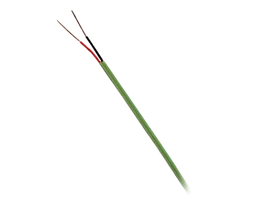


Should I choose a Type S thermocouple ?

Strengths points

  • ⚗️ Absolute reference sensor
    → Employed in metrology laboratories and calibration chains, he ensures exceptional reproducibility.
  • 🔥 Exceptional heat resistance
    → It withstands temperatures exceeding 1,700 °C without significant drift — ideal for melting furnaces.
  • 🧱 Noble and stable chemistry
    → Platinum and rhodium provide almost total immunity to oxidation and corrosion.
Type S Thermocouple sensors

Weaknesses points

  • 💸 Significant investment
    → Its very high cost limits it to scientific and critical uses, not to regular production.
  • 🐢 Slow response
    → The ceramic or alumina sheath provides good protection but significantly slows down the thermal response.
  • 📉 Weak signal
    → The generated tension remains modest, requiring a very precise differential amplifier.

Useful information

Here is some useful information regarding Type S thermocouples.

(Reference: cold junction at 0 °C — IEC 60584-1 standard)
Temperature (°C) Tension (mV) Temperature (°C) Tension (mV)
0 0,000 1 200 12,016
200 1,426 1 400 14,308
400 3,138 1 500 15,287
600 4,913 1 600 16,276
800 6,761 1 700 17,194
1 000 8,585 1 760 17,690
💡 The S type maintains remarkable accuracy across its entire range of use, even after numerous thermal cycles.
Class Tolerance (K) Usage area
Description
Class 1 ±1,0 K ou ±0,25 % 0 → +1 600 °C High precision
Class 2 ±1,5 K ou ±0,5 % 0 → +1 600 °C Industrial standard
Class 3 — Not applicable No class 3 for type S

🔹 Even class 2 ensures an accuracy of the order of one-tenth of a degree at high temperature.

Example 1 – Calculation of the generated voltage

Measured temperature: 1,200 °C

Cold weld: 0 °C

E = 12,016 mV

Cold welding at 25 °C → correction voltage ≈ 0.15 mV :

E_measured = 12,016 - 0,15 = 11,866 mV

✅ Actual voltage ≈ 11.87 mV


Example 2 – Calculating temperature from a measured voltage

Measured voltage: 16.276 mV (cold joint at 0 °C)

→ By consulting the IEC table:

T=1600°C

✅ Measured temperature ≈ 1,600 °C

The type S thermocouple generates a low voltage and requires highly stable and precise reading electronics.

🔹 Typical components

Component
Function
Thermocouple type S (Pt10Rh / Pt) Generate the Seebeck voltage
Differential amplifier (INA333, AD8495-S)
Amplify the signal µV → V
Compensation sensor (NTC or integrated)
Correct the temperature of the cold weld
ADC 24 bits Convert the amplified voltage
Microcontroller / Calibration System
Calculate the temperature according to the IEC table
🔹 Functional diagram (ASCII)

[HOT JUNCTION]──(Thermocouple S)──[AMPLIFIER]──[ADC]──[µCONTROLLER] │ └──(Compensation sensor)

💡 Type S is used in analytical furnaces, national laboratories, and applications where precision allows for no approximation.

 We integrate any sensor into any probe 

Smooth tube probe

 Smooth tube 

Waterproof probe

 Waterproof

Bayonet probe

 Bayonet

Slot probe

 Slot

Ambient probe

 Atmosphere

Head connection probe

Termal block

Stick-in probe

Stick-in

Thread probe

Thread

Contact probe

Contact

Jacketed probe

Jacketed

PCBA Design

PCBA design

Winding probe

Winding

More than 1,000,000 probes delivered in 2025

Contact us for a personalized offer

Contact Us

Need a Type S thermocouple?

Whether you need a few parts for a prototype or several hundred for a production line, we support you at every step.


Submit
Collegamenti utili
  • Casa
  • Chi Siamo
  • Lavori
  • Note Legali
  • Informativa sulla Privacy
  • Contattaci
Chi siamo

Presso Guilcor, la nostra missione è fornire a ogni cliente una soluzione di misurazione perfettamente adatta alle proprie esigenze specifiche. Con il pieno controllo sul design e sulla produzione, garantiamo la precisione e l'affidabilità dei nostri sensori anche negli ambienti più esigenti.

L'eccellenza tecnica e la soddisfazione del cliente sono al centro di tutto ciò che facciamo.

Entra in contatto con noi
  • Contattaci
  • contact@guilcor.com
Seguici

Politica sui cookie

Usiamo cookie per garantirti la migliore esperienza utente sul nostro sito web. Informativa sui cookie

Solo essenziali Accetto