Ir al contenido
guilcor.com
  • Sondas
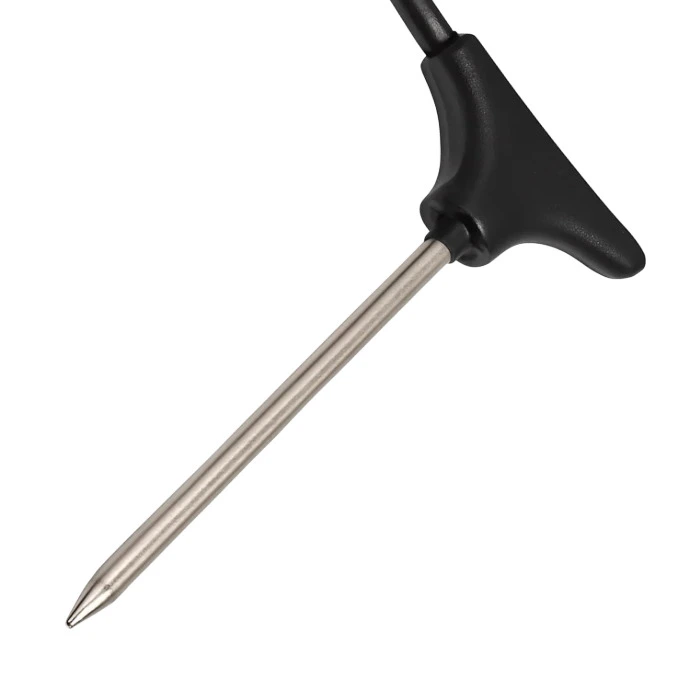
    Smooth tube probe

    Tubo liso

    Refrigerador, bomba de calor, horno, congelador, calentador de agua
    Contact probe

    Contacto

    Tubería, superficie de tubería, placa calefactora
    Slot probe

    Ranura

    Motor, alternador, bobinado, estator
    Head connection probe

    Cabezal de conexión

    Caldera, bomba de calor, aire acondicionado, salas técnicas, ventilación
    Waterproof probe

    Impermeable

    Aire acondicionado, ventilación, refrigeración, almacenamiento en frío, conductos
    Stick-in probe

    Inserción

    Horno, cocción, equipos de procesamiento de alimentos
    Winding probe

    Bobinado

    Motor, alternador, transformador, bobinado, estator
    Ambient probe

    Ambiente

    Caldera, bomba de calor, aire acondicionado, salas técnicas, ventilación
    Thread probe

    Con racor

    Máquina de café, caldera, vapor, fluido presurizado
    Jacketed probe

    Envainadas

    Instalaciones industriales, aplicaciones de alta resistencia
    Bayonet probe

    Bayoneta

    Moldeo de plástico, herramientas, máquina de moldeo por inyección, motor, alternador
    PCBA Design

    Diseño de PCBA

    Aplicación específica, electrónica embebida, placas electrónicas personalizadas
  • Sensores

    RTD

    Pt10, Pt50, Pt100, Pt200, Pt500, Pt1000, Pt5000, Ni100, Ni120, Cu10, Cu50, Balco

    PTC

    KTY81-110, KTY81-210, KTY83-110, KTY84-130, PTC130, Silistor, TFPT, MZ6, MZ8, MZ9

    1-Wire

    DS18B20, DS18S20, DS1822, DS28EA00, DS18B20-PAR, DS1920, DS2438, DS1835...

    Termopar

    B, E, J, K, N, R, S, T, C, D, G

    UART

    MLX90614, MLX90615, GY-906, DHT11, DHT22, AM2302, SHT75, SHT85, RS232, RS485

    SPI

    MAX6675, MAX31855, MAX31856, MCP3208, TMP125, TMP121, ADT7310, LTC2983...

    NTC

    1kΩ, 2kΩ, 3kΩ, 5kΩ, 10kΩ, 15kΩ, 20kΩ, 30kΩ, 50kΩ, 100kΩ, 200kΩ, 470kΩ, 1MΩ

    I²C

    TMP102, TMP117, LM75, LM73, MCP9808, MCP9600, SHT31, SHTC3, SHT85, BME280, BME688, HTU21D, HDC1080, Si7051, ADT7410, STTS751, TCN75A...
  • Sobre nosotros
  • 0
  • 0
  • Síganos
  • English (US) Français Español
  • Iniciar sesión
  • Contáctenos
guilcor.com
  • 0
  • 0
    • Sondas
    • Sensores
    • Sobre nosotros
  • Síganos
  • English (US) Français Español
  • Iniciar sesión
  • Contáctenos

 Type K 
 Temperature sensors 

Versatile thermocouple for general-purpose temperature measurement from −200 °C to +1260 °C in industrial and OEM applications.

 Maximum precision
+/- 1,5°K

 Minimum temperature
-200°C

 Maximum temperature
+1260°C

 Minimum dimensions
0,25 x 25 x 2

 Response time
High

 Internal Resistance
Medium

 Linearity
High

Price
Low

What is a Type K thermocouple ?Operating principleTechnical specificationsVoltage / Temperature CurveCompatibility / CompensationApplication areas

What is a Type K thermocouple ?


The type K thermocouple is the most universal and versatile of thermocouples.

Made of nickel-chrome (Chromel) and nickel-aluminum (Alumel), it combines stability, low cost, and a wide measurement range.

It is the global industrial standard, used in furnaces, engines, cooking appliances, as well as in laboratories and test benches.

Its popularity comes from its chemical robustness, resistance to oxidation, and good thermal performance in most environments.

Operating principle


The K type exploits the Seebeck effect, like all thermocouples:

a temperature difference between the hot junction and the cold junction creates a voltage proportional to this difference.

E = S × (T_hot - T_cold)

For type K:

S ≈ 41 µV/°C around 0 °C

This coefficient varies slightly with temperature but remains sufficiently linear for industrial applications.

Technical specifications


Parameter
Typical Value
Measurement range −200 °C → +1 260 °C
Sensitivity 41 µV/°C to 0 °C
Tension at 100 °C ≈ 4,10 mV
Tension at 500 °C ≈ 20,64 mV
Tension at 1,000 °C ≈ 54,89 mV
Oxidation resistance Excellent
Response time (cable sheath Ø3 mm) 0,5 to 3 s
Reference standard IEC 60584-1, ASTM E230

Voltage / Temperature Curve


(Reference: Cold junction at 0 °C — IEC 60584-1 standard)

Type K offers a nearly linear curve across its useful range.

It is the most balanced reference in terms of voltage amplitude, cost, and durability.

📈 General behavior:

  • From −200 to 0 °C → negative voltage (~−5.9 mV to 0 mV)
  • From 0 to 1,260 °C → positive voltage (~0 to +54.9 mV)
  • Average slope: ≈ 41 µV/°C

💡 It is the "go-to" thermocouple: reliable, stable, and compatible with almost everything.

Compatibility / Compensation


The K type is fully compatible with the majority of devices on the market (controllers, displays, data acquisition modules).

Cold junction compensation is automatically managed by many integrated circuits (MAX31855-K, AD8495-K, LTC2983).

Its stability and robustness make it a default standard in many industrial applications.

Application areas


⚙️ Industrial processes (furnaces, engines, heat exchangers, molds)

🔬 Laboratories and thermal testing

🔧 Maintenance, HVAC, food industry

🧪 Control equipment and routine calibrations


Should I choose a Type K thermocouple ?

Strengths points

  • 🔥 The universal industrial standard
    → Present in all sectors, it is recognized for its robustness, reliability, and low cost.
  • 🔥 Large measurement range
    → From -200 °C to +1,260 °C: type K covers both cryogenic cold zones and industrial furnaces.
  • ⚙️ Excellent stability / price ratio
    → A durable, accurate, and easy-to-maintain sensor, perfect for repeated measurements or long-term installations.
Type K Thermocouple sensors

Weaknesses points

  • ⚡ Long-term drift
    → In a reducing atmosphere or with strong thermal cycles, the signal may drift slowly.
  • 🌡️ Slight non-linearity above 1,000 °C
    → The sensitivity decreases slightly, requiring software correction for very precise applications.
  • 💨 Sensitive to sulfate atmospheres
    → Sulfur compounds quickly deteriorate Chromel — to be avoided in certain chemical industries.

Useful information

Here is some useful information regarding Type K thermocouples.

(Reference: cold junction at 0 °C — IEC 60584-1 standard)
Temperature (°C) Tension (mV) Temperature (°C) Tension (mV)
−200 −5,891 200 8,138
−100 −2,585 400 16,397
0 0,000 600 24,906
100 4,095 800 33,275
200 8,138 1 000 41,276
300 12,209 1 200 49,093
400 16,397 1 260 52,410

💡 Type K is one of the few thermocouples that can be used at both −200 °C and +1,200 °C.

Class Tolerance (K) Usage area
Description
Class 1 ±1,5 K ou ±0,4 % −40 → +1 000 °C High precision
Class 2 ±2,5 K ou ±0,75 % −200 → +1 200 °C Industrial standard
Class 3 ±2,5 K ou ±1,5 % −200 → 0 °C Low temperatures
🔹 Class 1 is favored for modern acquisition systems and demanding applications.

Example 1 – Calculation of the generated voltage

Measured temperature: 600 °C

Cold weld at 0 °C

E = 24,906 mV

If the cold weld is at 25 °C, equivalent voltage ~1,000 mV:

E_measured = 24,906 - 1000 = 23,906 mV

✅ Actual voltage ≈ 23.91 mV

Example 2 – Calculating temperature from a measured voltage

Measured voltage: 41.276 mV (cold junction at 0 °C)

→ According to the IEC table:


T=1000°C

✅ Measured temperature ≈ 1,000 °C

The type K thermocouple generates a voltage of a few tens of millivolts, proportional to the temperature.

It requires a differential amplifier, cold junction compensation, and a high-resolution A/D converter.

🔹 Typical components

Component
Function
Thermocouple type K (Chromel / Alumel)
Generate the Seebeck voltage
Differential amplifier (AD8495-K, INA333, etc.)
Amplify the signal µV → V
Compensation sensor (NTC or integrated)
Correct the cold junction
ADC 16–24 bits Digitize the signal
Microcontroller / Acquisition Module
Convert the voltage to temperature using IEC table
🔹 Functional diagram (ASCII)

[HOT JUNCTION]──(Thermocouple K)──[AMPLIFIER]──[ADC]──[µCONTROLLER] │ └──(Compensation sensor)

💡 Thanks to its wide compatibility, type K is often the default choice for multipoint measurement systems.

 We integrate any sensor into any probe 

Smooth tube probe

 Smooth tube 

Waterproof probe

 Waterproof

Bayonet probe

 Bayonet

Slot probe

 Slot

Ambient probe

 Atmosphere

Head connection probe

Termal block

Stick-in probe

Stick-in

Thread probe

Thread

Contact probe

Contact

Jacketed probe

Jacketed

PCBA Design

PCBA design

Winding probe

Winding

More than 1,000,000 probes delivered in 2025

Contact us for a personalized offer

Contact Us

Need a Type K thermocouple?

Whether you need a few parts for a prototype or several hundred for a production line, we support you at every step.


Submit
Enlaces útiles
  • Inicio
  • Sobre nosotros
  • Empleos
  • Avisos legales
  • Política de privacidad
  • Contáctenos
Sobre nosotros

At Guilcor, our mission is clear: to provide every client with a measurement solution perfectly suited to their specific needs.With full control over design and manufacturing, we ensure the precision and reliability of our sensors in even the most demanding environments.

La excelencia técnica y la satisfacción del cliente están en el corazón de todo lo que hacemos.

Contáctenos
  • Contáctenos
  • contact@guilcor.com
Síganos