What is a DS18B20 sensor?
The DS18B20 is a digital temperature sensor with a 1-Wire protocol developed by Maxim Integrated (formerly Dallas Semiconductor).
It integrates into a single component:
- a semiconductor temperature sensor,
- an analog-to-digital converter (ADC),
- an internal memory for calibration and unique identification.
Each DS18B20 has a unique 64-bit address, allowing multiple sensors to be chained on a single data line.
It is the preferred sensor for home automation integrators, data loggers, and embedded systems.
Operating principle
The DS18B20 converts the measured temperature into a 16-bit digital signal according to the relationship:
T = Lecture brut / 16
Each least significant bit corresponds to 0.0625 °C (12 bits) or 0.5 °C (9 bits) depending on the chosen resolution.
The 1-Wire bus allows for communication, power (parasitic or 3.0-5.5 V), and addressing via a single data line.
Technical specifications
| Parameter | Typical value |
| Measurement range | −55 °C → +125 °C |
| Typical accuracy | ±0,5 K (−10 → +85 °C) |
| Adjustable resolution | 9, 10, 11 or 12 bits |
| Conversion time | 93,75 to 750 ms |
| Nutrition | 3.0 → 5.5 V or parasite mode (1-Wire) |
| Interface | Digital (1-Wire bus) |
| Typical current | < 1 mA |
| Identification code | Unique 64 bits per sensor |
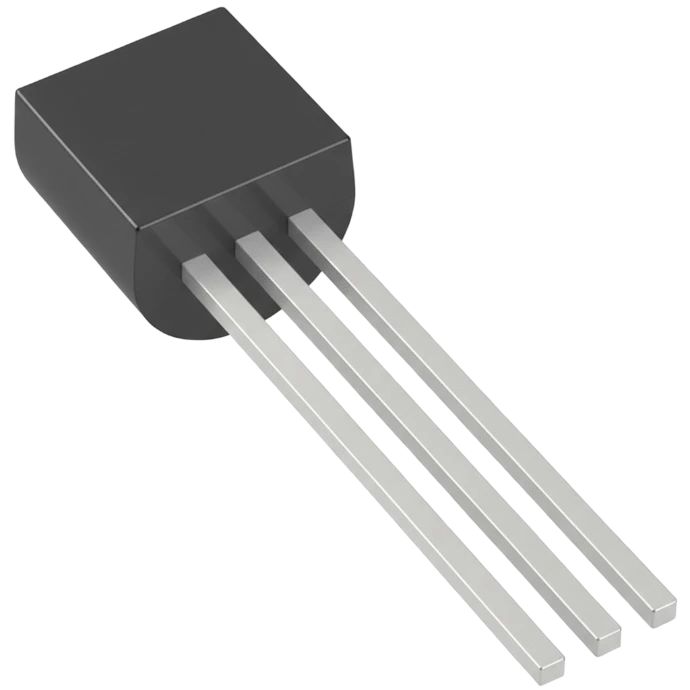
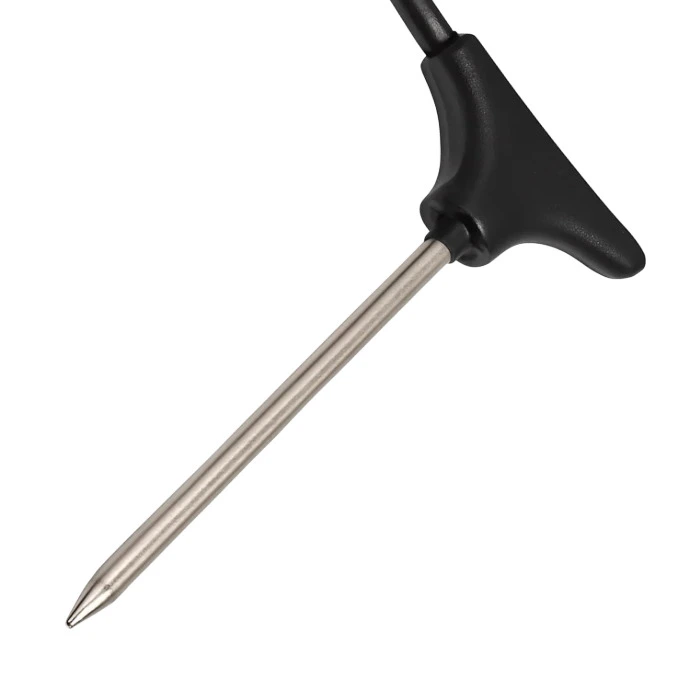
Protection | TO-92 housing, stainless steel or IP68 sealing (encapsulated versions) |
Wiring Configuration
| Type | Description | Precision |
3-wire |
VDD + DATA + GND (standard power supply) | ✅ Standard |
2-wire (parasite) |
DATA and combined nutrition | 💡 Wiring Economy |
Chained (multi-drop) |
Multiple DS18B20 on the same 1-Wire line | 🏆 Measurement networks |
Self-heating
Due to its very low power consumption, the self-heating of the DS18B20 is negligible (< 0.2 °C), even in continuous reading applications.
Application areas
🧠 Measurement and data recording systems (IoT, Arduino, ESP32, Raspberry Pi)
💧 Thermal monitoring of tanks, fluids, and greenhouses
⚙️ Industrial control and HVAC
🧱 Integration into waterproof cables for outdoor applications
🔋 Low-power applications powered by batteries