Se rendre au contenu
guilcor.com
  • Page d'accueil
  • Sondes
    Smooth tube probe

    Tube lisse

    Réfrigérateur, pompe à chaleur, four, congélateur, chauffe-eau
    Contact probe

    Contact

    Tuyau, surface de tuyau, plaque de chauffage
    Slot probe

    D'Encoche

    Moteur, alternateur, enroulement, stator
    Head connection probe

    Avec Bornier

    Chaudière, pompe à chaleur, climatisation, locaux techniques, ventilation
    Waterproof probe

    Étanche

    Climatisation, ventilation, réfrigération, stockage à froid, conduits
    Stick-in probe

    À Piquer

    Four, cuisson, équipements alimentaire
    Winding probe

    Bobinage

    Moteur, alternateur, transformateur, enroulement, stator
    Ambient probe

    Ambiance

    Chaudière, pompe à chaleur, climatisation, locaux techniques, ventilation
    Thread probe

    Avec Raccord

    Machine à café, chaudière, vapeur, fluide sous pression
    Jacketed probe

    Chemisée

    Installations industrielles, applications lourdes
    Bayonet probe

    Baïonnette

    Moulage plastique, outillage, machine de moulage par injection, moteur, alternateur
    PCBA Design

    PCB Design

    Application spécifique, électronique embarquée, cartes électroniques sur mesure
  • Capteurs

    RTD

    Pt10, Pt50, Pt100, Pt200, Pt500, Pt1000, Pt5000, Ni100, Ni120, Cu10, Cu50, Balco...

    PTC

    KTY81-110, KTY81-210, KTY83-110, KTY84-130, PTC130, Silistor, TFPT, MZ6, MZ8, MZ9...

    1-Wire

    DS18B20, DS18S20, DS1822, DS28EA00, DS18B20-PAR, DS1920, DS2438, DS1825...

    Thermocouple

    B, E, J, K, N, R, S, T, C, D, G

    UART

    MLX90614, MLX90615, GY-906, DHT11, DHT22, AM2302, SHT75, SHT85, RS232, RS485

    SPI

    MAX6675, MAX31855, MAX31856, MCP3208, TMP125, TMP121, ADT7310, LTC2983...

    NTC

    1kΩ, 2kΩ, 3kΩ, 5kΩ, 10kΩ, 15kΩ, 20kΩ, 30kΩ, 50kΩ, 100kΩ, 200kΩ, 470kΩ, 1MΩ...

    I²C

    TMP102, TMP117, TMP119, LM75, LM73, MCP9808, MCP9600, SHT31, SHTC3, BME280, BME688, HTU21D, HDC1080, Si7051, ADT7410, STTS751, TCN75A
  • Entreprise
  • 0
  • 0
  • Suivez-nous
  • English (US) Français Español
  • Se connecter
  • Contactez-nous
guilcor.com
  • 0
  • 0
    • Page d'accueil
    • Sondes
    • Capteurs
    • Entreprise
  • Suivez-nous
  • English (US) Français Español
  • Se connecter
  • Contactez-nous

 KTY81-210 
 Temperature sensors 

High-stability PTC sensor for precise temperature measurement in consumer electronics and automation applications.

 Maximum precision
+/- 2,0°K

 Minimum temperature
-55°C

 Maximum temperature
+150°C

 Minimum dimensions
1,8 x 2 x 4

 Response time
Fast

 Self-heating
Low

 Price
Low

Drift
Low

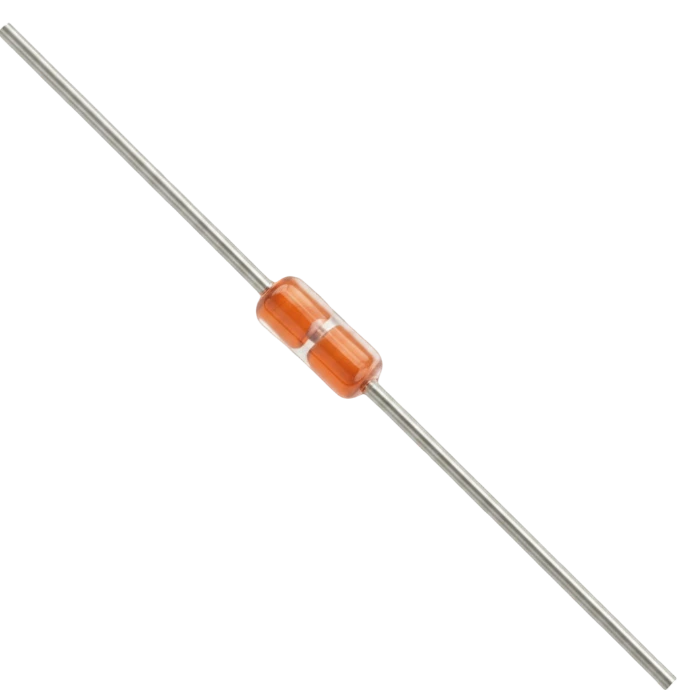
What is a KTY81-210 sensor ?Operating principleTechnical specificationsWiring configurationSelf-heatingApplication areas

What is a KTY81-210 sensor ?


The KTY81-210 is a doped silicon PTC sensor whose resistance increases almost linearly with temperature.

Its nominal resistance is 2000 Ω at 25 °C, which is twice that of the KTY81-110, providing a stronger signal and better noise immunity in analog circuits.

Robust, compact, and stable, it is widely used for thermal monitoring of power components, motor protection, and electronic regulation.

Operating principle


Like the other KTY81s, it relies on the variation of the conductivity of doped silicon:

when the temperature increases, the density of free carriers decreases, resulting in an increase in electrical resistance.

Its curve can be modeled by:

  • ​​​R(T) = R25 x [1 + A(T - 25) + B(T - 25)²]

with :

  • R25 = 2000 Ω

  • A = 7,88 × 10⁻³
  • B = 1,97 × 10⁻⁵ 

This relationship remains accurate between -55 °C and +150 °C.

Technical specifications


Parameter Typical value
Nominal resistance at 25 °C 2000 Ω
Temperature coefficient (at 25 °C) ≈ 1 Ω/°C
Recommended maximum tension 5 V
Typical measurement current 1 mA
Case material Hermetic glass
Typical response time 1–2 s (in the air)
Standard tolerance −±1 %

Wiring Configuration


Type Description

Precision

2-wire

Simple assembly, sufficient for short measurements.

✅ Standard

3-wire

Reduces errors related to cable resistance.

🏆 Industrial

Integrated

Stuck or inserted in power module.

💡 Direct thermal protection

Self-heating


Due to its high resistance (2000 Ω), the required current is very low:

at 1 mA, the power dissipated is only 2 mW, which limits self-heating to < 0.1 °C.

Application areas


⚙️ Thermal protection of transistors, IGBTs, and MOSFETs

🔋 Monitoring of transformers and power supplies

🚗 Automotive thermal regulation and engine management

💡 HVAC systems and power electronic boards

🧠 Embedded temperature measurement in electronic modules


Should I choose a KTY81-210 sensor ?

Strengths points

  • ⚡ Stronger and more stable signal
    → With 2000 Ω at 25 °C, the KTY81-210 generates an output signal twice as high as the KTY81-110, reducing errors due to noise and line losses.
  • 🧠 Very linear response curve
    → Its exceptional linearity in the range of -40 °C to +125 °C facilitates integration into simple analog circuits (voltage divider or 10-bit ADC without correction).
  • Low self-heating
    → Its high resistance allows for the use of a very low excitation current (< 1 mA), ideal for low-power and embedded applications.
KTY81-210

Weaknesses points

  • 🌡️ Limited measurement range
    → The sensor is only usable up to +150 °C, which is insufficient for high-temperature systems (> 200 °C).
  • 🧩 Sensitivity to overcurrents
    → A current > 2 mA can cause internal heating and distort the measurement by several degrees.
  • 📏 Non-interchangeable between manufacturers
    → Each brand (Philips, Infineon, NXP) has its own coefficients A and B, requiring software recalibration when replaced.

Useful information

Here is some useful information regarding the KTY81-210 sensors.

The KTY81-210 is offered in several classes according to the resistance tolerance at 25 °C and the accuracy over the full range. The deviations are very low due to the stability of the doped silicon used.
Class Tolerance at 25 °C
Max. gap on the range
Operating range
Remarks
A (enhanced precision)
±0,5 % (±10 Ω) ±1 °C −40 °C → +125 °C Strict selection, sensor sorted in production
B (standard)
±1 % (±20 Ω) ±2 °C −55 °C → +150 °C Most common value (standard KTY81-210 version)
C (extent)
±2 % (±40 Ω) ±4 °C −55 °C → +150 °C Wide tolerance for economic applications
🔹 Note: Version A is rare on the market and intended for calibrated measurement systems; Version B is the industrial standard for thermal protection systems.

The quadratic equation of the KTY81-210 models its resistance as a function of temperature:

  • ​​​R(T) = R25 x [1 + A(T - 25) + B(T - 25)²]

with :

  • R25 = 2000 Ω

  • A = 7,88 × 10⁻³
  • B = 1,97 × 10⁻⁵ 


🔹 Example 1: calculation of resistance at 100 °C

R(100) = 2000 × [1 + 7,88×10⁻³(100-25) + 1,97×10⁻⁵(100-25)²] 

R(100) = 2000 × [1 + 0,591 × (100-25) + 1,97×10⁻⁵ × (100-25)²] 

R(100) = 2000 × [1 + 0,591 + 0,110] = 2000 × 1,701 = 3402 Ω

✅ Result: at 100 °C, the resistance of the KTY81-210 is approximately 3402 Ω.


🔹 Example 2: calculating the temperature from a measured resistance

We measure R=2800ΩR = 2800 ΩR=2800Ω.

What is the corresponding temperature?

T = 25 + [-A + √(A² - 4B(1 - R/R₂₅))] / (2B)

T = 25 + -7,88×10⁻³ + √((7,88×10⁻³)² - 4×1,97×10⁻⁵×(1-1,4)) / (2×1,97×10⁻⁵)

T ≈ 66°C

✅ Result: the equivalent temperature is approximately 66 °C.


🔹 Practical notes

  • The KTY81-210 curve is extremely consistent up to +125 °C.
  • Quadratic modeling is sufficient for an error < ±1 °C over the useful range.
  • Ideal for embedded calculations on 8 or 16-bit microcontrollers.

The KTY81-210 is designed for simple integration: it connects in a voltage divider powered by direct current, just like the KTY81-110, but with a higher resistance (2 kΩ).

This allows for a lower measurement current and better noise immunity.

🔹 Typical components

Component Function
KTY81-210 (PTC silicon)
Sensitive element
Rref ≈ 2,0 kΩ Reference resistance in the voltage divider
Power Supply (5 V DC)
Source stable
ADC (10–12 bits) Measure the output voltage
Microcontroller (Arduino, STM32, ESP32)
Calculation of temperature
RC Filtering (1 kΩ / 100 nF)
Noise reduction
🔹 Functional diagram (ASCII)

+5 V │ [Rref] │ ├───→ Vout → ADC / µC │ [KTY81-210] │ GND

🔹 Operating Principle

1️⃣ The sensor and the fixed resistor form a voltage divider.

2️⃣ When the temperature increases, the resistance of the KTY81-210 increases → Vout rises.

3️⃣ The microcontroller calculates the temperature from Vout using the quadratic equation or a table.

🔹 Best Practices

  • 🧩 Choose Rref ≈ 2 kΩ for a symmetrical Vout curve around 25 °C.
  • ⚡ Limit the current to ≤ 1 mA to minimize self-heating.
  • 💧 Protect the connections with varnish or heat-shrink tubing.
  • 🔄 Calibrate at least at 25 °C and 100 °C for critical applications.
  • 🧲 Add an RC filter to stabilize the ADC reading.

 We integrate any sensor into any probe 

Smooth tube probe

 Smooth tube 

Waterproof probe

 Waterproof

Bayonet probe

 Bayonet

Slot probe

 Slot

Ambient probe

 Atmosphere

Head connection probe

Termal block

Stick-in probe

Stick-in

Thread probe

Thread

Contact probe

Contact

Jacketed probe

Jacketed

PCBA Design

PCBA design

Winding probe

Winding

Plus de 1 000 000 sondes livrées en 2025

Contactez-nous pour une offre personnalisée

Contactez-nous

Need a KTY81-210 sensor?

Whether you need a few parts for a prototype or several hundred for a production line, we support you at every step.


Submit
Liens utiles
  • Accueil
  • À propos de nous
  • Emplois
  • Mentions légales
  • Politique de confidentialité
  • Contactez-nous
À propos de nous

Chez Guilcor, notre mission est claire : fournir à chaque client une solution de mesure parfaitement adaptée à ses besoins spécifiques. Grâce à une maîtrise totale de la conception et de la fabrication, nous garantissons la précision et la fiabilité de nos capteurs, même dans les environnements les plus exigeants.

L'excellence technique et la satisfaction client sont au cœur de tout ce que nous faisons.

Rejoignez-nous
  • Contactez-nous
  • contact@guilcor.com
Suivez-nous