Se rendre au contenu
guilcor.com
  • Sondes
    Smooth tube probe

    Tube lisse

    Réfrigérateur, pompe à chaleur, four, congélateur, chauffe-eau
    Contact probe

    Contact

    Tuyau, surface de tuyau, plaque de chauffage
    Slot probe

    D'Encoche

    Moteur, alternateur, enroulement, stator
    Head connection probe

    Avec Bornier

    Chaudière, pompe à chaleur, climatisation, locaux techniques, ventilation
    Waterproof probe

    Étanche

    Climatisation, ventilation, réfrigération, stockage à froid, conduits
    Stick-in probe

    À Piquer

    Four, cuisson, équipements alimentaire
    Winding probe

    Bobinage

    Moteur, alternateur, transformateur, enroulement, stator
    Ambient probe

    Ambiance

    Chaudière, pompe à chaleur, climatisation, locaux techniques, ventilation
    Thread probe

    Avec Raccord

    Machine à café, chaudière, vapeur, fluide sous pression
    Jacketed probe

    Chemisée

    Installations industrielles, applications lourdes
    Bayonet probe

    Baïonnette

    Moulage plastique, outillage, machine de moulage par injection, moteur, alternateur
    PCBA Design

    PCB Design

    Application spécifique, électronique embarquée, cartes électroniques sur mesure
  • Capteurs

    RTD

    Pt10, Pt50, Pt100, Pt200, Pt500, Pt1000, Pt5000, Ni100, Ni120, Cu10, Cu50, Balco...

    PTC

    KTY81-110, KTY81-210, KTY83-110, KTY84-130, PTC130, Silistor, TFPT, MZ6, MZ8, MZ9...

    1-Wire

    DS18B20, DS18S20, DS1822, DS28EA00, DS18B20-PAR, DS1920, DS2438, DS1825...

    Thermocouple

    B, E, J, K, N, R, S, T, C, D, G

    UART

    MLX90614, MLX90615, GY-906, DHT11, DHT22, AM2302, SHT75, SHT85, RS232, RS485

    SPI

    MAX6675, MAX31855, MAX31856, MCP3208, TMP125, TMP121, ADT7310, LTC2983...

    NTC

    1kΩ, 2kΩ, 3kΩ, 5kΩ, 10kΩ, 15kΩ, 20kΩ, 30kΩ, 50kΩ, 100kΩ, 200kΩ, 470kΩ, 1MΩ...

    I²C

    TMP102, TMP117, TMP119, LM75, LM73, MCP9808, MCP9600, SHT31, SHTC3, BME280, BME688, HTU21D, HDC1080, Si7051, ADT7410, STTS751, TCN75A
  • Entreprise
  • 0
  • 0
  • Suivez-nous
  • English (US) Français Español
  • Se connecter
  • Contactez-nous
guilcor.com
  • 0
  • 0
    • Sondes
    • Capteurs
    • Entreprise
  • Suivez-nous
  • English (US) Français Español
  • Se connecter
  • Contactez-nous

 MAX31856 
 Temperature sensors 

Advanced thermocouple interface with high accuracy, fault detection, and wide thermocouple compatibility for industrial applications.

 Maximum precision
+/- 0,5°K

 Minimum temperature
-270°C

 Maximum temperature
+1800°C

 Minimum dimensions
32 x 15 x 5

Response time

Fast

 Drift

Low

 Self-warming
Low

Price
High

What is a MAX31856 sensor ?Operating principleTechnical SpecificationsWiring ConfigurationSelf-warmingApplication areas

What is a MAX31856 sensor ?


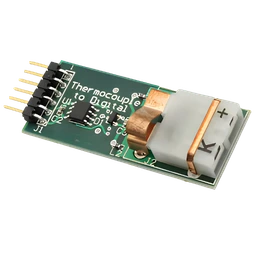
The MAX31856 is the most comprehensive thermocouple converter in the MAX series.

It allows for reading all standardized types (K, J, N, R, S, T, E, B) via a 4-wire SPI interface, while automatically managing:

  • cold junction compensation,
  • 19-bit ADC conversion,
  • and connection or short-circuit error detection.

This module is now a reference in industrial, scientific, and precision thermal control systems.

Operating principle


The MAX31856 measures the voltage generated by the thermocouple (a few µV/°C), converts it via a very low-noise 19-bit ADC, and applies a digital conversion according to the ITS-90 coefficients of the selected thermocouple type.

It integrates:

  • precise cold junction compensation (internal sensor ±0.5 °C),
  • digital filtering of 50/60 Hz noise,
  • and a programmable alarm system for threshold exceedances.

Technical specifications


Parameter
Typical value

Compatible thermocouple types

K, J, N, R, S, T, E, B
Maximum measurement range. −270 → +1800 °C
Resolution 19 bits (0,0078 °C)

Precision

±0,5 K (type K, 0–700 °C)

Interface

SPI (read/write)

SPI Frequency

Up to 5 MHz

Power supply voltage

3,0 → 3,6 V

Typical current

1.5 mA typical

Cold welding compensation

Integrated, 14-bit internal sensor

Cold welding compensation

Integrated, 14-bit internal sensor

Case

TQFN-20 / module breakout

Annual drift

Low (±0.1 K/year)

Wiring Configuration


Brooch
Name

Function

1

T-

Negative thermocouple input

2 T+

Positive thermocouple input

3 VCC

Power Supply (3.3 V)

4

GND

Mass

5

SCK

SPI Clock

6

CS

Chip Select

7

SDO

SPI Output (MISO)

8

SDI

SPI Input (MOSI)

9

DRDY

(optional) Data ready signal

10

FAULT

Configurable alarm signal

Self-warming


Almost zero (< 0.05 °C) thanks to ultra-low current ADC conversion.

Suitable for sensitive applications or precision measurement chains

Application areas


⚙️ High-temperature industrial processes (metallurgy, glassmaking, extrusion)

🔬 Laboratory instrumentation and thermal test benches

🧠 Precise control in 3D printing, ovens, and drying chambers

💡 Multi-type measurement systems (K, J, T, R...)

🧱 Embedded systems requiring high precision and integrated diagnostics


Should I choose a MAX31856 sensor ?

Strengths points

  • 🌡️ Universal multi-thermocouple compatibility
    → The MAX31856 supports all standardized types (K, J, T, N, E, R, S, B). A single module for all temperature ranges, from cryogenic to +1800 °C — a true thermal chameleon.
  • 🎯 Unmatched precision and resolution
    → With its 19-bit ADC and cold solder joint compensation of ±0.5 °C, it achieves a typical accuracy of ±0.5 K.

    It is the ideal choice for test benches, high-demand industrial processes, or thermal R&D.

  • ⚙️ Integrated diagnostics and filtering
    → Automatic error detection (short circuit, disconnected thermocouple), configurable 50/60 Hz digital filtering, and FAULT alarm output for intelligent real-time monitoring.
MAX31856 sensors

Weaknesses points

  • 💰 Higher cost
    → Its versatility and precision come at a price: the MAX31856 costs 2 to 3 times more than a MAX6675 or 31855 — reserved for professional or critical systems.
  • 🔋 Power supply 3.3 V only
    → Like the MAX31855, it requires a level shifter with 5 V microcontrollers (Arduino Uno, Mega, etc.).
  • → Multiple registers (configuration, filters, alarms, offset) require more advanced software initialization, even though libraries exist (Adafruit, STM32 HAL, etc.).

Useful information

Here is some useful information regarding the MAX31856 sensors.

The MAX31856 features a 19-bit analog-to-digital converter, a 14-bit cold junction sensor, and digital correction based on ITS-90 coefficients.

It thus offers exceptional accuracy, even in electrically noisy environments.

Parameter Valeur typique
Thermocouple resolution
19 bits (~0,0078 °C / LSB)
Cold welding resolution
14 bits (~0,0156 °C / LSB)
Precision ±0,5 K (type K, 0 → +700 °C)
Measurement range
−270 → +1800 °F (depending on type)
Annual drift
±0,1 K
Conversion time
100 → 200 ms
Power supply voltage
3,0 → 3,6 V
Max. SPI Frequency
5 MHz
Digital filters
Selectable 50 / 60 Hz
Cold solder joint
±0.5 °C typical

🔹 Remarks:

  • Internal automatic calibration, no external correction required.
  • Compatible with all ITS-90 thermocouples.
  • Exceptional stability due to multi-channel digital compensation.

The MAX31856 operates in SPI (4-wire) read/write mode.

Each transaction reads a 4-byte (32-bit) word, containing the thermocouple temperature, internal temperature, and status codes.

🔹 SPI Read Structure (32 bits)

Bits Name
Description
[31 → 13] Thermocouple temperature (19 signed bits)
Value × 0.0078125 °C
[12 → 4] Cold soldering temperature (9 bits)
Value × 0.015625 °C
[3] FAULT 1 = error detected
[2] OC Open thermocouple
[1] SCG Short circuit to GND
[0] SCV Short circuit to VCC
🔹 Conversion Equations

Thermocouple Temperature:

T_TC(°C) = Value_19b x 0,0078125

Cold weld temperature:

T_CJ(°C) = Value_14b x 0,015625


Final temperature:

TTOTAL = TTC + TCJ


🔹 Practical example

SPI reading (4 bytes) → 0x0010A4C0

Decoding:

  • Thermocouple temperature: 0x0010A = 426₁₀
  • Cold weld temperature: 0x4C = 76₁₀

✅ Measured temperature = 4.51 °C

T_TC = 426 × 0,0078125 = 3,32 °C

T_CJ = 76 × 0,015625 = 1,19 °C

T_TOTAL = 4,51 °C


🔹 Automatic error codes

  • OC = 1 → open thermocouple
  • SCV = 1 → short circuit to VCC
  • SCG = 1 → short circuit to GND
  • FAULT = 1 → error detected (check wiring or type)

The MAX31856 connects to any SPI-compatible microcontroller (Arduino, ESP32, STM32, Raspberry Pi, etc.).

It requires 4 SPI wires + power and supports software configuration (type of thermocouple, filter, offset, alarms).

🔹 Typical components

Composant Function
MAX31856 Universal thermocouple converter SPI
Thermocouple (K, J, T, N, R, S, E, B) Temperature sensor
Microcontroller
SPI management and data processing
Logic level converter (5V → 3.3V)
Optional
3.3 V Power Supply
Source stable
Capacitor (100 nF)
Power filtering
Pull-up resistor (10 kΩ)
Alarm Lines FAULT / DRDY (optional)
🔹 Functional diagram (ASCII)

+3.3V │ [Thermocouple] T+ ───┐ │ [MAX31856] │ T− ───┘ │ GND ───┴───────────────┐ │ ┌────────────────────┴────────────────────┐ │ Microcontroller │ │────────────────────────────────────────│ │ CS → GPIO D5 (chip select) │ │ SCK → GPIO D6 (SPI clock) │ │ SDI → GPIO D7 (MOSI) │ │ SDO → GPIO D8 (MISO) │ │ DRDY → GPIO D9 (data ready, optional) │ │ FAULT→ GPIO D10 (alarm, optional) │ │ VCC → 3.3V │ │ GND → GND │ └────────────────────────────────────────┘

🔹 Operating Principle

1️⃣ The microcontroller initializes the type of thermocouple (CONFIG0 register).

2️⃣ The MAX31856 measures the thermocouple voltage + internal temperature.

3️⃣ An SPI read returns the 32 bits of data + any error codes.

4️⃣ The system can trigger an alarm via the FAULT output if the thresholds are exceeded.

Advantage Description
🌡️ Universality Compatible with 8 different types of thermocouples
⚙️ Extreme precision and stability 19-bit resolution, drift ±0.1 K/year
🔧 Configurable digital filtering Eliminate 50/60 Hz noise
🔥 Automatic cold-junction compensation High-precision internal correction
🧠 Integrated diagnostics Automatically detected OC, SCV, SCG errors
🧩 Programmable alarms High/low thresholds, configurable FAULT signal
💻 Bidirectional SPI Interface Lecture + complete configuration from MCU

 We integrate any sensor into any probe 

Smooth tube probe

 Smooth tube 

Waterproof probe

 Waterproof

Bayonet probe

 Bayonet

Slot probe

 Slot

Ambient probe

 Atmosphere

Head connection probe

Termal block

Stick-in probe

Stick-in

Thread probe

Thread

Contact probe

Contact

Jacketed probe

Jacketed

PCBA Design

PCBA design

Winding probe

Winding

Plus de 1 000 000 sondes livrées en 2025

Contactez-nous pour une offre personnalisée

Contactez-nous

Need a MAX31856 sensor?

Que vous ayez besoin de quelques pièces pour un prototype ou de plusieurs centaines pour une ligne de production, nous vous accompagnons à chaque étape.

Soumettre
Liens utiles
  • Accueil
  • À propos de nous
  • Emplois
  • Mentions légales
  • Politique de confidentialité
  • Contactez-nous
À propos de nous

Chez Guilcor, notre mission est claire : fournir à chaque client une solution de mesure parfaitement adaptée à ses besoins spécifiques. Grâce à une maîtrise totale de la conception et de la fabrication, nous garantissons la précision et la fiabilité de nos capteurs, même dans les environnements les plus exigeants.

L'excellence technique et la satisfaction client sont au cœur de tout ce que nous faisons.

Rejoignez-nous
  • Contactez-nous
  • contact@guilcor.com
Suivez-nous