The SHTC3 temperature sensors
Typical current
100µA (active)
Price
Weak
Maximum precision
±0,3 °K
Measurement range (°C)
−40 / +125
Resolution
16 bits
Power supply voltage
1,62→3,6V
Sampling rate
1 to 10Hz
I²C Address
0x70
The SHTC3 is a digital humidity and temperature sensor from Sensirion, a direct successor to the SHTC1, and a more energy-efficient alternative to the SHT31.
It maintains excellent accuracy while reducing power consumption by a factor of 10.
Its compact design and wide voltage range (1.62 V to 3.6 V) make it an ideal choice for battery-operated applications, smartwatches, environmental IoT, or miniaturized embedded sensors.
The SHTC3 integrates:
- a capacitive sensor for humidity,
- a measurement diode for temperature,
- both converted by a 16-bit ADC and digitally compensated before being sent via I²C.
Official Sensirion formulas:
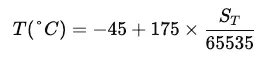
💡 The measurements are factory calibrated — no external compensation needed.
| Raw measurement (hex) | Temperature (°C) | Humidity (%) |
| 0x0000 | −45,0 | 0,0 |
| 0x8000 | +42,5 | 50,0 |
| 0xFFFF | +130,0 | 100,0 |
🧮 Resolution: 16 bits on each channel (T and RH).
+3.3V
 │
[SHTC3]
 │ SDA ─────────┐
 │ SCL ─────────┤── [I²C Microcontroller]
 │ GND
💡 Fixed address: 0x70 — therefore, there can only be one SHTC3 per I²C bus.
⌚ Wearables and connected objects
🧠 Environmental IoT sensors
🔋 Battery-powered devices (smart tags, watches, portable stations)
🏠 Home automation and ambient control
⚙️ Compact embedded applications
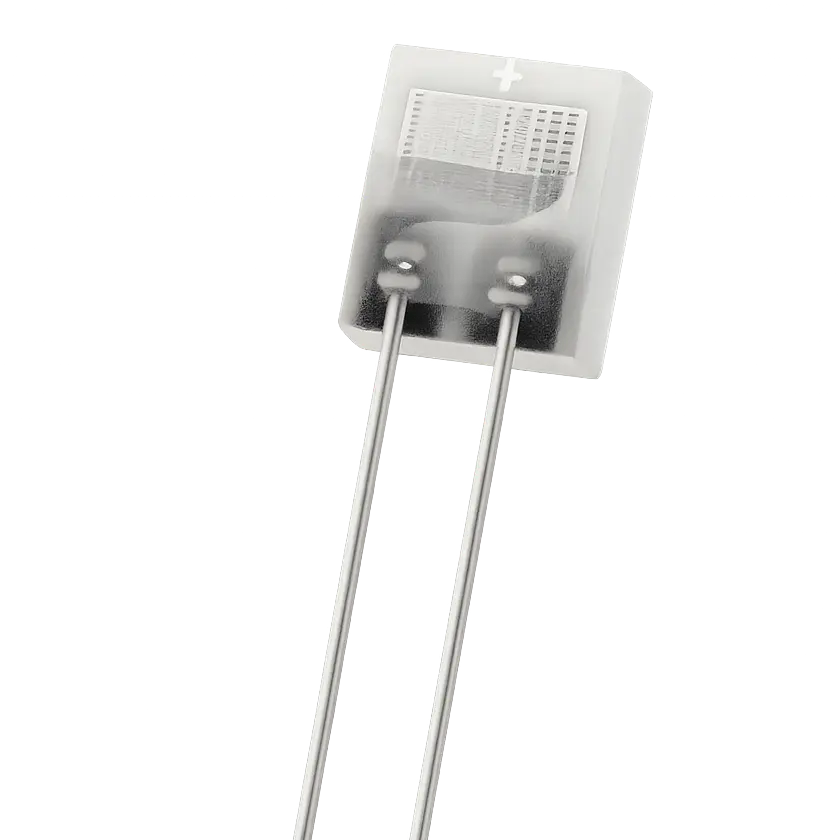
Should I choose an SHTC3 sensor?
Here are 3 strengths and 3 weaknesses to help you make your choice.
Strengths points
-
🔋 Ultra low power consumption
→ Less than 0.5 µA in standby — ideal for IoT or long-lasting battery products. - ⚙️ Ccompact and simple to integrate→ Miniature DFN package, standard I²C protocol and direct equations.
-
🎯 Good accuracy despite its compactness
→ ±0.3 K and ±2 % RH: more than sufficient for most embedded applications. -
🧠 Integrated automatic compensation
→ No external calibration or correction required.
Weak points
-
🌡️ More robust than the SHT31
→ No integrated PTFE coating — more susceptible to condensation and contaminants. -
📡 Fixed I²C address (0x70)
→ It is impossible to connect multiple devices on the same bus without multiplexing. -
💧 No independent temperature sensor
→ The two measurements (T and RH) are always linked in the I²C sequence.
Useful information
Here is some useful information regarding the SHTC3 sensors.
| Command (hex) |
Description |
| 0x3517 | Wake up (exit sleep mode) |
| 0xB098 | Sleep (sleep mode) |
| 0x7866 | High precision measurement, stretched clock |
| 0x58E0 | High precision measurement, without stretched clock |
| 0x609C | Low power measurement, without stretched clock |
| 0xE000 | State register lecture |
| 0x5D | Soft reset |
i2c_start();
i2c_write(0x70 << 1);
i2c_write(0x78);
i2c_write(0x66); // High precision mode
delay(15);
i2c_start();
i2c_write((0x70 << 1) | 1);
MSB_T = i2c_read_ack();
LSB_T = i2c_read_ack();
CRC_T = i2c_read_ack();
MSB_RH = i2c_read_ack();
LSB_RH = i2c_read_ack();
CRC_RH = i2c_read_nack();
i2c_stop();

S_T = (MSB_T << 8) | LSB_T;
S_RH = (MSB_RH << 8) | LSB_RH;
temp = -45 + (175.0 * S_T / 65535.0);
rh = 100.0 * S_RH / 65535.0;
✅ Example:
S_T = 31,000 → T = 37.8 °C
S_RH = 41,000 → RH = 62.5 %
1.8V–3.3V ────────┐
                   │
                  [SHTC3]
                   │ SDA ─────┐
                   │ SCL ─────┤── MCU (IoT, STM32, ESP32…)
                   │ GND
💡 Pull-up resistors of 10 kΩ on SDA/SCL are required if not included on the module.
| Bit | Name |
Description |
| 15 | Reset detected | Indicate a restart |
| 4 | Heater active | Internal heating ON |
| 0 | Command status | 0 = OK, 1 = CRC error |
| Temperature (°C) | Error (K) | HR Error (%) |
| −40 | ±0,5 | ±3,0 |
| 0 | ±0,3 | ±2,0 |
| 50 | ±0,3 | ±2,0 |
| 100 | ±0,4 | ±3,5 |
💡 The SHTC3 prioritizes low power consumption over industrial robustness, but its accuracy remains excellent for IoT.