Se rendre au contenu
guilcor.com
  • Page d'accueil
  • Sondes
    Smooth tube probe

    Tube lisse

    Réfrigérateur, pompe à chaleur, four, congélateur, chauffe-eau
    Contact probe

    Contact

    Tuyau, surface de tuyau, plaque de chauffage
    Slot probe

    D'Encoche

    Moteur, alternateur, enroulement, stator
    Head connection probe

    Avec Bornier

    Chaudière, pompe à chaleur, climatisation, locaux techniques, ventilation
    Waterproof probe

    Étanche

    Climatisation, ventilation, réfrigération, stockage à froid, conduits
    Stick-in probe

    À Piquer

    Four, cuisson, équipements alimentaire
    Winding probe

    Bobinage

    Moteur, alternateur, transformateur, enroulement, stator
    Ambient probe

    Ambiance

    Chaudière, pompe à chaleur, climatisation, locaux techniques, ventilation
    Thread probe

    Avec Raccord

    Machine à café, chaudière, vapeur, fluide sous pression
    Jacketed probe

    Chemisée

    Installations industrielles, applications lourdes
    Bayonet probe

    Baïonnette

    Moulage plastique, outillage, machine de moulage par injection, moteur, alternateur
    PCBA Design

    PCB Design

    Application spécifique, électronique embarquée, cartes électroniques sur mesure
  • Capteurs

    RTD

    Pt10, Pt50, Pt100, Pt200, Pt500, Pt1000, Pt5000, Ni100, Ni120, Cu10, Cu50, Balco...

    PTC

    KTY81-110, KTY81-210, KTY83-110, KTY84-130, PTC130, Silistor, TFPT, MZ6, MZ8, MZ9...

    1-Wire

    DS18B20, DS18S20, DS1822, DS28EA00, DS18B20-PAR, DS1920, DS2438, DS1825...

    Thermocouple

    B, E, J, K, N, R, S, T, C, D, G

    UART

    MLX90614, MLX90615, GY-906, DHT11, DHT22, AM2302, SHT75, SHT85, RS232, RS485

    SPI

    MAX6675, MAX31855, MAX31856, MCP3208, TMP125, TMP121, ADT7310, LTC2983...

    NTC

    1kΩ, 2kΩ, 3kΩ, 5kΩ, 10kΩ, 15kΩ, 20kΩ, 30kΩ, 50kΩ, 100kΩ, 200kΩ, 470kΩ, 1MΩ...

    I²C

    TMP102, TMP117, TMP119, LM75, LM73, MCP9808, MCP9600, SHT31, SHTC3, BME280, BME688, HTU21D, HDC1080, Si7051, ADT7410, STTS751, TCN75A
  • Entreprise
  • 0
  • 0
  • Suivez-nous
  • English (US) Français Español
  • Se connecter
  • Contactez-nous
guilcor.com
  • 0
  • 0
    • Page d'accueil
    • Sondes
    • Capteurs
    • Entreprise
  • Suivez-nous
  • English (US) Français Español
  • Se connecter
  • Contactez-nous

 Type C 
 Temperature sensors 

Pt10 temperature sensors provide accurate and reliable temperature measurement for industrial applications requiring low nominal resistance.

 Maximum precision
+/- 1,0°K

 Minimum temperature
0°C

 Maximum temperature
+2320°C

 Minimum dimensions
0,5 x 50 x 5

 Response time
Low

 Internal Resistance
Low

 Linearity
Low

Price
High

What is a Type C thermocouple ?Operating principleTechnical specificationsVoltage / Temperature CurveCompatibility / CompensationApplication areas

What is a Type C thermocouple ?


The type C thermocouple is designed for extreme temperatures — up to +2,320 °C.

It is made from tungsten-rhenium alloys:

  • W-5%Re / W-26%Re (tungsten with 5% and 26% rhenium).

It is the preferred sensor in inert or vacuum atmospheres, where noble metals like platinum would lose their properties.

It offers remarkable stability and excellent mechanical resistance at high temperatures.

Operating principle


Like all thermocouples, type C relies on the Seebeck effect: a temperature difference between the junctions generates a voltage proportional to this difference.

E = S × (T_hot - T_cold)

For type C:

S ≈ 20 µV/°C at 1,000 °C

It produces a moderate voltage but maintains exceptional linearity and stability up to 2,300 °C — where most other types literally melt.

Technical specifications


Parameter Typical Value
Measurement range 0 °C → +2 320 °C
Sensitivity 20 µV/°C at 1 000 °C
Tension at 1000 °C ≈ 14,80 mV
Tension at 2000 °C ≈ 29,12 mV
Tension at 2300 °C ≈ 33,10 mV
Oxidation resistance Null in open air (use under vacuum or inert gas)
Response time (6 mm diameter sheath) 5 to 12 s
Reference standard ASTM E230 (no official IEC standard)

Voltage / Temperature Curve


(Reference: Cold junction at 0 °C — ASTM E230 standard)

Type C offers a linear and stable curve between 400 °C and 2,300 °C, with very low drift even over the long term.

📈 General behavior:

  • From 0 to 2,300 °C → increasing voltage (~0 to +33 mV)
  • Average slope: ≈ 20 µV/°C at 1,000 °C
  • Drift: <0.05% after 100 hours at 2,000 °C

💡 Type C is an extreme thermocouple: high precision, great stability, but demanding on operating conditions.

Compatibility / Compensation


The type C is not compatible with oxidizing environments: it must be used in an inert atmosphere or under vacuum (argon, helium, dry hydrogen).

It requires a precision differential amplifier and stable cold junction compensation.

Compatible modules include, in particular, the LTC2983 and specialized high-temperature measurement chains.

Application areas


🚀 Aerospace, turbines and rocket engines

🔬 High-temperature laboratories, plasma and high vacuum

⚙️ Metallurgy, arc furnaces, melting of refractory metals

🧪 Nuclear industry and advanced materials
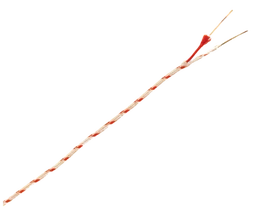


Should I choose a Type C thermocouple?

Strengths points

  • 🔥 King of Extreme Temperatures
    → With an operating limit of +2,320 °C, it surpasses all conventional thermocouples.
  • Remarkable stability under vacuum→ Ideal for inert environments, it maintains its accuracy even after long thermal exposures.
  • 🧱 Ultra-resistant materials
    → Tungsten-rhenium alloys retain their mechanical properties at very high temperatures.
Thermocouple Type C sensors

Weaknesses points

  • 🌬️ Incompatible with air
    → The oxidation of tungsten in open air destroys the probe within a few minutes at high temperature.
  • 💸 Very expensive and fragile
    → Its complex manufacturing and rare materials make it a sensor reserved for critical applications.
  • ⚙️ Specific electronics required
    → Requires a calibrated acquisition chain and special connectors to support the voltage level and temperature.

Useful information

Here is some useful information regarding Type C thermocouples.

(Reference: cold junction at 0 °C — ASTM E230 standard)
Temperature (°C) Tension (mV) Temperature (°C) Tension (mV)
0 0,000 1 400 20,13
400 5,33 1 600 22,73
800 10,52 1 800 25,70
1 000 14,80 2 000 29,12
1 200 17,50 2 300 33,10
💡 The tension increases almost linearly up to 2,300 °C, without significant drift.
Class Tolerance (K) Usage area
Description
Standard (C68)
±1,0 K ou ±0,25 % 0 → +2 300 °C High precision
No IEC class
— — Non-standardized according to IEC 60584
🔹 The actual precision mainly depends on the quality of the vacuum and the electronic stability of the system.

Example 1 – Calculation of the generated voltage

Measured temperature: 1,800 °C

Cold weld at 0 °C

E = 25,70mV

Cold welding at 25 °C → correction voltage ≈ 0.27 mV :

E_measured = 25,70 - 0,27 = 25,43 mV

✅ Actual voltage ≈ 25.43 mV


Example 2 – Calculating the temperature from a measured voltage

Measured voltage: 29.12 mV (cold weld at 0 °C)

→ By consulting the ASTM table:

T=2000°C

✅ Measured temperature ≈ 2,000 °C

The type C thermocouple generates a low but stable voltage at very high temperatures.

It requires an isolated differential amplifier and a high-precision acquisition system.

🔹 Typical components

Component
Function
Thermocouple type C (W5Re / W26Re)
Generate the Seebeck voltage
Isolated differential amplifier
Amplify and protect the signal
Compensation sensor
Correct the cold junction
ADC 24 bits Convert the voltage into digital data
Microcontroller / Oven Controller
Calculate the final temperature using the ASTM table
🔹Functional diagram (ASCII)

[HOT JUNCTION]──(Thermocouple C)──[ISOLATED AMPLIFIER]──[ADC]──[µCONTROLLER] │ └──(Compensation sensor)

💡 Type C is the thermocouple for extreme conditions: it exceeds 2,000 °C where all others fail.

 We integrate any sensor into any probe 

Smooth tube probe

 Smooth tube 

Waterproof probe

 Waterproof

Bayonet probe

 Bayonet

Slot probe

 Slot

Ambient probe

 Atmosphere

Head connection probe

Termal block

Stick-in probe

Stick-in

Thread probe

Thread

Contact probe

Contact

Jacketed probe

Jacketed

PCBA Design

PCBA design

Winding probe

Winding

Plus de 1 000 000 sondes livrées en 2025

Contactez-nous pour une offre personnalisée

Contactez-nous

Need a Type C thermocouple?

Que vous ayez besoin de quelques pièces pour un prototype ou de plusieurs centaines pour une ligne de production, nous vous accompagnons à chaque étape.


Soumettre
Liens utiles
  • Accueil
  • À propos de nous
  • Emplois
  • Mentions légales
  • Politique de confidentialité
  • Contactez-nous
À propos de nous

Chez Guilcor, notre mission est claire : fournir à chaque client une solution de mesure parfaitement adaptée à ses besoins spécifiques. Grâce à une maîtrise totale de la conception et de la fabrication, nous garantissons la précision et la fiabilité de nos capteurs, même dans les environnements les plus exigeants.

L'excellence technique et la satisfaction client sont au cœur de tout ce que nous faisons.

Rejoignez-nous
  • Contactez-nous
  • contact@guilcor.com
Suivez-nous