RTD
temperature sensors
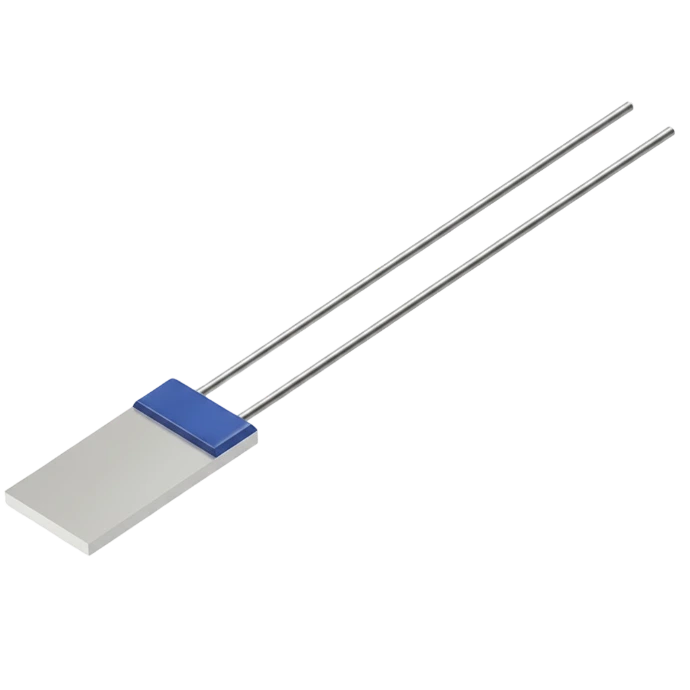
Highly regarded in the industry, RTDs are the benchmark for demanding projects: automation, regulation, quality control, etc.
What is an RTD sensor ?
An RTD (Resistance Temperature Detector) is a variable resistance temperature sensor. It utilizes the property of metals, typically platinum, whose resistance increases with temperature.
RTDs are known for their high precision, long-term stability, and excellent linear behavior.
We integrate any sensor into any probe


Termal block


✽ What RTDs Offer
Discover the main four benefits
High measurement precision
RTD sensors allow for highly accurate temperature measurements, often to ±0.1°C. They are especially suitable for environments where fine precision is essential, such as laboratories, HVAC systems, or sensitive processes.
Wide compatibility and variety of formats
RTD sensors (such as Pt100 or Pt1000) are recognized by most industrial devices. They can be configured in 2, 3, or 4 wires, mounted in rigid, flexible, or immersible probes, depending on requirements.
Linear response curve
Their resistance variation is almost linear with temperature, simplifying data analysis and enhancing compatibility with acquisition and control systems.
Stability and long-term reliability
Thanks to the stability of the material used (often platinum), an RTD sensor ensures reliable measurements over the long term without frequent recalibration. It is a safe choice for permanent or critical installations.
Do you have a project ? Let's talk about it.
Need an RTD sensor suited to your constraints ?
Whether for industrial thermal regulation, building control, or embedded solutions, our sensors are available in various formats and resistance values. Tell us more about your project.
Frequently asked questions
Here are some common questions about our RTDs.
RTD sensors operate based on a predictable relationship between temperature and resistance (R/T). This resistance increases with temperature, and the variation is measurable with precision.
Platinum elements are most commonly used due to their thermal stability and wide measurement range. Copper, although very linear, is limited to 150°C due to oxidation. Nickel becomes non-linear beyond 300°C.
The temperature coefficient of resistance, noted as α, expresses this variation. For industrial RTDs, the most common standard is α = 0.00385 Ω/(Ω·°C). This value may vary slightly depending on the purity of the platinum used.
To ensure the accuracy of an RTD sensor over its operating range, it must be calibrated at various temperatures, not just at 0°C and 100°C. This verifies the reliability of its resistance/temperature (R/T) curve under real conditions.
- The two main methods are: The fixed-point method, used in laboratories, relies on very stable reference temperatures (freezing point, triple point…) of pure substances like water, zinc, or tin. It offers precision up to ±0.001°C.
- The comparison method, more common in industry, uses an ice bath as a secondary standard (±0.005°C). It is simple, economical, and allows for calibrating multiple probes simultaneously.
There are several types of RTD elements, each with specific characteristics depending on usage, temperature range, or expected precision :
- Thin-film elements : a thin layer of platinum deposited on a ceramic substrate. Compact and economical, but less stable long-term. Max temperature: ~600°C with encapsulation.
- Wire-wound elements : platinum wire wound on an insulating core. Very precise but sensitive to mechanical stress.
- Coiled elements : an evolution of wire-wound elements, designed to allow the sensing wire to expand freely in a ceramic mandrel. Very stable and robust up to 850°C.
- Strain-free elements : used in laboratories (SPRT), offer extreme precision but are fragile. Operate up to 960°C.
- Carbon elements : for extremely low temperatures (-173°C to -273°C). Inexpensive and reproducible, but rarely used in industry.
The IEC 60751:2008 standard specifies the tolerances and characteristics of RTDs, particularly Pt100 and Pt1000, according to their nominal resistance at 0°C.
It is commonly used with secondary SPRTs and industrial RTDs. Thermometers being calibrated are compared to calibrated thermometers using a bath with uniformly stable temperature. Unlike fixed-point calibrations, comparisons can be made at any temperature between -100°C and 500°C. This method can be more cost-effective, as multiple sensors can be calibrated simultaneously with automated equipment. These electrically heated and well-stirred baths use silicone oils and molten salts as mediums for different calibration temperatures.
A resistance temperature detector (RTD) measures temperature by detecting the change in electrical resistance of a metal (often platinum) in response to temperature. Unlike thermocouples, it requires an external power source.
The resistance change follows a nearly linear relationship, modeled by the Callendar–Van Dusen equation. To remain stable and accurate, the sensing wire (often platinum) must be protected from contamination and mechanical deformation.
- Sensors are generally designed to have 100 Ω at 0°C.
- Two standards are used : the coefficient of 0.00385/°C (European standard IEC 60751) and 0.00392/°C (American standard).
- Errors related to connection wires are corrected using 3 or 4 wire configurations — the 3-wire version is most common in industry, while the 4-wire version is used for high-precision measurements.
Advantages :
- High accuracy : Ideal for demanding temperature measurements. - Low drift: RTDs maintain reliability over time.
- Wide operating range : Usable between -200°C and +600°C (or more with special versions).
- Good stability : Long-term measurement reproducibility.
Limitations :
- Extreme temperatures : Less suitable beyond 660°C due to platinum contamination risks. Ineffective below -270°C.
- Slower response time : Compared to thermocouples.
- Less sensitive than thermistors for small temperature variations.
A resistance temperature detector (RTD) typically consists of :
- A sensing element (often platinum),
- Insulated conductors, made of PVC, PTFE, or silicone for temperatures < 250°C, and fiberglass or ceramic beyond that.
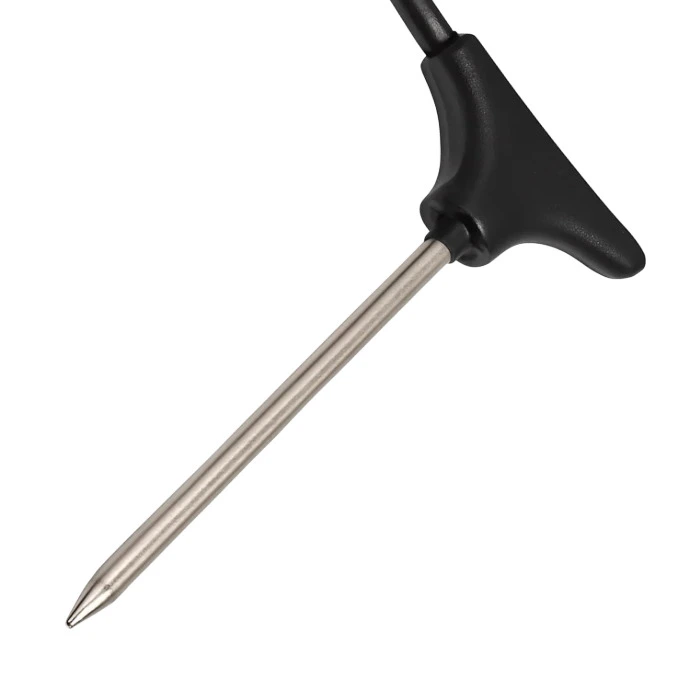
- A protective sheath, often metallic alloy, which guards against chemical or mechanical damage and also serves as a mounting point.
The design of this sheath is crucial to ensure the sensor's durability in industrial environments.
RTD sensors are classified into three main categories based on their precision and usage :
SPRT (Standard Platinum Resistance Thermometer): Used in laboratories, they offer the highest precision (±0.001°C) over a range of -200°C to 1000°C. Made with pure platinum and high-grade materials (quartz, silica), they are expensive and fragile.
Secondary SPRT : Also designed for laboratories, but with more accessible materials (less pure platinum, ceramic insulators). Less precise (±0.03°C) and limited to a maximum of 500°C, but more affordable.
Industrial PRT: Designed for demanding environments. Robust, they use thin-film or wire-wound elements with stainless steel sheaths. Less precise than laboratory versions, but well-suited for industrial applications.
RTD sensors are classified into three main categories based on their precision and usage :
- 1. 2-wire configuration
Simple and economical but not very precise; the resistance of the cables skews the measurement.
➡️ Best for applications where precision is not critical.
- 2. 3-wire configuration
The best compromise between cost and precision.
➡️ Compensates for wire resistance, widely used in industry.
- 3. 4-wire configuration
The most precise. Completely eliminates cable influence and reduces errors due to thermoelectric effects.
➡️ Used in metrological or highly sensitive applications.