10KΩ temperature sensors
10KΩ
Temperature sensors
Pt10 temperature sensors provide accurate and reliable temperature measurement for industrial applications requiring low nominal resistance.
Maximum precision
±0.1°K
Minimum temperature
-55°C
Maximum temperature
+150°C
Minimum dimensions
2x10
Response time
Fast
Self-warming
Weak
Price
Weak
Drift
Weak
The NTC 10 kΩ is the standard thermistor on the market, offering an excellent balance between cost, sensitivity, and stability.
With a nominal resistance of 10,000 Ω at 25 °C, it is compatible with most control boards, thermostats, HVAC systems, and Arduino/ESP32 modules.
The resistance varies exponentially with temperature:
R(T) = R₂₅ · e^(β(1/T − 1/T₂₅))
where:
R₂₅ = 10 000 Ω
β ≈ 3950 K
T en kelvins
This variation is measured by a microcontroller via a voltage divider, then converted to °C using a table or the Steinhart–Hart equation.
| Parameter | Typical value |
| Nominal resistance (25 °C) | 10 000 Ω ±1 % |
| Constant β | 3435–3950 K |
| Sensitive material | Metallic oxide (Mn, Ni, Co) |
| Type of case | Epoxy / glass / ceramic |
| Maximum measurement current | 0.1 to 0.3 mA |
| Response time | 0.2 to 1 s |
| Usage area | −55 → +150 °C |
| Lifetime | 100,000 thermal cycles |
Used in 2-wire configuration, the NTC 10 kΩ is often integrated into a voltage divider for reading by an ADC (microcontroller).
 +Vcc
   │
  [Rfixe]
   │────► ADC (µC)
  [NTC 10kΩ]
   │
  GND
The current being very low (≈ 0.1 mA), the power dissipated remains negligible, ensuring a reliable measurement without thermal correction.
🌡️ HVAC systems and smart thermostats
⚙️ Industrial control electronic boards
💧 Water/air immersion probes
🧠 Low-power IoT sensors
🩺 Medical and biomedical devices
🔋 Thermal compensation in batteries and power supplies
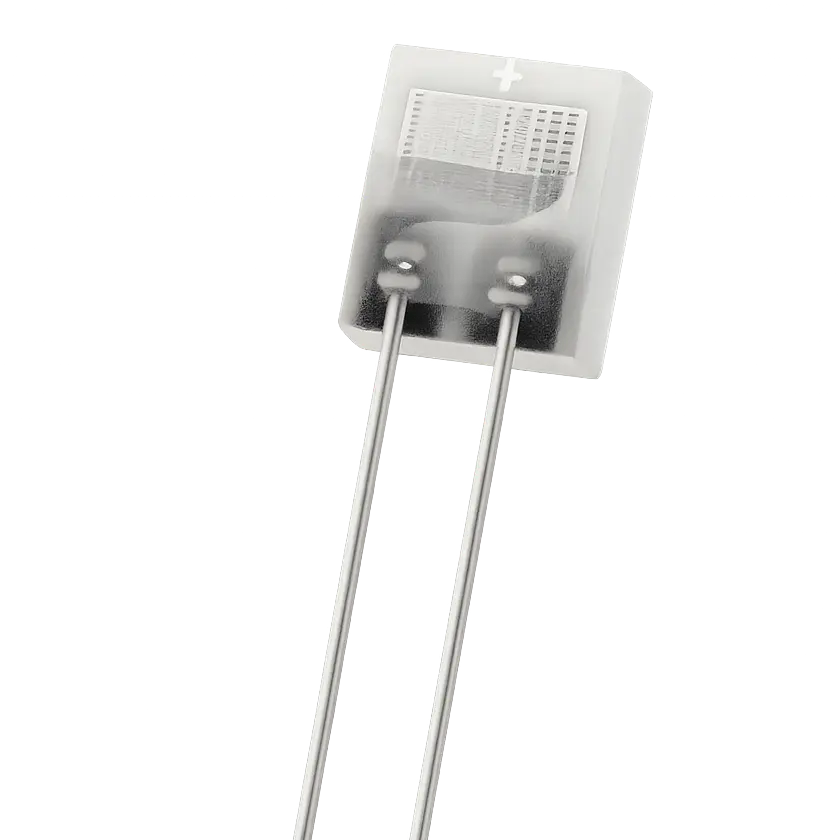
Should I choose a 10KΩ sensor?
Here are 3 strengths and 3 weaknesses to help you make your choice.
Strengths
-
🌍 Universal standard
→ The NTC 10 kΩ is the most widely used in the world: compatible with the majority of boards, probes, thermostats, and controllers on the market (HVAC, Arduino, ESP, STM32…). - 🎯 Excellent accuracy around 25 °C→ With a typical error of ±0.1 K and very good stability, it offers proven reliability for comfort and process measurements.
-
💸 Unbeatable performance/price ratio
→ Easy to integrate, low cost, robust — the 10 kΩ remains the best choice for most thermal applications.
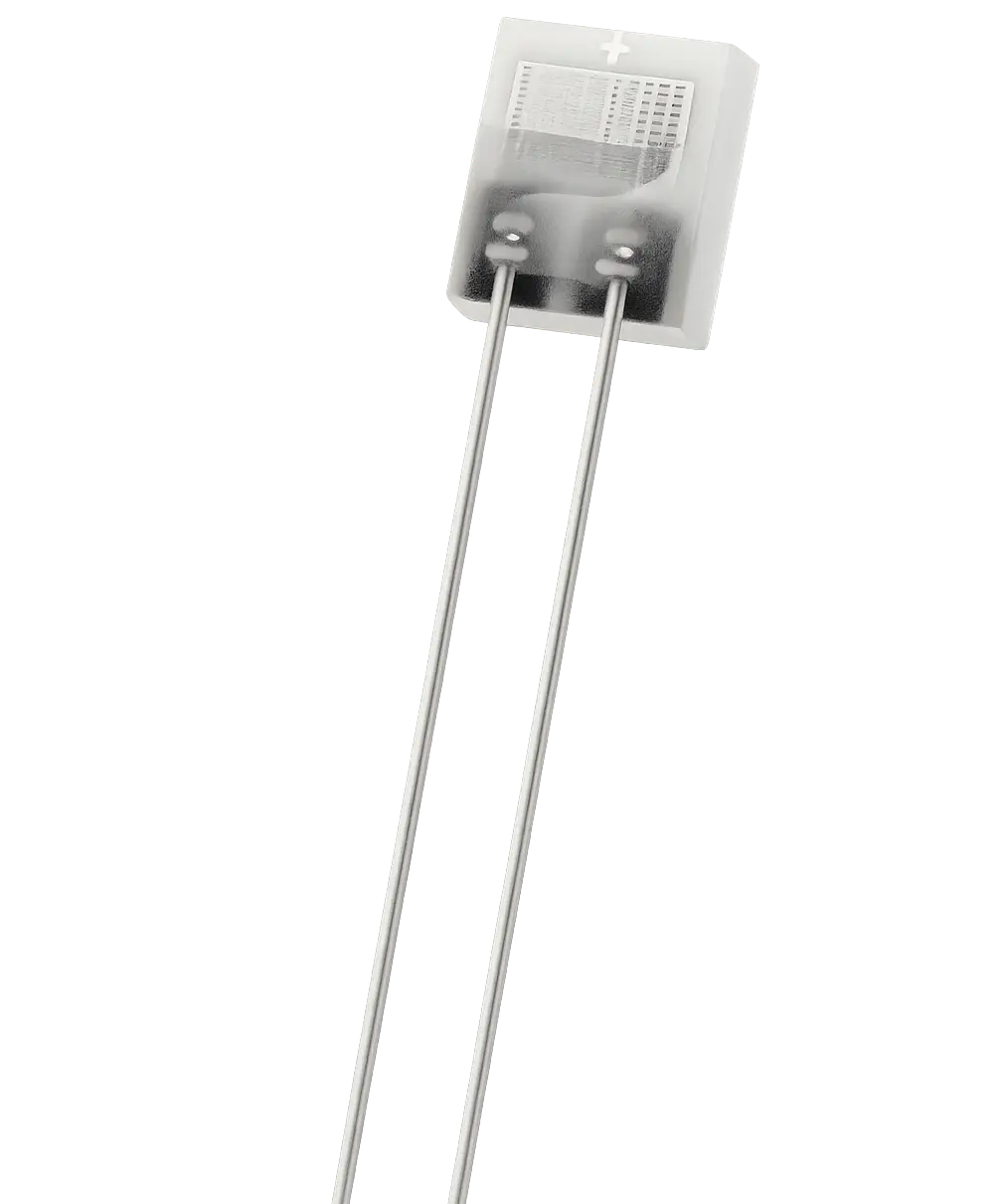
Weak points
-
📉 Natural non-linearity
→ Like any NTC, it requires digital processing (β formula or lookup table) to provide an accurate temperature. -
Lower sensitivity to high temperature
→ Beyond 100 °C, the resistance variation becomes small, reducing measurement resolution. -
🔋 Possible self-heating in direct current
→ In the case of continuous measurement or under high voltage, a self-drift of a few hundredths of a degree may occur.
Useful information
Here is some useful information regarding the 10KΩ sensors.
(NTC 10 kΩ at 25 °C, beta constant = 3950 K)
| Temperature (°C) | Resistance (Ω) | Temperature (°C) | Resistance (Ω) |
| −50 | 249 418 | 60 | 2 932 |
| −40 | 158 034 | 70 | 2 206 |
| −30 | 101 689 | 80 | 1 689 |
| −20 | 67 082 | 90 | 1 302 |
| −10 | 44 840 | 100 | 1 010 |
| 0 | 30 460 | 110 | 782 |
| 10 | 20 950 | 120 | 631 |
| 20 | 14 740 | 130 | 503 |
| 25 | 10 000 | 140 | 403 |
| 30 | 6 863 | 150 | 324 |
| 40 | 4 762 | 160 | 262 |
| 50 | 3 364 | 170 | 213 |
💡 Entre 0 °C et 100 °C, la résistance chute d’un facteur ≈ 30 — typique d’une NTC 10 kΩ avec β ≈ 3950 K.
| Class / Tolerance |
Tolerance at 25 °C (R25) |
Max error on T° (−40 → +125 °C) |
Typical usage |
| ±0,5 % | ±50 Ω | ±0,05 K | Metrological and Medical Studies |
| ±1 % | ±100 Ω | ±0,1 K | Precision measurement and HVAC control |
| ±2 % | ±200 Ω | ±0,2 K | Industrial applications |
| ±3 % | ±300 Ω | ±0,5 K | Consumer / IoT / mass-produced electronics |
Equation:
1/T = A + B · ln(R) + C · [ln(R)]³
Typical coefficients for NTC 10 kΩ β = 3950 K:
- A = 1.4051 × 10⁻³
- B = 2.369 × 10⁻⁴
- C = 1.019 × 10⁻⁷
🔹 Example 1: Temperature from R
R = 6,863 Ω
ln(6863) = 8,83
1/T = 1,4051e−3 + 2,369e−4 (8,83) + 1,019e−7 (8,83)³ = 3,03e−3
T = 1 / 3,03e−3 = 329,7 K = 56,5 °C
✅ Measured temperature: ≈ 56 °C
🔹 Example 2: Resistance from T
T = 80 °C = 353.15 K
R = R₂₅ · e^(β(1/T − 1/T₂₅))
R = 10000 · e^(3950 × (1/353,15 − 1/298,15)) = 1689 Ω
✅ Expected resistance: ≈ 1.69 kΩ
The NTC 10 kΩ is the absolute standard in temperature measurement circuits.
It connects directly to a microcontroller (ADC) via a voltage divider.
🔹 Typical components
| Component |
Function |
| NTC 10 kΩ |
Temperature sensor |
| R fixed (10 kΩ) |
Reference resistance |
| Microcontroller |
Lecture ADC / temperature conversion |
| 100 nF capacitor |
Filtering |
| Power Supply 3.3 / 5 V |
Tension stable |
  +3.3V / +5V
       │
     [Rfixe]
       │────► ADC (microcontroller input)
     [NTC 10kΩ]
       │
      GND
💡 The measured voltage is proportional to the temperature according to the calibration curve.
A simple calculation using Steinhart–Hart allows for obtaining T(°C) with an accuracy of ±0.1 K.