Skip to Content

 3KΩ 
 Temperature sensors 

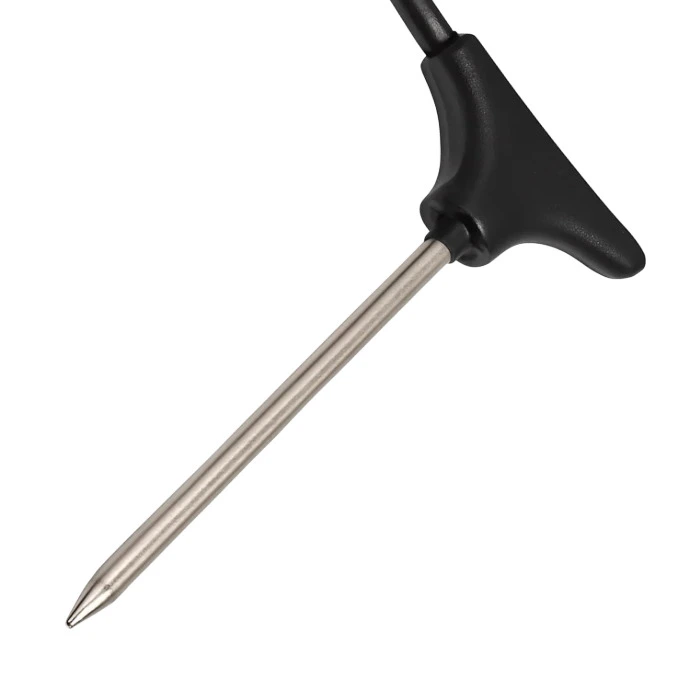
Versatile NTC thermistor designed for accurate temperature monitoring in industrial and consumer electronics.

 Maximum precision
+/- 0,10°K

 Minimum temperature
-50°C

 Maximum temperature
+150°C

 Minimum dimensions
2 x 10

Response time

Fast

 Drift

Low

 Self-warming
Low

Price
Low

What is a 3KΩ sensor ?


The NTC 3 kΩ is a thermistor with a nominal resistance of 3,000 Ω at 25 °C.

It offers greater stability and reduced self-heating compared to the 1 kΩ and 2 kΩ versions, while maintaining very good sensitivity in the 0–100 °C range.

It is an excellent compromise between accuracy, local linearity, and robustness.

Operating principle


As with all NTCs, the resistance decreases exponentially with temperature:

R(T) = R₂₅ · e^(β(1/T − 1/T₂₅))

  • R₂₅ = 3 000 Ω 
  • β ≈ 3950 K
  • T exprimée en kelvins

The signal is then linearized via software (β formula or Steinhart–Hart equation).

Technical Specifications


Parameter
Typical value

Nominal resistance (25 °C)

3000 Ω ±1 %
Constant β 3500–3900 K

Sensitive material

Metallic oxide (Mn, Ni, Co)

Type of case Epoxy / glass / pearl

Maximum measurement current

0,4 mA (to limit self-heating)

Response time

0.3 to 1 s

Operating temperature

−50 → +150 °C

Lifetime

100,000 thermal cycles

Wiring Configuration


Always in 2 wires via a voltage divider bridge, or integrated into an analog measurement module.

+Vcc │ [Rfixe] │────► ADC [NTC 3kΩ] │ GND

Self-warming


Less than 0.03 °C for a measurement current of 0.3 mA — excellent for precision applications.

Application areas


🧭 Ambient temperature measurement in control electronics

⚙️ Regulation and thermal compensation in analog circuits

💧 Submersible sensors for liquids and gases

🧱 Air conditioning systems, HVAC, OEM probes

🧠 Medical and metrological equipment


Should I choose a 3KΩ sensor ?

Strengths points

  • 🎯 Very good thermal stability
    → The 3 kΩ offers low drift and minimal self-heating, ensuring excellent measurement repeatability over the long term.
  • ⚙️ Ideal compromise sensitivity / consumption
    → It maintains good sensitivity around 25 °C while reducing the current flowing through, perfect for precise but low-power systems
  • 💶 Economic and sturdy
    → Its simple construction and low cost make it a reliable and durable choice for industrial and HVAC applications.
3kΩ sensors

Weaknesses points

  • 📉 Non-linear response
    → Like all NTCs, the voltage-temperature conversion requires software processing, which complicates calculations without a microcontroller.
  • 🌡️ Decreasing sensitivity at high temperature
    → The variation in resistance becomes less pronounced beyond 100 °C, which reduces accuracy in the higher ranges.
  • 🔋 Measurement current dependence
    → A current that is too strong can distort the values: the design of the bridge must be carefully calibrated.

Useful information

Here is some useful information regarding the 3KΩ sensors.

(NTC 3 kΩ at 25 °C, beta constant = 3950 K)

Temperature (°C) Resistance (Ω) Temperature (°C) Resistance (Ω)
−50 74 826 60 879
−40 47 410 70 661
−30 30 507 80 506
−20 20 125 90 390
−10 13 451 100 305
0 9 136 110 241
10 6 283 120 192
20 4 421 130 154
25 3 000 140 124
30 2 058 150 100
40 1 428 160 81
50 1 008 170 66

💡 Entre 0 °C et 50 °C, la résistance est divisée par environ 9 — caractéristique typique d’une NTC à β ≈ 3950.

Class / Tolerance
Tolerance at 25 °C (R25)
Max error on T° (−40 → +125 °C)
Typical usage
±1 % ±30 Ω ±0,2 K Laboratory applications and calibrated sensors
±2 % ±60 Ω ±0,4 K HVAC and industrial systems
±3 % ±90 Ω ±0,6 K Common electronic devices
±5 % ±150 Ω ±1 K Public or security applications

🔹 The 3 kΩ NTCs coated with glass or ceramic ensure excellent thermal stability up to 150 °C.

Complete equation:

1/T = A + B · ln(R) + C · [ln(R)]³


Typical coefficients for a 3 kΩ NTC, β = 3950 K:

  • A = 1,4051 × 10⁻³
  • B = 2,369 × 10⁻⁴
  • C = 1,019 × 10⁻⁷


🔹 Example 1: temperature from R

R = 2058 Ω

ln(2058) = 7,629

1/T = 1,4051e−3 + 2,369e−4 (7,629) + 1,019e−7 (7,629)³ = 3,06e−3

T = 1 / 3,06e−3 = 326,8 K = 53,6 °C

✅ Temperature ≈ 54 °C


🔹 Example 2: resistance from T

T = 80 °C = 353.15 K

R = R₂₅ · e^(β(1/T − 1/T₂₅))

R = 3000 · e^(3950 × (1/353,15 − 1/298,15)) = 506 Ω

✅ Expected resistance ≈ 506 Ω

🔹 Typical components

Component
Function
NTC 3 kΩ Temperature sensor
Fixed resistor (3 kΩ) Bridge reference
Microcontroller Lecture ADC
Power Supply 3.3 / 5 V Tension stable
100 nF capacitor Noise filtering

🔹 Functional diagram (ASCII)

+3.3V / +5V │ [Rfixe] │────► ADC (microcontroller input) [NTC 3kΩ] │ GND

💡 A two-point calibration (0 °C and 100 °C) improves the effective accuracy to ±0.1 K.

More than 1,000,000 probes delivered in 2025

Contact us for a personalized offer

Contact Us

Need a 3KΩ sensor?

Whether you need a few parts for a prototype or several hundred for a production line, we support you at every step.