Skip to Content
GUILCOR SENSORS
  • Home
  • Probes
    Smooth tube probe

    Smooth Tube

    Refrigerator, heat pump, oven, freezer, water heater
    Contact probe

    Contact

    Pipe, pipe surface, heating plate
    Slot probe

    Slot

    Motor, alternator, winding, stator
    Head connection probe

    Connection head

    Boiler, heat pump, air conditioning, technical rooms, ventilation
    Waterproof probe

    Waterproof

    Air conditioning, ventilation, refrigeration, cold storage, ductwork
    Stick-in probe

    Stick-in

    Oven, cooking, food processing equipment
    Winding probe

    Winding

    Motor, alternator, transformer, winding, stator
    Ambient probe

    Ambient

    Boiler, heat pump, air conditioning, technical rooms, ventilation
    Thread probe

    Thread

    Coffee machine, boiler, steam, pressurized fluid
    Jacketed probe

    Jacketed

    Industrial installations, heavy-duty applications
    Bayonet probe

    Bayonet

    Plastic molding, tooling, injection molding machine, engine, alternator
    PCBA Design

    PCBA design

    Specific application, embedded electronics, custom electronic boards
  • Sensors

    RTD

    Pt10, Pt50, Pt100, Pt200, Pt500, Pt1000, Pt5000, Ni100, Ni120, Cu10, Cu50, Balco

    PTC

    KTY81-110, KTY81-210, KTY83-110, KTY84-130, PTC130, Silistor, TFPT, MZ6, MZ8, MZ9

    1-Wire

    DS18B20, DS18S20, DS1822, DS28EA00, DS18B20-PAR, DS1920, DS2438, DS1835...

    Thermocouple

    B, E, J, K, N, R, S, T, C, D, G

    UART

    MLX90614, MLX90615, GY-906, DHT11, DHT22, SHT75, SHT85, RS232, RS485

    SPI

    MAX6675, MAX31855, MAX31856, MCP3208, TMP125, TMP121, ADT7310, LTC2983...

    NTC

    1kΩ, 2kΩ, 3kΩ, 5kΩ, 10kΩ, 15kΩ, 20kΩ, 30kΩ, 50kΩ, 100kΩ, 200kΩ, 470kΩ, 1MΩ

    I²C

    TMP102, TMP117, LM75, LM73, MCP9808, MCP9600, SHT31, SHTC3, BME280, BME688, HTU21D, HDC1080, Si7051, ADT7410, STTS751, TCN75A...
  • About us
  • 0
  • 0
  • Follow us
  • English (US) Français Español
  • Sign in
  • Contact Us
GUILCOR SENSORS
  • 0
  • 0
    • Home
    • Probes
    • Sensors
    • About us
  • Follow us
  • English (US) Français Español
  • Sign in
  • Contact Us

 KTY83-110 
 Temperature sensors 

Compact PTC temperature sensor ideal for embedded systems and industrial equipment monitoring, with excellent linearity.

 Maximum precision
+/- 2,0°K

 Minimum temperature
-55°C

 Maximum temperature
+300°C

 Minimum dimensions
1,8 x 2 x 4

 Response time
Fast

 Self-heating
Low

 Price
Medium

Drift
Low

What is a KTY83-110 sensor ?Operating principleTechnical specificationsWiring configurationSelf-heatingApplication areas

What is a KTY83-110 sensor ?


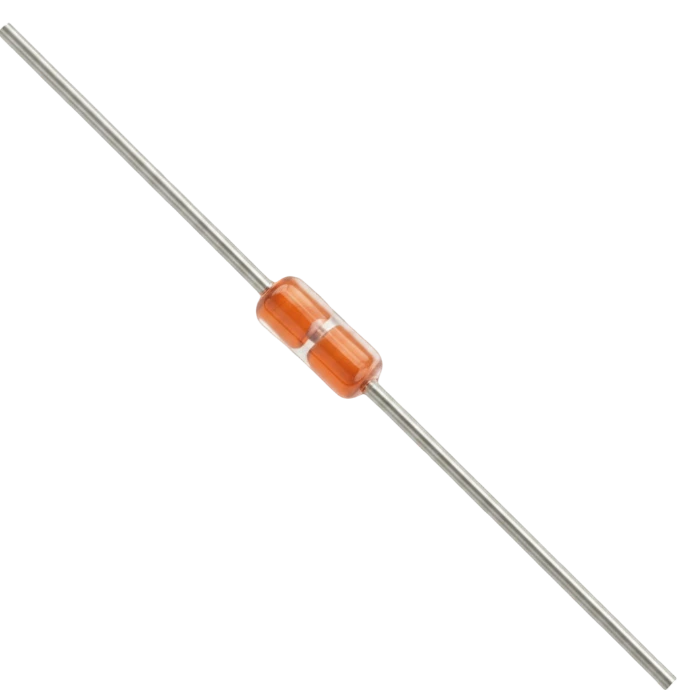
The KTY83-110 is a high-temperature silicon PTC sensor designed for demanding environments up to +300 °C.

It is an improved version of the KTY81-110, offering enhanced thermal stability, better mechanical resistance, and a more consistent R/T curve at high temperatures.

It is found in power converters, electric motors, transformer windings, and high-performance automotive systems.

Operating principle


Like all silicon PTCs, the resistance of the KTY83-110 increases with temperature according to a quadratic law:

  • ​​​R(T) = R25 x [1 + A(T - 25) + B(T - 25)²]

with :

  • R25 = 1000 Ω

  • A = 7,874 × 10⁻³
  • B = 1,874 × 10⁻⁵ 

(Valid from -55°C to +300°C)

The doped silicon used in the KTY83 series exhibits superior stability against oxidation and reduced drift, even after thousands of thermal cycles.

Technical specifications


Parameter
Typical Value
Nominal resistance at 25 °C 1000 Ω
Temperature coefficient (at 25 °C) ≈ 8 Ω/°C at 25°C
Recommended maximum tension 5 V
Typical measurement current 1 mA
Operating temperature −55 °C → +300 °C
Standard deviation at 100°C ±1,5 %
Case material Hermetic axial glass
Typical response time 1 to 2 s

Wiring configuration


Type
Description

Precision

2-wire

Simple connection.

✅ Standard

3-wire

Compensate for the resistance of the cable.

🏆 Industrial

Integrated

Stuck in the engine housing or on the heatsink.

💡 Direct thermoprotection

Self-heating


At 1 mA, the dissipation remains below 2 mW, resulting in an internal heating of < 0.1 °C, even at high temperatures.

Application areas


⚙️ Thermal surveillance of electric motors, IGBTs, and MOSFETs

🧱 High-temperature industrial systems (up to 300 °C)

🚗 Automotive applications under the hood

🔋 Thermal protection in converters and fast chargers

💡 Instrumentation and thermal test benches


Should I choose a KTY83-110 sensor ?

Strengths points

  • 🔥 Exceptional temperature maintenance
    → The KTY83-110 remains stable up to +300 °C, making it one of the most durable silicon PTCs on the market.
  • ⚙️ Ideal for harsh environments
    → Thanks to its hermetic glass casing, it withstands thermal shocks, vibrations, and oily or humid environments.
  • 🧠 Very regular R/T curve
    → Its extended linearity simplifies integration into analog circuits or converters without complex correction.
KTY83-110

Weaknesses points

  • 🌡️ Limited measurement range
    → A current that is too strong (> 2 mA) causes significant self-heating, which should be avoided in precision applications.
  • 💰 Slightly higher cost

→ Its high-temperature design and sorting in production make the KTY83-110 a bit more expensive than the KTY81 models.

  • 📐 Calibration necessary at high T°
    → Beyond 200 °C, a spot recalibration may be required to maintain accuracy ±1 %.

Useful information

Here is some useful information regarding the KTY83-110 sensors.

The KTY83 sensors offer excellent thermal and mechanical stability, even at high temperatures. They are sorted into several classes based on the accuracy of the resistance at 25 °C and the drift over the full range.
Class Tolerance at 25 °C
Max. gap on the range
Operating range
Remarks
A (enhanced precision)
±0,5 % (±5 Ω) ±1 °C −40 °C → +200 °C Production release version
B (standard)
±1 % (±10 Ω) ±2 °C −55 °C → +300 °C Most common value (KTY83-110)
C (extent)
±2 % (±20 Ω) ±4 °C −55 °C → +300 °C Wide tolerance for economic applications

🔹 Note:

Even the standard class (B) ensures excellent accuracy and long-term stability better than 0.1% per year, even after 1000 thermal cycles.

The quadratic equation of the KTY83-110 allows for the resistance to be obtained as a function of temperature:

  • ​​​R(T) = R25 x [1 + A(T - 25) + B(T - 25)²]

with :

  • R25 = 1000 Ω

  • A = 7,874 × 10⁻³
  • B = 1,874 × 10⁻⁵ 


🔹 Example 1: calculation of resistance at 200 °C

R(200) = 1000 × [1 + 7,784×10⁻³(200-25) + 1,874×10⁻⁵(200-25)²]

R(200) = 1000 × [1 + 1,378 × (200-25) + 1,874×10⁻⁵ × (200-25)²]

R(200) = 1000 × [1 + 1,378 + 0,574] = 1000 × 2,952 = 2952 Ω

✅ Result: at 200 °C, the resistance of the KTY83-110 is approximately 2952 Ω.


🔹 Example 2: calculating the temperature from a measured resistance

We measure R=1900ΩR = 1900 ΩR=1900Ω.

What is the corresponding temperature?

T = 25 + [-A + √(A² - 4B(1 - R/R₂₅))] / (2B)

T = 25 + -7,874×10⁻³ + √((7,874×10⁻³)² - 4×1,874×10⁻⁵×(1-1,9)) / (2×1,874×10⁻⁵)

T ≈ 145°C

✅ Result: the corresponding temperature is approximately 145 °C.


🔹 Practical notes

  • The simplified equation is sufficient for most engine control calculations.
  • For temperatures > 250 °C, a calibration table can refine accuracy.
  • The R/T curve is very stable and repeatable from one component to another.

The KTY83-110 is designed for direct use in a divider bridge or a differential amplifier.

Its high nominal resistance allows for the use of low current circuits without specific amplification.

🔹 Typical components

Component Function
KTY83-110 (PTC silicon)
High temperature sensitive element
Rref ≈ 1 kΩ
Reference resistance for the voltage divider
5 V DC Power Supply
Source stable
ADC (12–16 bits)
Convert the voltage to a digital signal
Microcontroller (STM32, ESP32, Arduino)
Calculate T = f(R)
RC Filtering (1 kΩ / 100 nF)
Stabilize the signal against industrial noise
🔹 Functional diagram (ASCII)

+5 V │ [Rref] │ ├───→ Vout → ADC / µC │ [KTY83-110] │ GND

🔹 Operating principle

1️⃣ The probe and Rref form a voltage divider.

2️⃣ When the temperature increases, the resistance of the KTY83-110 increases → Vout increases.

3️⃣ The microcontroller measures Vout and deduces the temperature using the quadratic formula.

🔹 Best Practices

  • 🧩 Choose Rref ≈ 1 kΩ to optimize sensitivity around 25 °C.
  • ⚡ Limit the current to 1 mA max. to avoid self-heating.
  • 💧 Protect the sensor with a ceramic or glass sheath in humid environments.
  • 🔄 Calibrate at 25 °C and 200 °C for industrial use.
  • 🧲 Add an RC filter to reduce noise on the ADC signal.

 We integrate any sensor into any probe 

Smooth tube probe

 Smooth tube 

Waterproof probe

 Waterproof

Bayonet probe

 Bayonet

Slot probe

 Slot

Ambient probe

 Atmosphere

Head connection probe

Termal block

Stick-in probe

Stick-in

Thread probe

Thread

Contact probe

Contact

Jacketed probe

Jacketed

PCBA Design

PCBA design

Winding probe

Winding

More than 1,000,000 probes delivered in 2025

Contact us for a personalized offer

Contact Us

Need a KTY83-110 sensor?

Whether you need a few parts for a prototype or several hundred for a production line, we support you at every step.


Submit
Useful Links
  • Home
  • About Us
  • Jobs
  • Legal Notices
  • Privacy Policy
  • Contact us
About us

At Guilcor, our mission is to provide every client with a measurement solution perfectly suited to their specific needs. With full control over design and manufacturing, we ensure the precision and reliability of our sensors in even the most demanding environments.

Technical excellence and customer satisfaction are at the heart of everything we do.

Connect with us
  • Contact us
  • contact@guilcor.com
Follow us