Skip to Content
GUILCOR SENSORS
  • Home
  • Probes

    Smooth Tube

    Refrigerator, heat pump, oven, freezer, water heater

    Contact

    Pipe, pipe surface, heating plate

    Slot

    Motor, alternator, winding, stator

    Connection head

    Boiler, heat pump, air conditioning, technical rooms, ventilation

    Waterproof

    Air conditioning, ventilation, refrigeration, cold storage, ductwork

    Stick-in

    Oven, cooking, food processing equipment

    Winding

    Motor, alternator, transformer, winding, stator

    Ambient

    Boiler, heat pump, air conditioning, technical rooms, ventilation

    Thread

    Coffee machine, boiler, steam, pressurized fluid

    Jacketed

    Industrial installations, heavy-duty applications

    Bayonet

    Plastic molding, tooling, injection molding machine, engine, alternator

    PCBA design

    Specific application, embedded electronics, custom electronic boards
  • Sensors

    RTD

    Pt10, Pt50, Pt100, Pt200, Pt500, Pt1000, Pt5000, Ni100, Ni120, Cu10, Cu50, Balco

    PTC

    KTY81-110, KTY81-210, KTY83-110, KTY84-130, PTC130, Silistor, TFPT, MZ6, MZ8, MZ9

    1-Wire

    DS18B20, DS18S20, DS1822, DS28EA00, DS18B20-PAR, DS1920, DS2438, DS1835...

    Thermocouple

    B, E, J, K, N, R, S, T, C, D, G

    UART

    MLX90614, MLX90615, GY-906, DHT11, DHT22, AM2302, SHT75, SHT85, RS232, RS485

    SPI

    MAX6675, MAX31855, MAX31856, MCP3208, TMP125, TMP121, ADT7310, LTC2983...

    NTC

    1kΩ, 2kΩ, 3kΩ, 5kΩ, 10kΩ, 15kΩ, 20kΩ, 30kΩ, 50kΩ, 100kΩ, 200kΩ, 470kΩ, 1MΩ

    I²C

    TMP102, TMP117, LM75, LM73, MCP9808, MCP9600, SHT31, SHTC3, SHT85, BME280, BME688, HTU21D, HDC1080, Si7051, ADT7410, STTS751, TCN75A...
  • About us
  • 0
  • English (US) Français Español
  • Sign in
  • Contact Us
GUILCOR SENSORS
  • 0
    • Home
    • Probes
    • Sensors
    • About us
  • English (US) Français Español
  • Sign in
  • Contact Us

 Pt10 
 Temperature sensors 

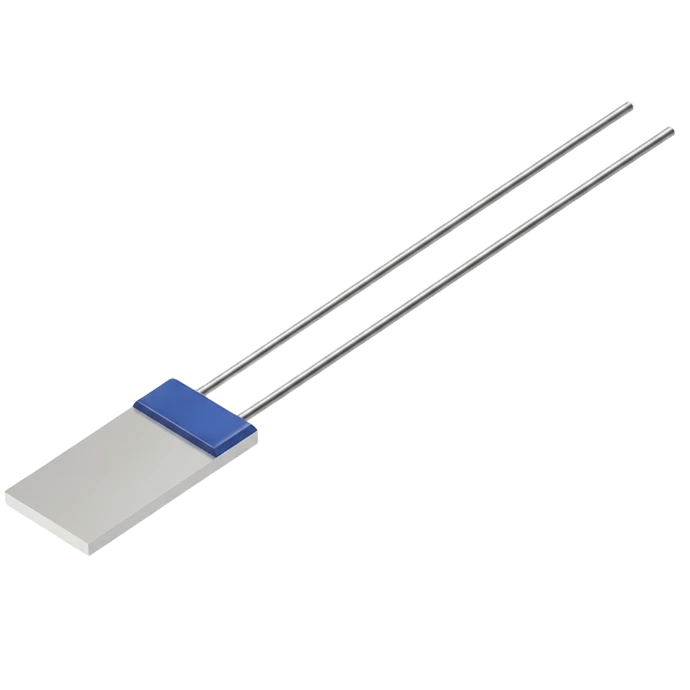
Pt10 temperature sensors provide accurate and reliable temperature measurement for industrial applications requiring low nominal resistance.

 Maximum precision
+/- 0.15°K

 Minimum temperature
-200°C

 Maximum temperature
+600°C

 Minimum dimensions
2x20x40

 Response time
Fast

 Self-heating
Weak

 Price
High

Drift
Weak

What is a Pt10 sensor ?Operating principleTechnical specificationsWiring configurationSelf-heatingApplication areas

What is a Pt10 sensor ?


This type of sensor is mainly used for precision applications in a low temperature range, including laboratory, calibration, or scientific measurement.

It offers great long-term stability and very low drift, while allowing rapid measurements on miniaturized devices. 

Operating principle


The principle is based on the change in platinum resistivity with temperature.

The relationship between temperature (T) and resistance (R) follows the standardized Callendar–Van Dusen equation :

​​​R(T) = R0[(1+A⋅T+B⋅T²+C⋅(T-100)⋅T³]

with :

  • R_0 = 10 Ω

  • A = 3,9083 × 10⁻³
  • B = -5,775 × 10⁻⁷
  • C = −4,183×10−12 (pour T < 0 °C)

This equation ensures extreme accuracy over the range −200 °C → +600 °C, with platinum offering exemplary linearity and reproducibility. 

Technical specifications


Parameter
Typical Value
Nominal resistance at 0 °C 10 Ω
Temperature coefficient (α) 0,00385 °C⁻¹
Measurement range −200 °C to +600 °C
Linearity Excellent
Element material Platinium pur (99,99 %)
Typical measuring current 0,5 mA
Response time < 0,3 s (in Ø2 mm sheath)
 Long-term drift < 0,05 °C/year

Wiring configuration


Type
Description

Precision

2-wire

Simple connection, suitable for short distances.

⚠️ Average

3-wire

Partial compensation of cable resistance.

✅ Good

4-wire

Completely eliminates line resistance.

🏆 Excellent

Self-heating


For the Pt10, with its low resistance, the measuring current must remain below 0.5 mA to prevent any heating.

Typical self-heating is less than 0.05 °C, even in still air.

A current that is too high would distort the measurement by several tenths of a degree.

Application areas


🧪 Calibration and metrology laboratories

⚙️ Precision reference measurements

🧭 Miniaturized embedded sensors

🌡️ Thermal control in cryogenic or scientific environments

🔍 Calibration equipment for Pt100/Pt1000
Should I choose a Pt10 sensor ?

Strengths points

  • 🎯 Extreme precision → Thanks to its low R₀ (10 Ω) and pure platinum, the Pt10 offers excellent metrological stability, ideal for calibrations and reference measurements.
  • ⚡ Ultra-fast response → Its low thermal mass and small diameter enable almost instantaneous responsiveness to temperature changes.
  • 🧬 Remarkable linearity → The Callendar–Van Dusen equation ensures a perfectly predictable response curve over the entire range of −200 to +600 °C.

Weaknesses points

  • 💸 High cost→ The pure platinum construction and fine calibration make this sensor more expensive than Cu or Ni versions.
  • 🧲 Low signal→ With only 10 Ω at 0 °C, the Pt10 delivers a very low voltage, requiring a high-precision instrumentation amplifier.
  • 🔧 Sensitive to cable resistance
    → In 2-wire configurations, even a small cable length can distort the measurement; a 4-wire setup is almost mandatory.

Useful information

Here is some useful information about Pt10 sensors.

Temp (°C)

0

1

2

3

4

5

6

7

8

9

0

10.0

10.039

10.078

10.117

10.156

10.195

10.234

10.273

10.312

10.351

10

10.39

10.429

10.468

10.507

10.546

10.585

10.624

10.663

10.702

10.74

20

10.779

10.818

10.857

10.896

10.935

10.973

11.012

11.051

11.09

11.129

30

11.167

11.206

11.245

11.283

11.322

11.361

11.4

11.438

11.477

11.515

40

11.554

11.593

11.631

11.67

11.708

11.747

11.786

11.824

11.863

11.901

50

11.94

11.978

12.017

12.055

12.094

12.132

12.171

12.209

12.247

12.286

60

12.324

12.363

12.401

12.439

12.478

12.516

12.554

12.593

12.631

12.669

70

12.708

12.746

12.784

12.822

12.861

12.899

12.937

12.975

13.013

13.052

80

13.09

13.128

13.166

13.204

13.242

13.28

13.318

13.357

13.395

13.433

90

13.471

13.509

13.547

13.585

13.623

13.661

13.699

13.737

13.775

13.813

100

13.851

13.888

13.926

13.964

14.002

14.04

14.078

14.116

14.154

14.191

110

14.2293

14.2671

14.305

14.343

14.38

14.418

14.456

14.494

14.531

14.569

120

14.607

14.644

14.682

14.72

14.757

14.795

14.833

14.87

14.908

14.946

130

14.983

15.021

15.058

15.096

15.133

15.171

15.208

15.246

15.283

15.321

140

15.358

15.396

15.433

15.471

15.508

15.546

15.583

15.62

15.658

15.695

150

15.733

15.77

15.807

15.845

15.882

15.919

15.956

15.994

16.031

16.068

160

16.105

16.143

16.18

16.217

16.254

16.291

16.329

16.366

16.403

16.44

170

16.477

16.514

16.551

16.589

16.626

16.663

16.7

16.737

16.774

16.811

180

16.848

16.885

16.922

16.959

16.996

17.033

17.07

17.107

17.143

17.18

190

17.217

17.254

17.291

17.328

17.365

17.402

17.438

17.475

17.512

17.549

200

17.586

17.622

17.659

17.696

17.733

17.769

17.806

17.843

17.879

17.916

210

17.953

17.989

18.026

18.063

18.099

18.136

18.172

18.209

18.246

18.282

220

18.319

18.355

18.392

18.428

18.465

18.501

18.538

18.574

18.611

18.647

230

18.684

18.72

18.756

18.793

18.829

18.866

18.902

18.938

18.975

19.011

240

19.047

19.084

19.12

19.156

19.192

19.229

19.265

19.301

19.337

19.374

250

19.41

19.446

19.482

19.518

19.555

19.591

19.627

19.663

19.699

19.735

260

19.771

19.807

19.843

19.879

19.915

19.951

19.987

20.023

20.059

20.095

270

20.131

20.167

20.203

20.239

20.275

20.311

20.347

20.383

20.419

20.455

280

20.49

20.526

20.562

20.598

20.634

20.67

20.705

20.741

20.777

20.813

290

20.848

20.884

20.92

20.956

20.991

21.027

21.063

21.098

21.134

21.17

300

21.205

21.241

21.276

21.312

21.348

21.383

21.419

21.454

21.49

21.525

310

21.561

21.596

21.632

21.667

21.703

21.738

21.774

21.809

21.844

21.88

320

21.915

21.951

21.986

22.021

22.057

22.092

22.127

22.163

22.198

22.233

330

22.268

22.304

22.339

22.374

22.409

22.445

22.48

22.515

22.55

22.585

340

22.621

22.656

22.691

22.726

22.761

22.796

22.831

22.866

22.902

22.937

350

22.972

23.007

23.042

23.077

23.112

23.147

23.182

23.217

23.252

23.287

360

23.321

23.356

23.391

23.426

23.461

23.496

23.531

23.566

23.6

23.635

370

23.67

23.705

23.74

23.774

23.809

23.844

23.879

23.913

23.948

23.983

380

24.018

24.052

24.087

24.122

24.156

24.191

24.226

24.26

24.295

24.329

390

24.364

24.399

24.433

24.468

24.502

24.537

24.571

24.606

24.64

24.675

400

24.709

24.744

24.778

24.813

24.847

24.881

24.916

24.95

24.985

25.019

Temperature (°C) Classe B Classe A Classe 1/3 B (DIN) Classe 1/10 B (DIN)
-200 1.30 0.55 0.39 0.38
-150 1.05 0.45 0.23 0.21
-100 0.80 0.35 0.15 0.12
-90 0.75 0.33 0.14 0.10
-80 0.70 0.31 0.13 0.09
-70 0.65 0.29 0.12 0.08
-60 0.60 0.27 0.11 0.07
-50 0.55 0.25 0.10 0.06
-40 0.50 0.23 0.10 0.06
-30 0.45 0.21 0.09 0.05
-20 0.40 0.19 0.09 0.04
-10 0.37 0.17 0.08 0.03
0 0.30 0.15 0.08 0.03
10 0.35 0.17 0.09 0.04
20 0.40 0.19 0.10 0.04
30 0.45 0.21 0.11 0.05
40 0.50 0.23 0.12 0.06
50 0.55 0.25 0.13 0.07
60 0.60 0.27 0.14 0.08
70 0.65 0.29 0.16 0.09
80 0.70 0.31 0.17 0.10
90 0.75 0.33 0.18 0.11
100 0.80 0.35 0.19 0.12
110 0.85 0.37 0.20 0.13
120 0.90 0.39 0.21 0.14
130 0.95 0.41 0.22 0.15
140 1.00 0.43 0.24 0.15
150 1.05 0.45 0.25 0.16
160 1.10 0.47 0.26 0.17
170 1.15 0.49 0.27 0.18
180 1.20 0.51 0.29 0.19
190 1.25 0.53 0.30 0.21
200 1.30 0.55 0.31 0.22

The Pt10 follows the standardized Callendar–Van Dusen law, which relates the measured resistance R(T) to the temperature T as follows :

R(T) = R_0 [1 + A·T + B·T^2 + C·(T - 100)·T^3]

at :

  • R_0 = 10Ω to 0 °C

  • A = 3,9083 × 10^{-3}

  • B = -5,775 × 10^{-7}

  • C = -4,183 × 10^{-12} (pour T < 0 °C)

For T ≥ 0 °C, the cubic part (C) is negligible.


🔹 Example 1 : calculating resistance at a given temperature

We seek the resistance of the Pt10 at 100 °C :

R(100) = 10 × [1 + 3,9083×10^{-3}×100 - 5,775×10^{-7}×100^{2}]

R(100) = 10 × [1 + 0,39083 - 0,005775] = 10 × 1,385055 = 13,85Ω

✅ Result : at 100 °C, the Pt10 shows a resistance of 13.85 Ω.


🔹 Example 2: calculating temperature from a measured resistance

A resistance of R = 11.39 Ω is measured. What is the temperature ?

T = - A + √{A^2 - 4B(1 - R/R_0) / {2B}

T = - 3,9083×10^{-3} + √(3,9083×10^{-3})^2 - 4×(-5,775×10^{-7})×(1 - 11,39/10) / 2×(-5,775×10^{-7})

T ≈ 36 °C

✅ Result : the corresponding temperature is approximately 36 °C.


🔹 Application Notes

  • This equation can be directly implemented in a microcontroller (STM32, ESP32, Arduino).

  • In practice, devices often use a simplified polynomial interpolation or a lookup table (0.1 °C per step).

  • For T < 0 °C, the cubic component C(T−100)T³ must be added.

The Pt10, being a very low resistance, requires a high-precision setup with a stable current source and differential amplification.

The most reliable method is 4-wire wiring, which cancels out the parasitic resistance of the conductors.

🔹 Typical components of the setup
Composant Fonction
RTD Pt10 (4 wires)

Platinum sensing element

Precise current source (0.5 mA max)

Sensor power supply

Instrumentation amplifier (INA333, AD8421)

Amplifies the mV signal 

ADC converter (24 bits)

Analog signal conversion
Microcontroller

Calculation of T via Callendar–Van Dusen

Shielded 4-wire cabling

Noise and loss reduction

🔹 Functional Diagram (ASCII)
+3.3V / +5V
│
Stable current source (1 mA)
│
[Pt10]
(2 power wires + 2 sense wires)
│ │
│ │
Amplifier → ADC (16–24 bits)
Instrumentation │
│
Microcontroller
│
Callendar–Van Dusen Equation
🔹 Operating principle
  1. The current source sends 0.5 mA into the Pt10 probe.
  • At 0 °C → V=R×I=10×0.0005=5mV
  • At 100 °C → V≈13.85×0.0005=6.93mV

​2. The amplifier boosts this voltage (gain 100 → 500) to match the ADC.

​ ​→ Typical output: 0.5 to 3.5 V.

​3. The ADC measures the voltage, and the microcontroller calculates the temperature via Callendar–Van Dusen.

🔹 Practical recommendations
  • 🧩 4-wire setup mandatory for low resistances (<100 Ω).

  • ⚡ Avoid interference : twisted and shielded cables.

  • 💧 Mechanically protect the probe to prevent platinum micro-cracks.

  • 🔄 Periodically calibrate with a bath at 0 °C (melting ice) and 100 °C (boiling water).

 We integrate any sensor into any probe 

 Smooth tube 

 Waterproof

 Bayonet

 Slot

 Atmosphere

Termal block

Stick-in

Thread

Contact

Jacketed

PCBA design

Winding

More than 1,000,000 probes delivered in 2025

Contact us for a personalized offer

Contact Us

Need a Pt10 sensor ?

Whether you need a few pieces for a prototype or several hundred for a production line.

We support you every step of the way.


Submit
Useful Links
  • Home
  • About Us
  • Jobs
  • General terms and conditions of sale
  • Legal Notices
  • Privacy Policy
  • Contact us
About us

At Guilcor, our mission is to provide every client with a measurement solution perfectly suited to their specific needs. With full control over design and manufacturing, we ensure the precision and reliability of our sensors in even the most demanding environments.

Technical excellence and customer satisfaction are at the heart of everything we do.

Connect with us
  • Contact us
  • contact@guilcor.com
Follow us