Skip to Content
GUILCOR SENSORS
  • Home
  • Probes

    Smooth Tube

    Refrigerator, heat pump, oven, freezer, water heater

    Contact

    Pipe, pipe surface, heating plate

    Slot

    Motor, alternator, winding, stator

    Connection head

    Boiler, heat pump, air conditioning, technical rooms, ventilation

    Waterproof

    Air conditioning, ventilation, refrigeration, cold storage, ductwork

    Stick-in

    Oven, cooking, food processing equipment

    Winding

    Motor, alternator, transformer, winding, stator

    Ambient

    Boiler, heat pump, air conditioning, technical rooms, ventilation

    Thread

    Coffee machine, boiler, steam, pressurized fluid

    Jacketed

    Industrial installations, heavy-duty applications

    Bayonet

    Plastic molding, tooling, injection molding machine, engine, alternator

    PCBA design

    Specific application, embedded electronics, custom electronic boards
  • Sensors

    RTD

    Pt10, Pt50, Pt100, Pt200, Pt500, Pt1000, Pt5000, Ni100, Ni120, Cu10, Cu50, Balco

    PTC

    KTY81-110, KTY81-210, KTY83-110, KTY84-130, PTC130, Silistor, TFPT, MZ6, MZ8, MZ9

    1-Wire

    DS18B20, DS18S20, DS1822, DS28EA00, DS18B20-PAR, DS1920, DS2438, DS1835...

    Thermocouple

    B, E, J, K, N, R, S, T, C, D, G

    UART

    MLX90614, MLX90615, GY-906, DHT11, DHT22, AM2302, SHT75, SHT85, RS232, RS485

    SPI

    MAX6675, MAX31855, MAX31856, MCP3208, TMP125, TMP121, ADT7310, LTC2983...

    NTC

    1kΩ, 2kΩ, 3kΩ, 5kΩ, 10kΩ, 15kΩ, 20kΩ, 30kΩ, 50kΩ, 100kΩ, 200kΩ, 470kΩ, 1MΩ

    I²C

    TMP102, TMP117, LM75, LM73, MCP9808, MCP9600, SHT31, SHTC3, SHT85, BME280, BME688, HTU21D, HDC1080, Si7051, ADT7410, STTS751, TCN75A...
  • About us
  • 0
  • English (US) Français Español
  • Sign in
  • Contact Us
GUILCOR SENSORS
  • 0
    • Home
    • Probes
    • Sensors
    • About us
  • English (US) Français Español
  • Sign in
  • Contact Us

 Pt100 
 Temperature sensors 

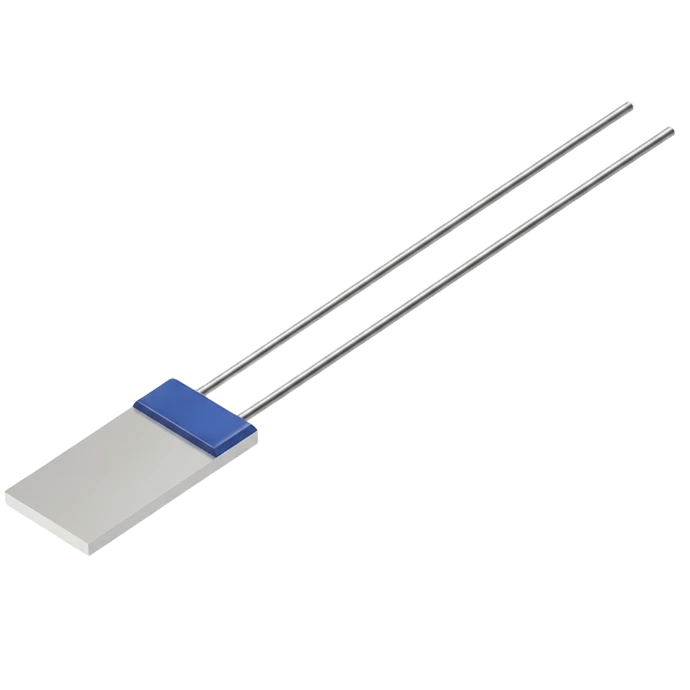
Pt100 temperature sensors provide high accuracy and excellent stability, making them the industry standard for industrial temperature measurement.


 Maximum precision
+/- 0.1°K

 Minimum temperature
-200°C

 Maximum temperature
+850°C

 Minimum dimensions
3x30x50

 Response time
Medium

 Self-heating
Weak

 Price
Medium

Drift
Weak

What is a Pt100 sensor ?Operating principleTechnical specificationsWiring configurationSelf-heatingApplication areas

What is a Pt100 sensor ?


 The Pt100 is the global standard for platinum resistance temperature detectors (RTD).

Its nominal resistance is 100 Ω at 0 °C, and it varies in a perfectly stable and reproducible manner with temperature.

Robust, precise, and universal, it is the most widely used sensor in industry, research, and HVAC.

Operating principle


The Pt100 exploits the physical property of pure platinum (99.99%): its resistivity increases linearly with temperature.

This variation is described by the Callendar–Van Dusen formula:

  ​ ​ ​ ​​R(T) = R0[(1+A⋅T+B⋅T²+C⋅(T-100)⋅T³]

with :

  • R0 = 100 Ω
  • A = 3.9083 × 10⁻³
  • B = -5.775 × 10⁻⁷
  • C = -4,183 x 10−12 (pour T < 0 °C)

The result is a very stable, practically linear signal that is easy to digitize and calibrate.

Technical specifications


Parameter
Typical Value
Nominal resistance at 0 °C 100 Ω
Temperature coefficient (α) 0,00385 °C⁻¹
Measurement range −200 °C to +850 °C
Linearity Excellent
Element material Pure platinium
Typical measuring current 0,1 → 1 mA
Response time < 0,5 s (gain Ø3 mm)
Long-term drift < 0,05 °C/year

Wiring configuration


Type
Description

Precision

2-wire

Simple, low-cost scheme.

⚠️ Average

3-wire

Partial compensation of cable resistance.

✅ Good

4-wire

Complete suppression of line errors.

🏆 Excellent

Self-heating


With a current ≤ 1 mA, self-heating remains < 0.05 °C even in open air.

In stagnant or encapsulated environments, it is advisable to reduce the current to avoid any internal overheating.

Application areas


🚗 Automotive instrumentation and energy

💨 HVAC and air conditioning systems

🧪 Test and calibration benches

🌡️ Thermal monitoring of engines and pumps

🏭 Industrial processes and automation

Should I choose a Pt100 sensor ?

Strengths points

  • 🌍 Standard international
    → The Pt100 is the most standardized RTD sensor in the world, compatible with the majority of existing instruments and controllers.
  • 📊 Ideal balance of precision / robustness
    → It combines excellent accuracy with superior mechanical stability, making it reliable even in harsh industrial environments.
  • 🧠 Easy to calibrate
    → Thanks to its well-known response, the Pt100 can be easily calibrated at fixed points (0 °C and 100 °C) without significant drift.

Weaknesses points

  • 💰 Price higher than NTC thermistors
    → Despite its reliability, the Pt100 remains more expensive to manufacture and implement.
  • ⚙️ Moderate response time
    → The stability of platinum is accompanied by a thermal inertia slightly higher than that of a copper or nickel sensor.
  • 🔌 Sensitive to the quality of the assembly
    → A wiring error (especially in 2 wires) can introduce a significant drift if the cable length is not compensated.

Useful information

Here is some useful information regarding Pt100 sensors.

°C0123456789
0100.00100.39100.78101.17101.56101.95102.34102.73103.12103.51
10103.90104.29104.68105.07105.46105.85106.24106.63107.02107.40
20107.79108.18108.57108.96109.35109.73110.12110.51110.90111.28
30111.67112.06112.45112.83113.22113.61113.99114.38114.77115.15
40115.54115.93116.31116.70117.08117.47117.85118.24118.62119.01
50119.40119.78120.16120.55120.93121.32121.70122.09122.47122.86
60123.24123.62124.01124.39124.77125.16125.54125.92126.31126.69
70127.07127.45127.84128.22128.60128.98129.37129.75130.13130.51
80130.89131.27131.66132.04132.42132.80133.18133.56133.94134.32
90134.70135.08135.46135.84136.22136.60136.98137.36137.74138.12
100138.50138.88139.26139.64140.02140.39140.77141.15141.53141.91
110142.29142.66143.04143.42143.80144.17144.55144.93145.31145.68
120146.06146.44146.81147.19147.57147.94148.32148.70149.07149.45
130149.82150.20150.57150.95151.33151.70152.08152.45152.83153.20
140153.58153.95154.32154.70155.07155.45155.82156.19156.57156.94
150157.31157.69158.06158.43158.81159.18159.55159.93160.30160.67
160161.04161.42161.79162.16162.53162.90163.27163.65164.02164.39
170164.76165.13165.50165.87166.24166.61166.98167.35167.72168.09
180168.46168.83169.20169.57169.94170.31170.68171.05171.42171.19
190172.16172.53172.90173.26173.63174.00174.37174.74175.10175.47
200175.84176.21176.57176.94177.31177.68178.04178.41178.78179.14
210179.51179.88180.24180.61180.97181.34181.71182.07182.44182.80
220183.17183.53183.90184.26184.63184.99185.36185.72186.09186.45
230186.82187.18187.54187.91188.27188.63189.00189.36189.72190.09
240190.45190.81191.18191.54191.90192.26192.63192.99193.35193.71
250194.07194.44194.80195.16195.52195.88196.24196.60196.96197.33
260197.69198.05198.41198.77199.13199.49199.85200.21200.57200.93
270201.29201.65202.01202.36202.72203.08203.44203.80204.16204.52
280204.88205.23205.59205.95206.31206.67207.02207.38207.74208.10
290208.45208.81209.17209.52209.88210.24210.59210.95211.31211.66
300212.02212.37212.73213.09213.44213.8214.15214.51214.86215.22
310215.57215.93216.28216.64216.99217.35217.70218.05218.41218.76
320219.12219.47219.82220.18220.53220.88221.24221.59221.94222.29
330222.65223.00223.35223.70224.06224.41224.76225.11225.46225.81
340226.17226.52226.87227.22227.57227.92228.27228.62228.97229.32
350229.67230.02230.37230.72231.07231.42231.77232.12232.47232.82
360233.17233.52233.87234.22234.56234.91235.26235.61235.96236.31
370236.65237.00237.35237.70238.04238.39238.74239.09239.43239.78
380240.13240.47240.82241.17241.51241.86242.20242.55242.90243.24
390243.59243.93244.28244.62244.97245.31245.66246.00246.35246.69
400247.04 
Temperature (°C) Classe B Classe A Classe 1/3 B (DIN) Classe 1/10 B (DIN)
-200 1.30 0.55 0.39 0.38
-150 1.05 0.45 0.23 0.21
-100 0.80 0.35 0.15 0.12
-90 0.75 0.33 0.14 0.10
-80 0.70 0.31 0.13 0.09
-70 0.65 0.29 0.12 0.08
-60 0.60 0.27 0.11 0.07
-50 0.55 0.25 0.10 0.06
-40 0.50 0.23 0.10 0.06
-30 0.45 0.21 0.09 0.05
-20 0.40 0.19 0.09 0.04
-10 0.37 0.17 0.08 0.03
0 0.30 0.15 0.08 0.03
10 0.35 0.17 0.09 0.04
20 0.40 0.19 0.10 0.04
30 0.45 0.21 0.11 0.05
40 0.50 0.23 0.12 0.06
50 0.55 0.25 0.13 0.07
60 0.60 0.27 0.14 0.08
70 0.65 0.29 0.16 0.09
80 0.70 0.31 0.17 0.10
90 0.75 0.33 0.18 0.11
100 0.80 0.35 0.19 0.12
110 0.85 0.37 0.20 0.13
120 0.90 0.39 0.21 0.14
130 0.95 0.41 0.22 0.15
140 1.00 0.43 0.24 0.15
150 1.05 0.45 0.25 0.16
160 1.10 0.47 0.26 0.17
170 1.15 0.49 0.27 0.18
180 1.20 0.51 0.29 0.19
190 1.25 0.53 0.30 0.21
200 1.30 0.55 0.31 0.22

The Pt100 follows the famous Callendar–Van Dusen equation, used in almost all precision temperature measurement instruments:


For T ≥ 0 °C, the CCC component becomes negligible.

🔹 Example 1 : calculation of resistance at 100 °C

✅ Result : at 100 °C, the resistance of the Pt100 is approximately 138.5 Ω.

🔹 Example 2: calculating the temperature from a measured resistance

We measure R = 118.1 Ω. What is the temperature ?


✅ Result : the corresponding temperature is approximately 46 °C.

🔹 Practical remarks

  • The equation is integrated by default in most industrial temperature controllers and converters.
  • For microcontrollers, it can be implemented via a simple polynomial function or replaced by an R/T table.
  • The typical error between the equation and the standardized IEC 60751 tables is less than ±0.05 °C.

Grâce à sa résistance nominale de 100 Ω, le Pt100 produit un signal exploitable sans amplification extrême, tout en gardant une très bonne immunité au bruit.

Il s’utilise avec une source de courant stable ou un pont de Wheatstone et un amplificateur différentiel.

🔹 Composants typiques

Component Function
RTD Pt100 (3 or 4 wires)
Sensitive platinum element
Current source (0.3 mA)
Feed the probe without overheating
INA333 / AD8426 Amplifier
Amplify the weak signal
16 to 24 bit ADC
Analog-to-digital conversion
Microcontroller (STM32, ESP32, Arduino)
Calculation T = f(R) + compensation
RC filtering / shielding
Reduction of pests and noise
🔹 Functional diagram (ASCII)

​ ​ ​+5 V

│

Current source (0.3 mA)

│

[ Pt100 ]

(2 power wires + 2 measurement wires)

│ │

│ │

Differential amplifier ──→ 24-bit ADC

│

[ Microcontroller ]

(Calculating T = f(R) + display)

🔹 Operating principle

1️⃣ A constant current flows through the probe.

→ At 0 °C: V = 100 Ω × 0.3 mA = 30 mV

→ At 100 °C: V = 138.5 Ω × 0.3 mA = 41.6 mV

2️⃣ The amplifier raises the signal (gain ≈ 100 → 3 to 4 V).

3️⃣ The ADC digitizes the voltage, then the microcontroller applies the equation to calculate T.

🔹 Best practices

  • 🧩 Use a 4-wire setup for precision measurements.
  • 💧 Protect the probe from moisture and corrosion.
  • ⚙️ Limit the excitation current to < 1 mA to avoid self-heating.
  • 🔄 Calibrate regularly at fixed points (0 °C and 100 °C).
  • 🧲 Use shielded twisted cables for long distances.

 We integrate any sensor into any probe 

 Smooth tube 

 Waterproof

 Bayonet

 Slot

 Atmosphere

Termal block

Stick-in

Thread

Contact

Jacketed

PCBA design

Winding

More than 1,000,000 probes delivered in 2025

Contact us for a personalized offer

Contact Us

Need a Pt100 sensor?

Whether you need a few parts for a prototype or several hundred for a production line.

We support you at every step.


Submit
Useful Links
  • Home
  • About Us
  • Jobs
  • General terms and conditions of sale
  • Legal Notices
  • Privacy Policy
  • Contact us
About us

At Guilcor, our mission is to provide every client with a measurement solution perfectly suited to their specific needs. With full control over design and manufacturing, we ensure the precision and reliability of our sensors in even the most demanding environments.

Technical excellence and customer satisfaction are at the heart of everything we do.

Connect with us
  • Contact us
  • contact@guilcor.com
Follow us