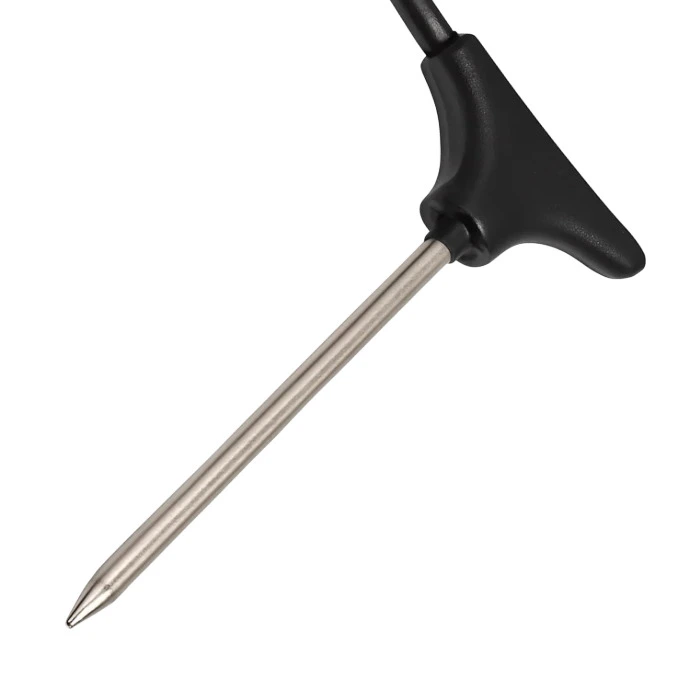
What is a Pt50 sensor ?
The Pt50 is a platinum RTD sensor with a nominal resistance of 50 Ω at 0 °C.
It offers an ideal compromise between sensitivity, stability, and linearity, while generating a more comfortable measurement voltage than the Pt10.
Used in industrial systems, thermal control chains, and test benches, it combines platinum precision with better noise immunity.
Operating principle
Like other platinum sensors, the Pt50 follows the Callendar–Van Dusen equation :
R(T) = R0[(1+A⋅T+B⋅T²+C⋅(T-100)⋅T³]
with :
R_0 = 50 Ω
- A = 3,9083 × 10⁻³
- B = -5,775 × 10⁻⁷
- C = −4,183×10−12 (pour T < 0 °C)
This relationship gives the Pt50 excellent linearity and high stability over the range of −200 °C to +600 °C.
Technical specifications
| Parameter |
Typical Value |
| Nominal resistance at 0 °C | 50 Ω |
| Temperature coefficient (α) | 0,00385 °C⁻¹ |
| Measurement range | −200 °C to +600 °C |
| Linearity | Excellent |
| Element material | Platinium pur (99,99 %) |
| Typical measuring current | 0,3 to 1 mA |
| Response time | < 0,4 s (Ø2 mm) |
| Long-term drift | < 0,05 °C/year |
Wiring configuration
| Type |
Description | Precision |
2-wire |
Simple, but the cable resistance adds to the measurement. | ⚠️ Average |
3-wire |
Partially compensates for parasitic resistance. | ✅ Good |
4-wire |
Kelvin measurement: completely cancels line errors. | 🏆 Excellent |
Self-heating
The Pt50 generates negligible power even under 1 mA.
Self-heating remains below 0.05 °C, ensuring reliable measurements, even in isolated environments or with low air circulation.
Application areas
⚙️ Industrial process control
🌡️ Laboratory equipment temperature control
🔧 Embedded instrumentation
🧪 Calibration and thermal test benches
🏭 Measurement systems in harsh environments